Conventional tubes at microwave frequencies | RF loss&Radiation Loss| Microwave Engineering | Lec-83
TL;DR
Conventional tubes face significant RF and radiation losses at micro frequencies affecting performance.
Transcript
hi everyone in this video I am going to explain about the limitations and losses of conventional tubes at micro frequencies which are effects due to RF losses another one is the radiation loss so first one affected due to RF loss effects due to radio frequency loss because all the microwave components are microwave frequencies which are operated wi... Read More
Key Insights
- 🤢 RF losses are prominent at micro frequencies, necessitating an understanding of their impact on performance.
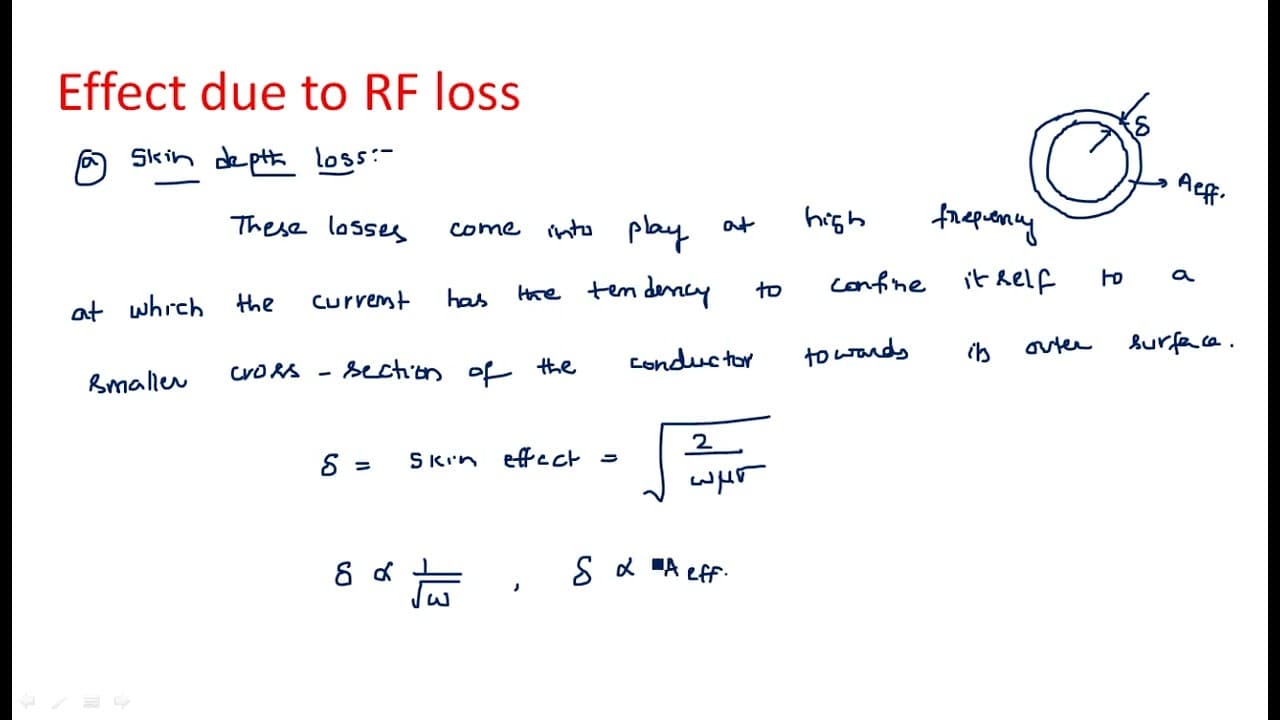
- ✋ Skin depth loss refers to how high-frequency currents restrict themselves to the outer surfaces of conductors, increasing resistance.
- ✋ Dielectric loss influences the insulating materials within devices, which can affect their efficiency at high frequencies.
- 🌸 Increasing conductor area is a potential remedy to mitigate resistance from skin effect losses.
- 🫚 Effective area reductions of conductors are inversely proportional to the square root of frequency, highlighting design considerations.
- 🌸 Shielding is critical in preventing radiation losses, especially when conductor lengths are similar to signal wavelengths.
- 🌸 The operating environment and materials significantly influence the losses and limitations of conventional tubes.
Install to Summarize YouTube Videos and Get Transcripts
Explore YouTube Video Summarizer or Get YouTube Transcript Extractor
Questions & Answers
Q: What are RF losses, and why are they significant for conventional tubes?
RF losses, particularly significant at high micro frequencies, arise due to the nature of microwave components which conduct high-frequency currents. These losses are mainly due to the skin effect, where current confines itself to the outer surface of conductors, increasing resistance and thereby reducing efficiency in signal transmission.
Q: Can you explain skin depth loss and its implications?
Skin depth loss occurs when high-frequency currents tend to limit themselves to a smaller area on the conductor’s outer surface. It implies that as frequency increases, the effective cross-sectional area through which current flows decreases, leading to higher resistance and energy loss in the conductor. This phenomenon highlights the challenges posed by increased frequency in circuit design.
Q: What is dielectric loss, and how does it affect insulating materials?
Dielectric loss occurs in insulating materials like spacers and glass envelopes used within devices, primarily due to the inherent properties of these materials at high frequencies. The loss can affect performance, as it represents energy that is not effectively transmitted. Reducing surface area and eliminating unnecessary tube bases can mitigate this issue.
Q: How can radiation loss be characterized in conventional tubes?
Radiation loss occurs when the length of a wire corresponds to the wavelength of the signals it carries, causing the wire to act as an effective radiator. Such scenarios can lead to significant electromagnetic signal emission, which can interfere with device operation. Proper shielding is required to prevent this loss and ensure signal integrity.
Summary & Key Takeaways
-
The video discusses various limitations and losses associated with conventional tubes operating at high micro frequencies, primarily focusing on RF losses and radiation losses.
-
It elaborates on skin depth and dielectric losses, explaining how high frequencies cause current to confine to the outer surface of conductors, leading to increased resistance.
-
Remedies for these losses include increasing the effective area of conductors and using proper shielding to mitigate radiation losses when wire length matches wavelength.
Read in Other Languages (beta)
Share This Summary 📚
Summarize YouTube Videos and Get Video Transcripts with 1-Click
Try YouTube Summary with ChatGPT & Claude or YouTube Transcript Generator