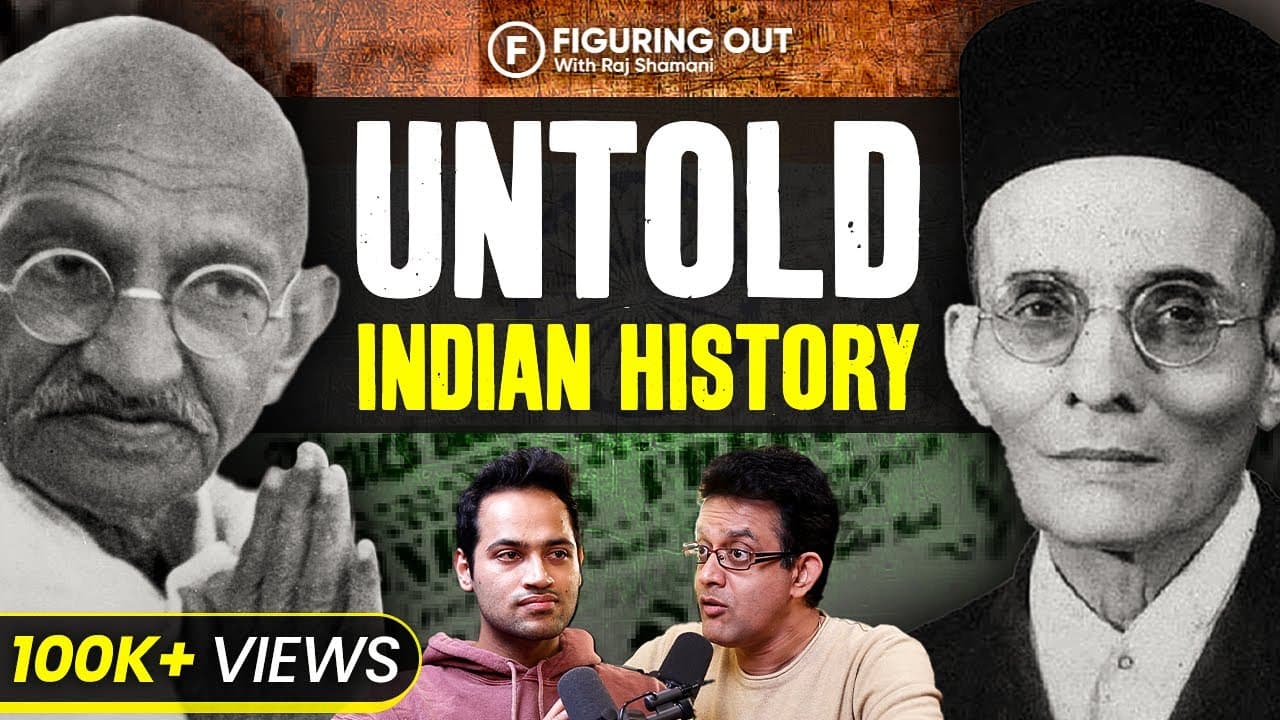
Indian History SHOCKING Facts You Never Knew ft. Historian Dr. Vikram Sampath | FO 92 - Raj Shamani
TL;DR
The discussion highlights the need for a more inclusive and accurate representation of India's history in education.
Transcript
all are gods and goddesses are shown with weapons in their hands that is not for ornamentation that is for attacking what you think is Gandhi said you know I'm not talking about political stuff I'm going to talk about ramraja and its establishment and how it's so important and how non-violence is important and all that and then he steps aside and s... Read More
Key Insights
- 🎓 A comprehensive understanding of history requires acknowledgment of diverse narratives, particularly from regions often overlooked in mainstream education.
- 🇮🇳 The ideological clash between figures like Gandhi and Savarkar exemplifies differing philosophies on resistance and freedom in India's independence movement.
- ✊ Films have the power to both enlighten and misinform audiences about historical events and figures, depending on how they balance fact with creative interpretation.
- 🥺 A more candid portrayal of history in educational materials can nurture a sense of identity and pride among students, leading to a more informed citizenry.
- 🥳 The celebration of historically controversial figures challenges modern values and can ignite social tensions, emphasizing the need for critical discourse on historical legacies.
- 🧑⚕️ Renewed focus on underrepresented histories can facilitate national integration and heal communal rifts that persist as a result of historical grievances.
- 🥺 Engaging community participation in education reform can lead to more relevant and relatable content for students, bridging gaps in historical knowledge.
Install to Summarize YouTube Videos and Get Transcripts
Explore YouTube Video Summarizer or Get YouTube Transcript Extractor
Questions & Answers
Q: Why is there such a disparity in how historical figures like Gandhi and Savarkar are celebrated?
Gandhi is often celebrated for his role in non-violent resistance against colonial rule, serving as a unifying symbol for the nation. In contrast, Savarkar's legacy is contentious; he is sometimes viewed as extremist due to his advocacy for armed rebellion and Hindutva ideology. Celebrating Gandhi serves political and social harmony, while Savarkar's complex history often elicits polarizing opinions.
Q: How has the portrayal of history in Indian textbooks affected public perception?
Indian textbooks tend to emphasize certain narratives, often focusing on Northern history and downplaying significant contributions from Southern and Eastern regions. This leads to a narrow understanding of India's rich and diverse history, fostering a lack of awareness regarding many influential figures and events outside the central narrative.
Q: What role do films play in shaping interest in history among young people?
Films spark curiosity and engagement with history, presenting it in an accessible manner. They can either reinforce or distort historical understanding, depending on how closely they adhere to factual accuracy versus dramatization. Successful adaptations can promote research and interest, while sensationalist portrayals may lead to misunderstandings.
Q: What changes in the education system are suggested for teaching history?
The conversation advocates for a more inclusive curriculum that represents various regions and communities in India. It suggests integrating a broader spectrum of historical narratives, emphasizing the significance of regional histories, and presenting a balanced view that includes both positive and negative aspects of historical figures.
Q: What are the implications of glorifying figures like Aurangzeb?
Glorifying Aurangzeb, who is associated with violence and religious persecution, contradicts efforts to promote a harmonious society. It risks alienating communities that were adversely affected under his rule. History should not romanticize harmful figures, and there should be a move towards celebrating more unifying symbols that reflect India’s diverse heritage.
Q: How can the government address the issue of historical representation in textbooks?
The government needs to prioritize comprehensive historical research and collaborate with historians to create curricula that accurately represent India’s diversity. This involves revisiting existing texts, incorporating grassroots feedback, and ensuring that previously marginalized histories gain visibility in education.
Summary & Key Takeaways
-
The conversation emphasizes the necessity to reevaluate India's historical narrative, arguing for a balanced representation of all regions and figures, including Veer Savarkar.
-
It explores the ideological conflict between Mahatma Gandhi and Savarkar, especially regarding non-violence versus armed resistance, and critiques how historical figures are prioritized in education.
-
Key issues include the portrayal of history in textbooks, the impact of films on public understanding of history, and the government’s response to regional histories and identity.
Read in Other Languages (beta)
Share This Summary 📚
Summarize YouTube Videos and Get Video Transcripts with 1-Click
Try YouTube Summary with ChatGPT & Claude or YouTube Transcript Generator
Explore More Summaries from Figuring Out With Raj Shamani 📚

Summarize YouTube Videos and Get Video Transcripts with 1-Click
Try YouTube Summary with ChatGPT & Claude or YouTube Transcript Generator