Graphene - Periodic Table of Videos
TL;DR
Physicists discovered graphene, a carbon sheet one atom thick, leading to groundbreaking experiments and Nobel Prize in Physics.
Transcript
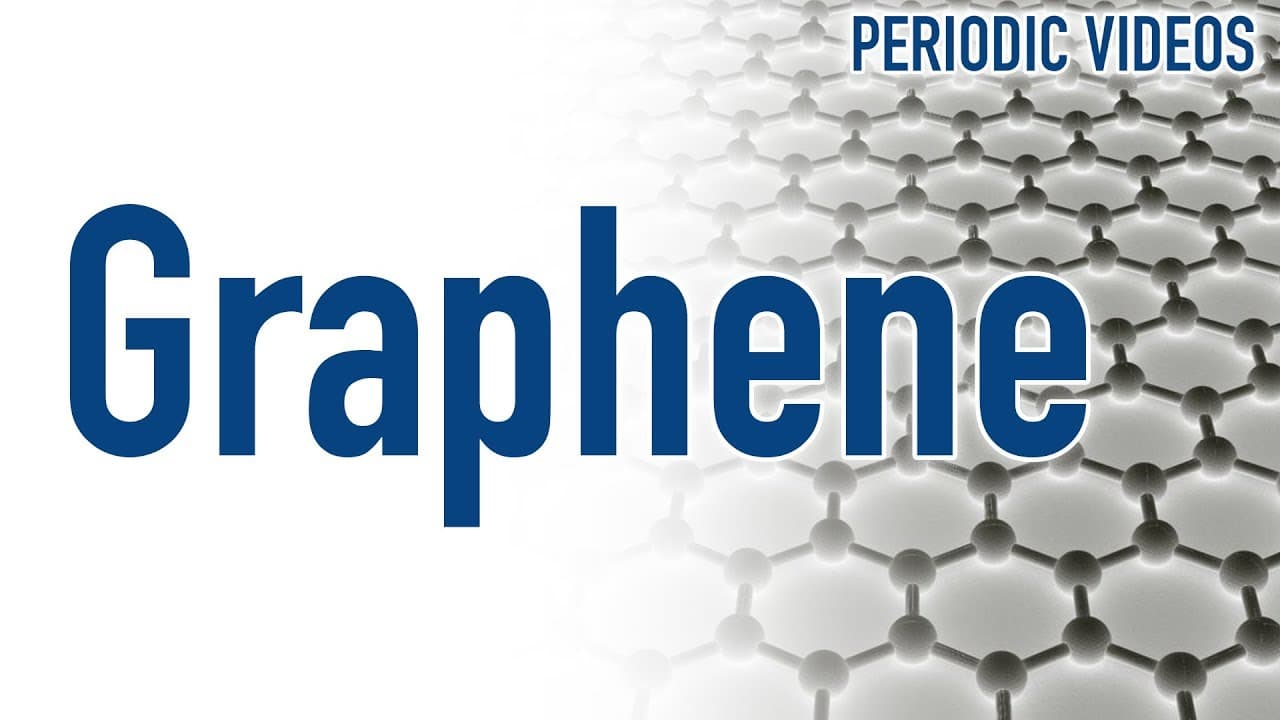
this is graphene it's a sheet of carbon atoms arranged in hexagons but it's only one atom thick you can see a very large sheet but very thin very flexible and two physicists and three gaim and Konstantin Novoselov in University of Manchester here in England have been honored for discovering it and now I'm going to try and do their experiment here i... Read More
Key Insights
- 🫀 Graphene is a single atomic layer of carbon with unique properties.
- ❓ Physicists used sticky tape to peel off graphene layers from graphite.
- 🏆 The Nobel Prize in Physics was awarded for the discovery of graphene and its groundbreaking potential.
- ❓ Graphene's electron behavior and electrical conductivity make it a subject of intense scientific interest.
- 🤗 Graphene opens up a vast array of possibilities for experimenting with carbon structures and properties.
- 👻 Graphene's properties allow for quantum calculations and studying physical properties.
- ❓ Graphene's discovery highlights the importance of simple experiments in scientific breakthroughs.
Install to Summarize YouTube Videos and Get Transcripts
Explore YouTube Video Summarizer or Get YouTube Transcript Extractor
Questions & Answers
Q: How did physicists discover graphene?
Physicists at the University of Manchester used sticky tape to peel off single layers of graphene from graphite, leading to the groundbreaking discovery of a one-atom-thick carbon sheet.
Q: What are the properties of graphene that make it unique?
Graphene's single-layer structure allows for unique electron behavior, making it an excellent conductor of electricity and appealing for quantum calculations and studying physical properties.
Q: Why was the Nobel Prize in Physics awarded for the discovery of graphene?
The discovery of graphene revolutionized the understanding of carbon materials, opening up a new realm of experiments and possibilities due to its unique properties and electron behavior.
Q: How did the Nobel Prize-winning experiment with graphene influence further research?
The discovery of graphene has sparked a wave of research into its properties, leading to experiments demonstrating its ability to transform into other carbon structures like c60, expanding its potential applications.
Summary & Key Takeaways
-
Graphene is a single sheet of carbon atoms, one atom thick, with unique properties.
-
Physicists used sticky tape to peel off graphene layers from graphite, enabling groundbreaking experiments.
-
The Nobel Prize in Physics was awarded for discovering graphene's properties and the potential it holds.
Read in Other Languages (beta)
Share This Summary 📚
Summarize YouTube Videos and Get Video Transcripts with 1-Click
Try YouTube Summary with ChatGPT & Claude or YouTube Transcript Generator
Explore More Summaries from Periodic Videos 📚


Summarize YouTube Videos and Get Video Transcripts with 1-Click
Try YouTube Summary with ChatGPT & Claude or YouTube Transcript Generator