Compensating Differentials
TL;DR
Firms increase job safety to lower wages by compensating for risk.
Transcript
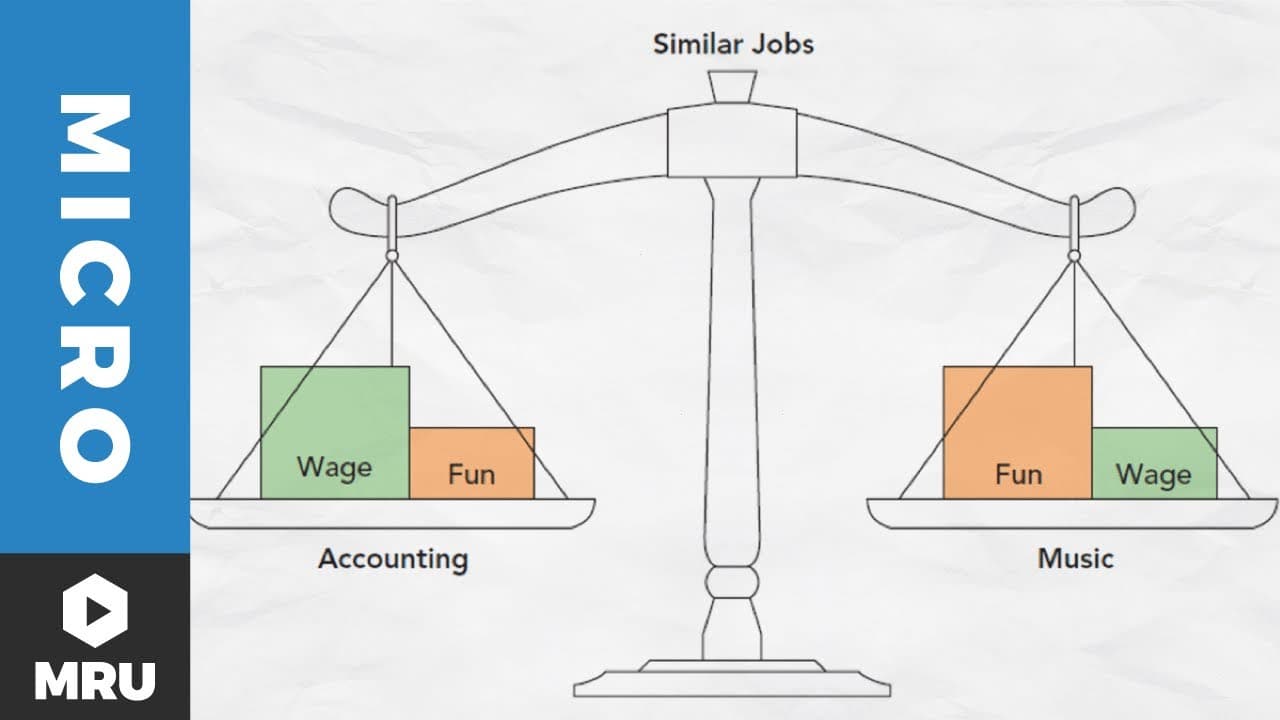
♪ [music] ♪ - [Alex] In this short lecture, I want to elaborate on a surprising claim made at the end of the last video. Namely that firms have an incentive to increase job safety, because then it can lower wages. Recall that the main idea of compensating variations is that wages adjust until jobs requiring a similar level of skill have similar c... Read More
Key Insights
- Firms have an incentive to increase job safety because safer jobs allow them to lower wages, compensating for risk.
- Jobs with similar skill levels adjust wages based on safety; riskier jobs require higher wages to attract workers.
- Increased wealth in developed countries has led to greater demand for job safety, driven by the profit motive.
- Government regulations and unions play a minor role in enhancing job safety compared to wealth and profit motives.
- Firms are incentivized to invest in safety when the cost of safety measures is less than the wage premium for risk.
- Workers need to be aware of risks for the market process to effectively manage job safety and compensation.
- Hidden long-term risks, like asbestos exposure, are not well-managed by market processes or workers' compensation systems.
- The tort system and government regulation are necessary to address hidden long-term risks that the market fails to handle.
Install to Summarize YouTube Videos and Get Transcripts
Explore YouTube Video Summarizer or Get YouTube Transcript Extractor
Questions & Answers
Q: Why do firms have an incentive to increase job safety?
Firms have an incentive to increase job safety because it allows them to lower wages by compensating for risk. When jobs are safer, they require lower wages to attract workers, as opposed to riskier jobs that need to offer higher wages to compensate for the increased risk.
Q: How do compensating differentials affect wage adjustments?
Compensating differentials lead to wage adjustments by ensuring that jobs requiring similar skill levels offer similar compensation packages. Riskier or less enjoyable jobs must offer higher wages to attract workers, while safer or more enjoyable jobs can offer lower wages, balancing the overall compensation.
Q: What role do wealth and profit motives play in job safety?
Wealth and profit motives play a significant role in job safety by driving the demand for safer workplaces. As workers become wealthier, they demand higher wages for riskier jobs, prompting firms to enhance safety to reduce wage costs. This profit-driven incentive is more impactful than regulations or unions.
Q: What factors have contributed to increased job safety over time?
Increased job safety over time is largely attributed to rising wealth and the profit motive, rather than government regulations or unions. As workers' wealth grows, they demand higher compensation for risk, motivating firms to improve safety to offer lower wages for safer jobs, thus enhancing overall safety standards.
Q: How do workers' awareness of risks impact job safety management?
Workers' awareness of risks is crucial for effective job safety management, as it influences their willingness to accept lower wages for safer jobs. When workers are informed about risks, the market process can adjust compensation accordingly. However, hidden risks that workers are unaware of can undermine this process.
Q: What challenges exist in managing hidden long-term risks?
Managing hidden long-term risks, such as those from asbestos or radiation, poses challenges because they are not easily addressed by market processes or workers' compensation systems. These risks often remain undetected until it's too late, necessitating the involvement of the tort system and government regulations to provide adequate protection.
Q: Why are government regulations and unions less impactful on job safety?
Government regulations and unions are less impactful on job safety compared to wealth and profit motives because the primary driver of safety improvements is the economic incentive for firms to reduce wage costs. As workers demand higher wages for riskier jobs, firms naturally invest in safety to offer lower wages, with regulations playing a supporting role.
Q: What is the significance of workers' compensation in job safety?
Workers' compensation plays a significant role in job safety by providing an experience-rated insurance system that incentivizes firms to reduce workplace accidents. Firms with more accidents face higher insurance costs, encouraging them to invest in safety measures. However, it is less effective for managing hidden long-term risks that occur outside the workplace.
Summary & Key Takeaways
-
The lecture discusses how firms have an incentive to improve job safety because safer jobs allow them to lower wages. This is based on the principle of compensating differentials where jobs requiring similar skills offer similar compensation packages, with riskier jobs needing to offer higher wages.
-
The increase in job safety over time is primarily due to increased wealth and the profit motive, rather than government regulations or unions. As workers become wealthier, they demand higher wages for riskier jobs, incentivizing firms to make workplaces safer.
-
The effectiveness of the market process in managing job safety relies on workers' awareness of risks. Hidden long-term risks are not well-managed by the market or workers' compensation systems, necessitating the role of the tort system and government regulations.
Read in Other Languages (beta)
Share This Summary 📚
Summarize YouTube Videos and Get Video Transcripts with 1-Click
Try YouTube Summary with ChatGPT & Claude or YouTube Transcript Generator
Explore More Summaries from Marginal Revolution University 📚

Summarize YouTube Videos and Get Video Transcripts with 1-Click
Try YouTube Summary with ChatGPT & Claude or YouTube Transcript Generator