Caselet DI | Solving problems | Reasoning | Part - 10 | Bharath Kumar
TL;DR
The session explains how to interpret caseload data effectively through examples from three classes.
Transcript
hi everyone welcome to this session in this session I am continuing caseland data interpretation here I am continuing caseload data and predation first of all in this case data interpretation whatever the information which is provided in the given passage we need to read that passage carefully and then we need to understand the passage based on tha... Read More
Key Insights
- ♻️ Understanding data interpretation is crucial for accurate analysis and decision-making in educational environments.
- 😥 Class structure and gender distributions are common data points that can be represented numerically for easier understanding.
- 🥳 Ratios and percentages are effective tools in representing comparative data and extracting meaningful insights from it.
- ❓ Mastering arithmetic operations is essential for solving practical problems arising from caseload data.
- 🧑🎓 The total number of students varies by class, requiring careful aggregation for overall totals.
- 💁 Differences between gender distributions illuminate trends in student demographics and can inform future educational strategies.
- 🤔 Real-world applications of these data interpretation skills enhance students' critical thinking and quantitative reasoning.
Install to Summarize YouTube Videos and Get Transcripts
Explore YouTube Video Summarizer or Get YouTube Transcript Extractor
Questions & Answers
Q: What are the key steps in interpreting caseload data?
Key steps include carefully reading the provided passage, understanding the structure of the classes and student distributions, and performing necessary calculations based on the given information to extract relevant values.
Q: How many total students are there in class 7?
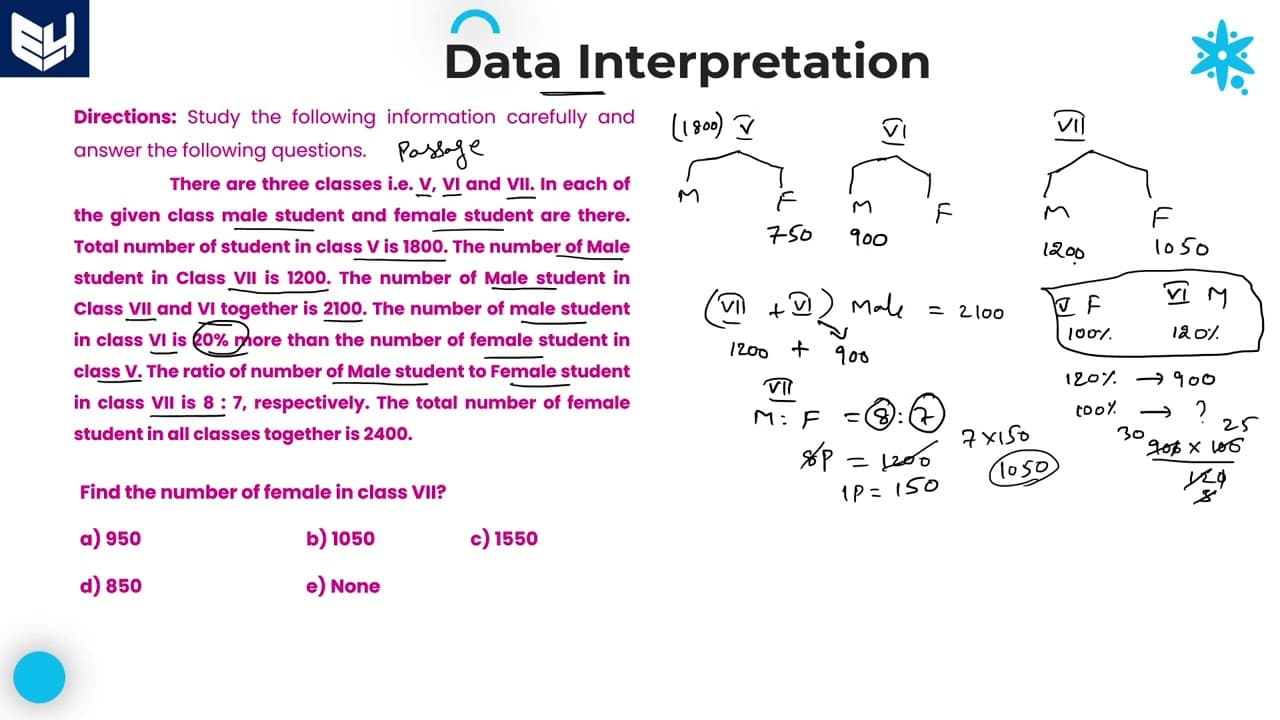
Class 7 contains a total of 2250 students. This includes 1200 male students and 1050 female students, leading to the final count of students in that class.
Q: What is the process to determine the ratio of female to male students in class 6?
The ratio is determined by comparing the number of female students (600) to male students (900) in class 6. After simplification, the ratio comes out to 2:3, making it straightforward for analysis.
Q: How do you calculate the average number of male students across all classes?
To calculate the average, sum the total male students across classes 5, 6, and 7 (1050, 900, 1200) and divide by the number of classes (3), resulting in an average value of 1050 male students.
Q: How can one find the difference between class 6 female students and class 5 male students?
To find the difference, subtract the number of females in class 6 (600) from the number of males in class 5 (1050). The resulting difference is 450 students.
Q: What percentage do the male students in class 6 represent of class 7?
The percentage is calculated by dividing the number of male students in class 6 (900) by those in class 7 (1200) and multiplying by 100, resulting in 75%.
Q: How is the number of male students in class 6 compared to class 5?
The number of male students in class 6 is found to be greater than those in class 5. However, without specific figures provided earlier, this conclusion is based on comparative reasoning from the overall data context.
Summary & Key Takeaways
-
The content emphasizes the importance of careful reading and understanding of caseload data before proceeding with calculations, especially in a classroom setting.
-
It provides specific examples from three classes, detailing the male and female student distributions, their ratios, and how to derive values through arithmetic methods.
-
The session concludes with sample questions and detailed solutions, demonstrating how to apply the learned concepts to solve problems related to class data.
Read in Other Languages (beta)
Share This Summary 📚
Summarize YouTube Videos and Get Video Transcripts with 1-Click
Try YouTube Summary with ChatGPT & Claude or YouTube Transcript Generator