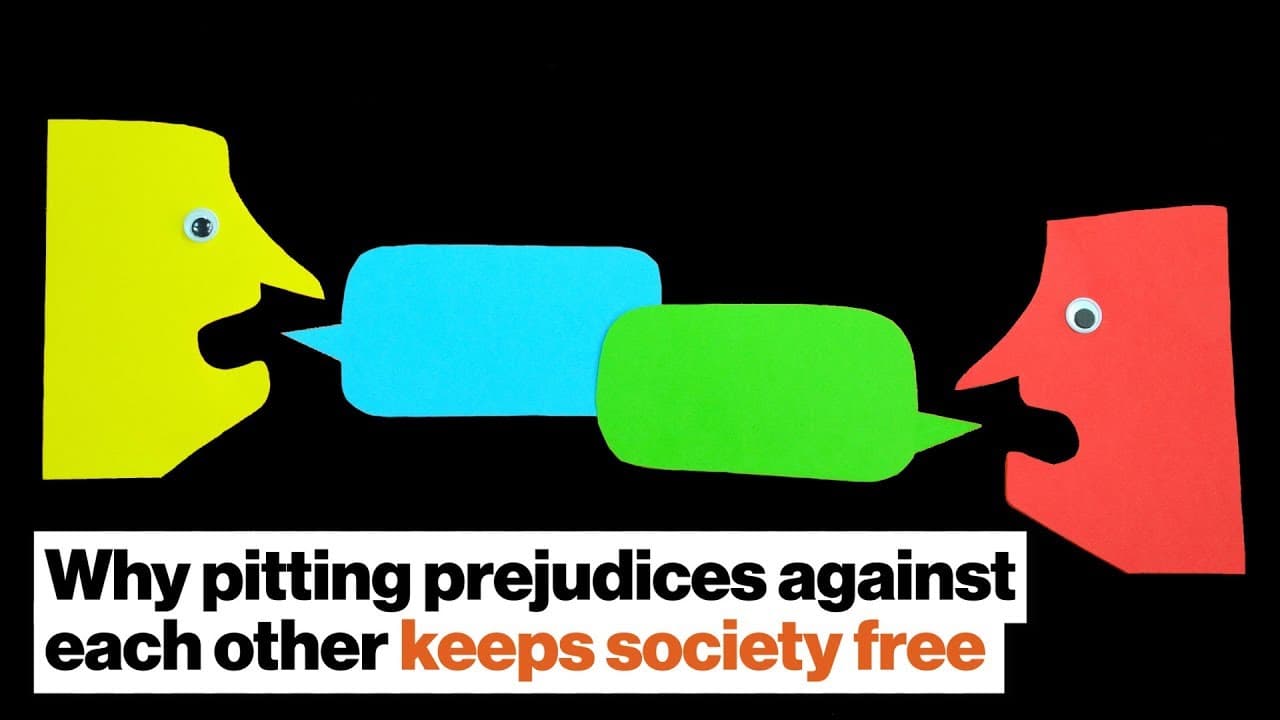
Why pitting prejudices against each other keeps society free | Jonathan Rauch | Big Think
TL;DR
Liberal societies grapple with tolerating intolerance to maintain open discourse and intellectual diversity.
Transcript
We live in a liberal society - small 'L'. That means we're committed to values like free speech and toleration. It means we try to create an open forum. And it also means we understand there are going to be some obnoxious, and sociopathic, and racist, and anti-Semitic, and homophobic people in our midst. And, to some degree, we not only allow that,... Read More
Key Insights
- 🤗 Tolerance in liberal societies involves accepting and engaging with diverse, sometimes offensive viewpoints to promote open discourse and intellectual growth.
- 🥶 The balance between free speech and preventing intolerant individuals from gaining power is a complex ethical challenge for liberal democracies.
- 💡 Pluralism advocates argue for the importance of intellectual diversity and conflicting ideas in arriving at truth as a society.
Install to Summarize YouTube Videos and Get Transcripts
Explore YouTube Video Summarizer or Get YouTube Transcript Extractor
Questions & Answers
Q: How do liberal societies balance free speech and tolerating intolerant views?
Liberal societies aim to uphold free speech and toleration to allow for open discourse and intellectual diversity, even when faced with offensive and harmful ideas, highlighting the challenge of maintaining a balance between openness and preventing intolerant individuals from gaining power.
Q: What role does pluralism play in the quest for truth in society?
Pluralism suggests that the way to find truth as a society is by pitting different prejudices against each other, fostering intellectual diversity and allowing conflicting ideas to interact and persuade, ultimately leading to a better understanding of truth.
Q: What distinguishes purist communities from pluralist societies?
Purist communities adhere to defined doctrines and sacred beliefs that are not open to debate, striving for purity in their commitment to truth by ostracizing dissenting views, while pluralist societies value diverse viewpoints and open discourse in their pursuit of truth.
Q: How does the legal framework of a society impact the balance between tolerance and intolerance?
A well-established legal framework in liberal societies ensures that intolerant views can be expressed without legal repercussions, allowing for a safe environment for debate, but also necessitates institutions like courts and universities to uphold free speech and intellectual rigor to prevent intolerant ideologies from gaining power.
Summary & Key Takeaways
-
Liberal societies embrace free speech and toleration, even when faced with obnoxious, racist, and homophobic individuals, to allow for open debate.
-
The challenge arises in deciding if being tolerant of intolerant individuals can lead to them gaining power and shutting down opposing views.
-
Pluralism advocates support pitting different prejudices against each other to arrive at truth, unlike purist communities that stand by defined beliefs.
Read in Other Languages (beta)
Share This Summary 📚
Summarize YouTube Videos and Get Video Transcripts with 1-Click
Try YouTube Summary with ChatGPT & Claude or YouTube Transcript Generator
Explore More Summaries from Big Think 📚




Summarize YouTube Videos and Get Video Transcripts with 1-Click
Try YouTube Summary with ChatGPT & Claude or YouTube Transcript Generator