3 Fun Facts About Ostriches You'll Love
TL;DR
Ostriches are unique flightless birds with incredible adaptations, including speed, vision, and size.
Transcript
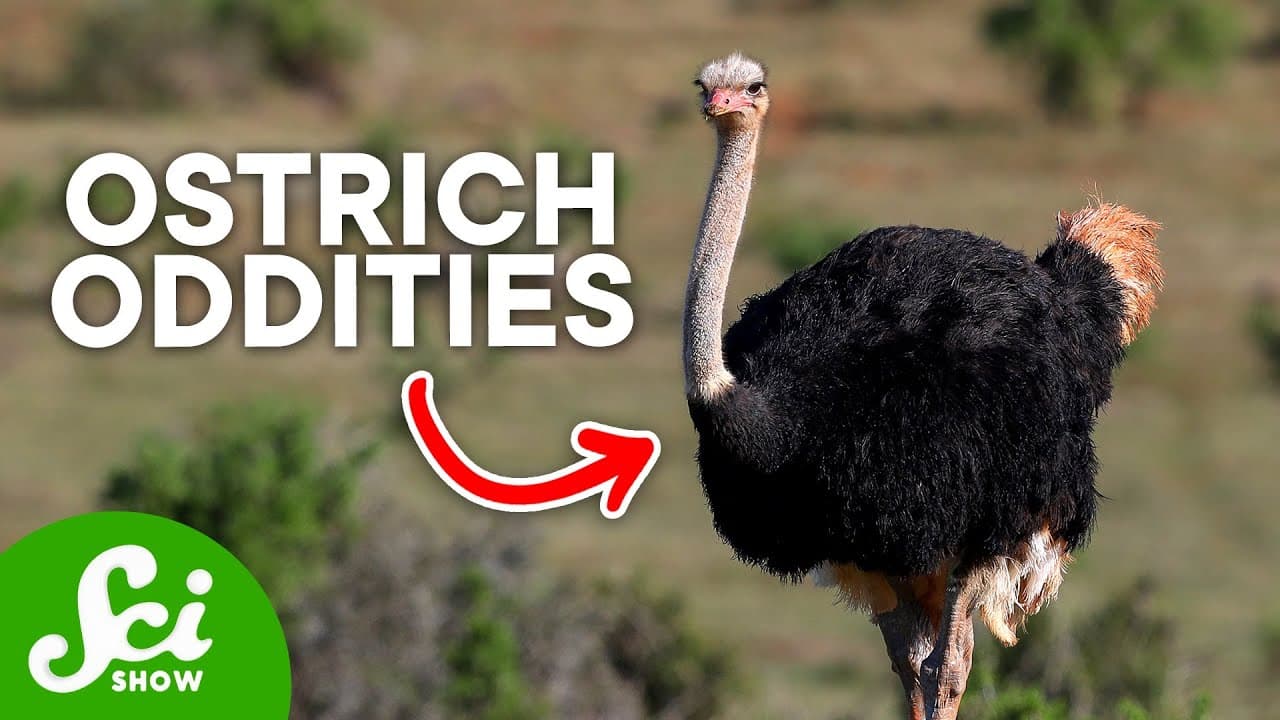
The animal kingdom is full of all sorts of weirdos and evolutionary outliers, but with their long necks, huge, judgey eyes, and beautiful eyelashes, ostriches are probably some of the oddest. They also happen to be incredibly well-adapted to life as a huge, lumbering ball of feathers. Ostriches are part of the group of large, flightless birds calle... Read More
Key Insights
- 👥 Ostriches are part of the ratite group of large, flightless birds that evolved from flying ancestors.
- ❓ They have evolved flightlessness independently to conserve energy.
- 💨 Ostriches are incredibly fast runners, capable of sprinting at nearly 70 km/h.
- 😃 Their large eyes provide superior vision for detecting predators.
- 😎 Ostriches have unique adaptations like talons for traction and fluffier feathers for cooling.
- 🤒 Ostriches are the largest living birds on Earth, growing up to 2.5 meters tall.
- 🤕 Despite myths, ostriches do not bury their heads in the sand when scared; they minimize their silhouette to appear like a clump of earth.
Install to Summarize YouTube Videos and Get Transcripts
Explore YouTube Video Summarizer or Get YouTube Transcript Extractor
Questions & Answers
Q: How did ostriches evolve flightlessness?
Ostriches evolved flightlessness independently from their flying ancestors due to the energy-saving advantage of not flying.
Q: What adaptations make ostriches the fastest running bird?
Ostriches have long, lean legs, massive thigh muscles, stable leg joints, elastic tendons, and large talons for traction, contributing to their speed.
Q: Why do ostriches have such large eyes?
Ostriches have the largest eyes of any land vertebrate to spot predators, with protective eyelashes made of feathers to shield their eyes.
Q: How do ostriches cool off in hot temperatures?
Ostriches use their fluffy body feathers to fan out and air their skin, aiding in cooling off during high temperatures.
Summary & Key Takeaways
-
Ostriches are part of a group of large, flightless birds called ratites that evolved from flying ancestors.
-
They are the fastest creatures to run on two legs, capable of sprinting at nearly 70 km/h.
-
Ostriches have unique adaptations like large eyes, powerful legs, and fluffy feathers for cooling.
Read in Other Languages (beta)
Share This Summary 📚
Summarize YouTube Videos and Get Video Transcripts with 1-Click
Try YouTube Summary with ChatGPT & Claude or YouTube Transcript Generator
Explore More Summaries from SciShow 📚

Summarize YouTube Videos and Get Video Transcripts with 1-Click
Try YouTube Summary with ChatGPT & Claude or YouTube Transcript Generator