What Is Orbital Hybridization and Why Is It Important?
TL;DR
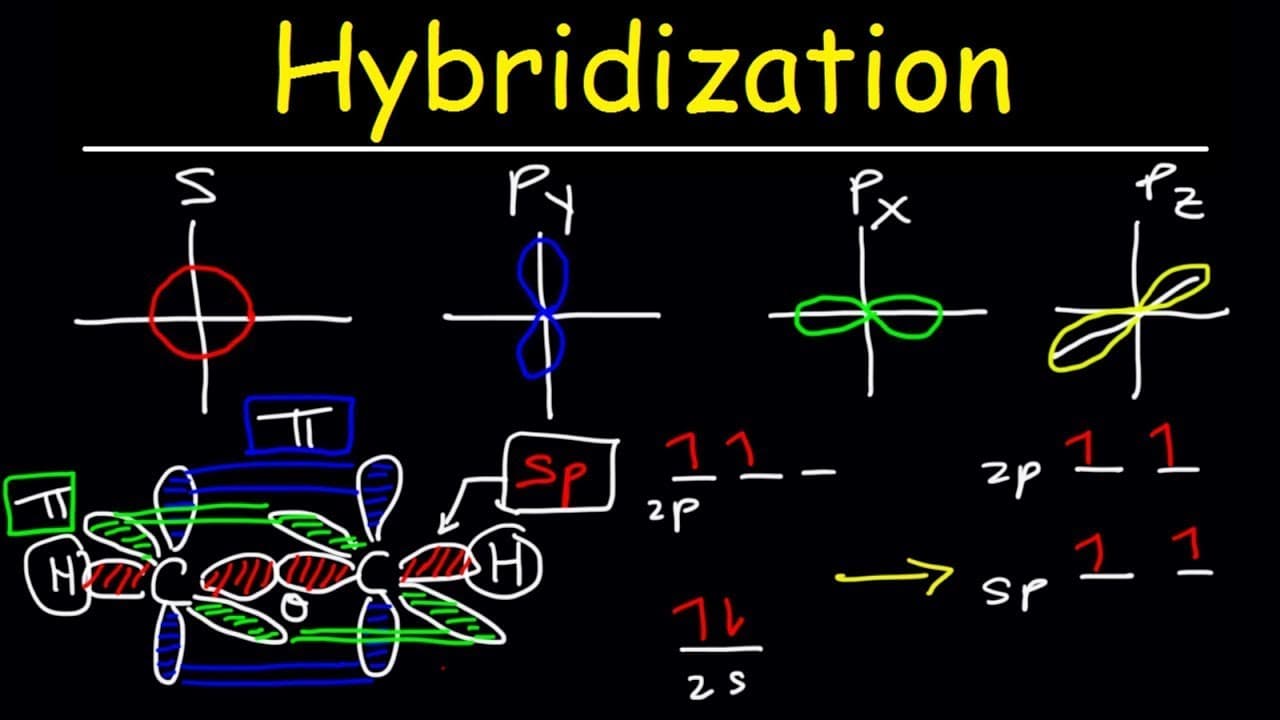
Orbital hybridization is the mixing of atomic orbitals, like s and p, to form new hybrid orbitals (sp3, sp2, sp), which dictate molecular bonding and geometry. This process is crucial for understanding the strength and character of bonds, as sigma bonds form from hybrid orbitals while pi bonds arise from unhybridized p orbitals.
Transcript
in this video we're going to talk about hybridization of atomic orbitals so what exactly is hybridization hybridization is basically combining atomic orbitals to make hybrid orbitals so for example the sp3 hybrid orbital is a blend of one s orbital and three p orbitals as you can see it's s1p3 sp2 squared is a hybrid of an s orbital and two p orbit... Read More
Key Insights
- 🫀 Hybridization is the process of combining atomic orbitals to create hybrid orbitals with distinct shapes and characteristics.
- 📌 S and p orbitals have different shapes and probabilities of electron location.
- 💁 Carbon's electron configuration determines the type of hybrid orbitals it forms.
- 💁 Hybrid orbitals are used to form sigma bonds, while unhybridized p orbitals form pi bonds.
- 💪 Sigma bonds are stronger than pi bonds, and triple bonds are stronger but shorter than single bonds.
- #️⃣ The number of sigma bonds in a structure can be determined by counting the number of bonds, while pi bonds are present in double and triple bonds.
Install to Summarize YouTube Videos and Get Transcripts
Explore YouTube Video Summarizer or Get YouTube Transcript Extractor
Questions & Answers
Q: What is hybridization?
Hybridization is the process of combining atomic orbitals to form hybrid orbitals. This allows for the formation of new types of orbitals with different shapes and characteristics than the original atomic orbitals.
Q: Why are s and p orbitals important in hybridization?
S orbitals are spherical and represent the most probable location to find an electron, while p orbitals have different orientations (px, py, pz). These orbitals are combined in hybridization to create new orbitals with unique characteristics.
Q: How does carbon's electron configuration affect hybridization?
Carbon's electron configuration, specifically the arrangement of its valence electrons (1s2 2s2 2p2), determines the type of hybrid orbitals it forms. For example, sp3 hybridization occurs when carbon combines one s orbital and three p orbitals.
Q: How are sp3, sp2, and sp hybrid orbitals different?
Sp3 hybrid orbitals are a blend of one s and three p orbitals, sp2 hybrid orbitals are a combination of one s and two p orbitals, and sp hybrid orbitals result from the mixing of one s and one p orbital. Each hybrid orbital has a different distribution of s and p character.
Q: What is the significance of degenerate orbitals in hybridization?
Degenerate orbitals are orbitals that have the same energy. In hybridization, degenerate hybrid orbitals are formed by combining the same number of atomic orbitals. Electrons are then added to the degenerate hybrid orbitals one at a time with parallel spins.
Q: How are sigma and pi bonds formed in hybridized and unhybridized orbitals?
Sigma bonds are formed from the overlap of hybrid orbitals, while pi bonds are made from the overlap of unhybridized p orbitals. In carbon atoms, sigma bonds contain hybrid orbitals, while pi bonds involve unhybridized p orbitals.
Summary & Key Takeaways
-
Hybridization is the mixing of atomic orbitals to create hybrid orbitals, such as sp3, sp2, and sp orbitals.
-
S and p orbitals have different shapes and probabilities of electron location within an atom.
-
Carbon's electron configuration influences the type of hybrid orbitals it forms, with sp3, sp2, and sp hybrid orbitals being the most common.
Read in Other Languages (beta)
Share This Summary 📚
Summarize YouTube Videos and Get Video Transcripts with 1-Click
Try YouTube Summary with ChatGPT & Claude or YouTube Transcript Generator
Explore More Summaries from The Organic Chemistry Tutor 📚



Summarize YouTube Videos and Get Video Transcripts with 1-Click
Try YouTube Summary with ChatGPT & Claude or YouTube Transcript Generator