What Happens When Resistors Are Connected in Series?
TL;DR
In a series circuit, the current remains constant while the voltage across each resistor varies based on their individual resistance. The total resistance of the circuit is the sum of the individual resistances, leading to increased overall resistance and decreased current flow when more resistors are added.
Transcript
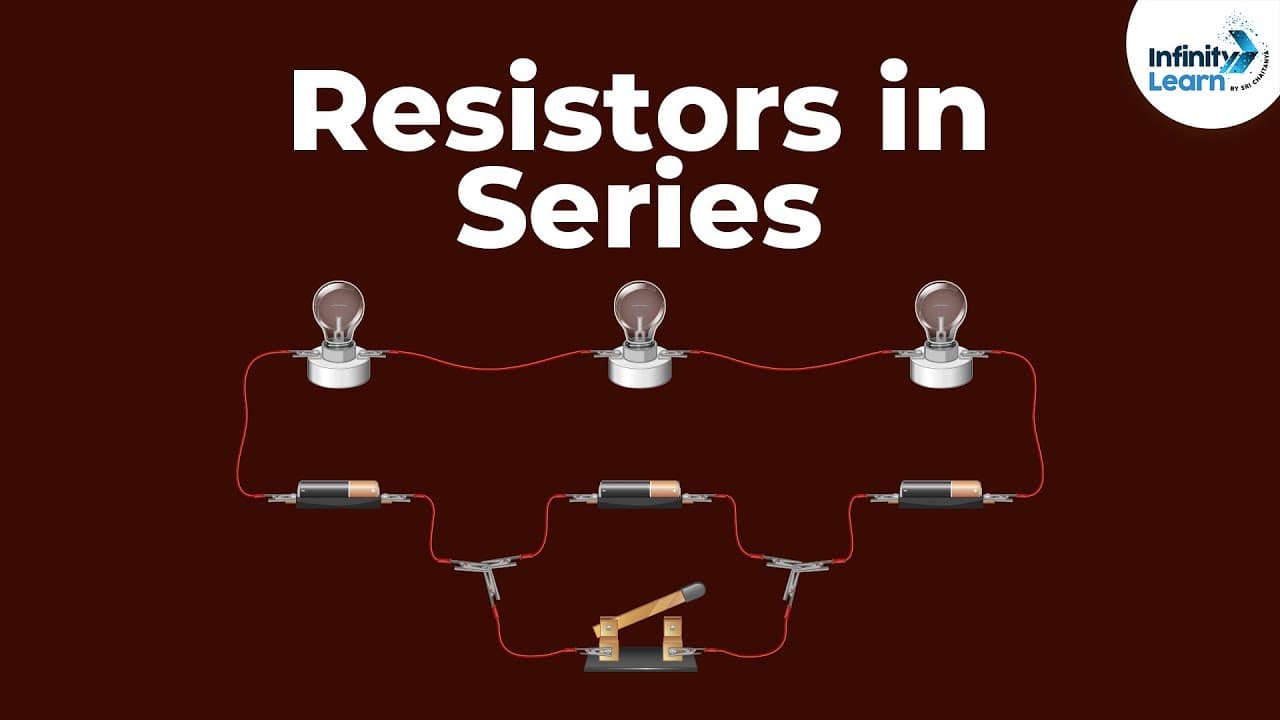
in the circuit we have three resistors of different values connected in series how do we know they're in series because they connected one after the other forming just one path and not multiple paths let's perform a small activity now close the plucky and note the amateur reading but these three resistors connected in series let it be I amperes nex... Read More
Key Insights
- 🥺 In a series circuit, resistors are interconnected one after the other, leading to the same current flow throughout.
- ⚡ The voltage across each resistor in a series circuit differs based on their individual resistance values.
- 👮 Ohm's law can be applied to each resistor separately in a series connection to determine the total resistance.
- 🍹 The total resistance in a series connection of resistors is the sum of individual resistances.
- 🪜 Adding more resistors in series increases the overall resistance and decreases the current in the circuit.
- 😥 Current remains constant at every point in a series circuit with resistors.
- ⚡ Understanding the relationship between voltage, current, and resistance is essential in analyzing resistors connected in series.
Install to Summarize YouTube Videos and Get Transcripts
Explore YouTube Video Summarizer or Get YouTube Transcript Extractor
Questions & Answers
Q: How is current distributed in a series circuit with resistors?
In a series circuit, the current remains constant throughout all components, including resistors, as they are connected sequentially, forming a single path for current flow.
Q: Why do voltages across resistors differ in a series circuit?
Voltages across resistors differ due to their individual resistance values, causing varying potential differences as current flows through each resistor in the series.
Q: How does Ohm's law apply to resistors connected in series?
By applying Ohm's law individually to each resistor, the total resistance in a series connection is calculated as the sum of the individual resistances, showing how voltage, current, and resistance are interrelated.
Q: Why does the overall resistance increase in a series connection of resistors?
The overall resistance increases in a series connection as each additional resistor in the series circuit adds up to the total resistance, leading to higher combined resistance.
Summary & Key Takeaways
-
In a series circuit with resistors, current remains constant throughout the circuit.
-
Voltage across each resistor differs, but the total sum of voltages equals the initial voltage.
-
By applying Ohm's law individually to each resistor, the total resistance in a series connection is the sum of all resistances.
Read in Other Languages (beta)
Share This Summary 📚
Summarize YouTube Videos and Get Video Transcripts with 1-Click
Try YouTube Summary with ChatGPT & Claude or YouTube Transcript Generator
Explore More Summaries from Infinity Learn NEET 📚


Summarize YouTube Videos and Get Video Transcripts with 1-Click
Try YouTube Summary with ChatGPT & Claude or YouTube Transcript Generator