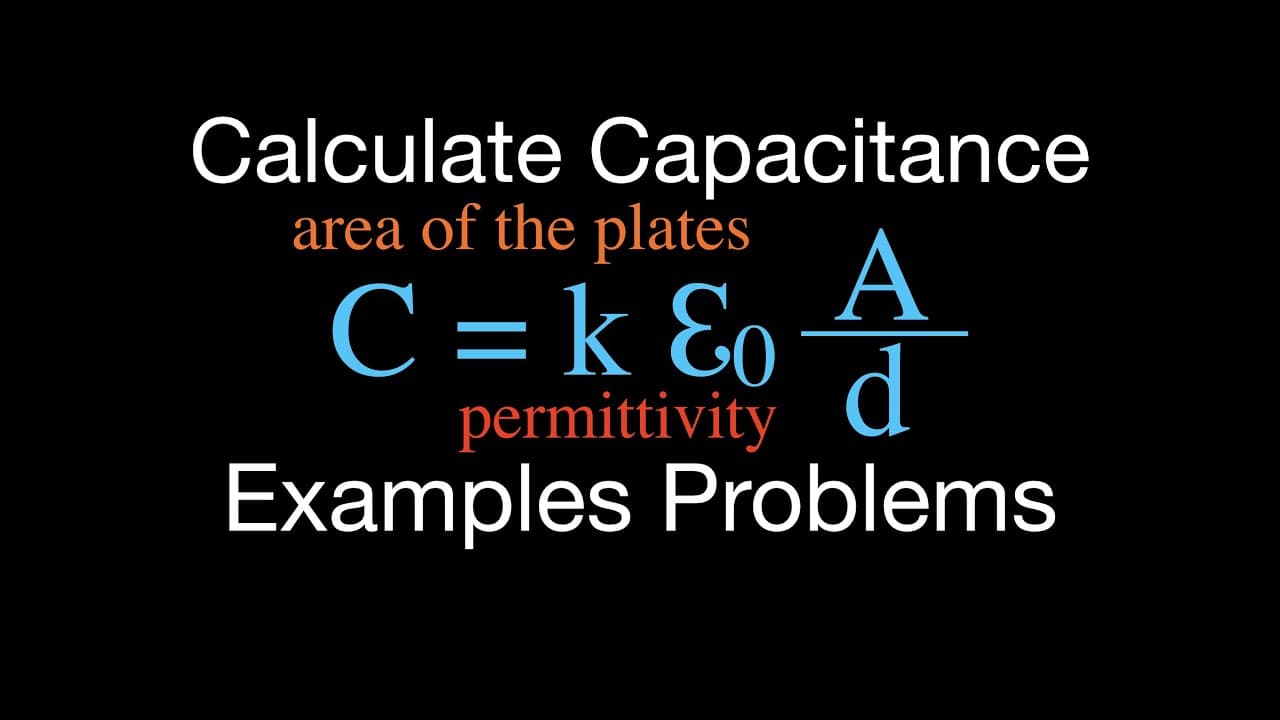
Capacitors (5 of 9) Calculating the Capacitance of a Capacitor, Worked Examples
TL;DR
Two examples calculating capacitance with and without dielectric using a basic equation.
Transcript
okay in today's video I'm gonna go through a couple of quick examples about how we calculate the capacitance of a capacitor in a previous video I went through an explanation of this equation the one we're going to use the closet the capacitor capacitor and the factors that affect the capacitance of the capacitor but in this video we're just gonna g... Read More
Key Insights
- 🥶 Capacitance can be calculated using the formula C = ε * A / d, where ε is the permittivity of free space.
- ❓ Dielectric materials can affect capacitance calculations by influencing the effective permittivity value.
- 🤒 Measurements for area and distance between capacitor plates must be in meters for accurate capacitance calculations.
- 😉 The presence of a dielectric changes the calculation by incorporating the dielectric constant (K) into the equation.
- 😑 Capacitance values are expressed in farads, indicating the amount of charge storage per unit voltage.
- 🤒 Proper conversion of all measurements to meters is crucial in capacitance calculations to maintain unit consistency.
- ❓ Capacitors with or without dielectrics require careful consideration of material properties and dimensions for accurate capacitance determination.
Install to Summarize YouTube Videos and Get Transcripts
Explore YouTube Video Summarizer or Get YouTube Transcript Extractor
Questions & Answers
Q: What is the basic equation used to calculate capacitance?
The basic equation for calculating capacitance is C = ε * A / d, where ε is the permittivity of free space, A is the area of the plates, and d is the distance between the plates.
Q: How does the presence of a dielectric affect capacitance calculations?
When a dielectric is present, the dielectric constant (K) is included in the equation, modifying the capacitance calculation based on the material properties of the dielectric.
Q: Why is it important to convert all measurements to meters in capacitance calculations?
Converting all measurements to meters ensures that the units align properly in the capacitance equation, resulting in correct calculations without any discrepancies in the final answer.
Q: What are the unit of capacitance and what does it signify?
The unit of capacitance is the farad (F), which represents the amount of charge (coulombs) stored per unit voltage (volts) across the capacitor.
Summary & Key Takeaways
-
Explanation of how to calculate capacitance of a capacitor using the equation C = ε * A / d.
-
Example 1: Calculating capacitance of a parallel plate capacitor without dielectric.
-
Example 2: Calculating capacitance of a capacitor with a dielectric between two round aluminum plates.
Read in Other Languages (beta)
Share This Summary 📚
Summarize YouTube Videos and Get Video Transcripts with 1-Click
Try YouTube Summary with ChatGPT & Claude or YouTube Transcript Generator
Explore More Summaries from Step by Step Science 📚


Summarize YouTube Videos and Get Video Transcripts with 1-Click
Try YouTube Summary with ChatGPT & Claude or YouTube Transcript Generator