What Is Model Stacking in Machine Learning?
TL;DR
Model stacking is a machine learning technique that involves using predictions from multiple models as features to train a new model, known as a meta-model. This process can enhance predictive performance, but it's crucial to manage cross-validation folds to avoid overfitting. Stacking allows for combining the strengths of different models for improved results.
Transcript
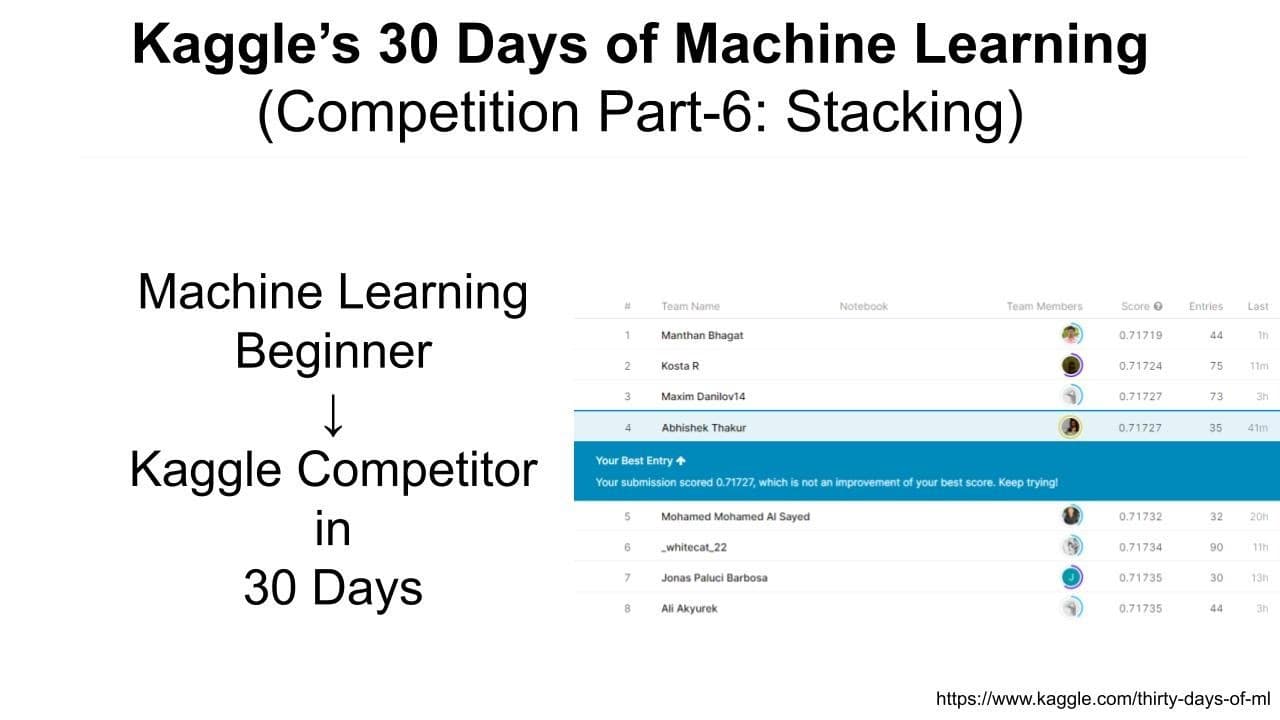
hello everyone and welcome to my youtube channel this is part six of competition day in kaggle's 30 days of machine learning challenge and so far we have seen a lot of things from creating cross validation folds to feature engineering to xd boost hyper parameter optimization blending and today we are going to learn about stacking so we're going to ... Read More
Key Insights
- ❓ Stacking involves creating predictions from multiple models on the same dataset.
- 👶 The predictions from these models are used as features to train a new model.
- ❓ Stacking can potentially improve the overall performance and accuracy of the final model.
- 😨 Care must be taken to prevent overfitting when using stacking.
- 😵 Using the same cross-validation folds throughout the process helps avoid overfitting.
- 👻 Stacking allows for the combination of different models, leveraging their strengths and weaknesses.
- 🚂 The final model in a stacking approach is trained on the predictions from the previous models.
Install to Summarize YouTube Videos and Get Transcripts
Explore YouTube Video Summarizer or Get YouTube Transcript Extractor
Questions & Answers
Q: What is stacking in machine learning?
Stacking is a technique where predictions from multiple models are combined as features to train a new model.
Q: How does stacking work?
Stacking involves creating predictions from multiple models on the same dataset, and then using these predictions as features to train a new model. The new model combines the predictions from the previous models to generate the final predictions.
Q: What is the advantage of using stacking?
Stacking allows for the combination of different models, each with their own strengths and weaknesses. By combining their predictions, stacking can potentially improve the overall performance and accuracy of the final model.
Q: How do you prevent overfitting when using stacking?
It is important to carefully control the cross-validation folds when using stacking to avoid overfitting. Using the same folds throughout the process helps ensure that the model generalizes well to unseen data.
Summary & Key Takeaways
-
Stacking involves creating predictions from multiple models on the same dataset.
-
These predictions are then used as features to train a new model.
-
The new model combines the predictions from the previous models to generate the final predictions.
Read in Other Languages (beta)
Share This Summary 📚
Summarize YouTube Videos and Get Video Transcripts with 1-Click
Try YouTube Summary with ChatGPT & Claude or YouTube Transcript Generator
Explore More Summaries from Abhishek Thakur 📚


Summarize YouTube Videos and Get Video Transcripts with 1-Click
Try YouTube Summary with ChatGPT & Claude or YouTube Transcript Generator