Bootstrap time base generator | Transistor | Part-1/2 | PDC | Lec-86
TL;DR
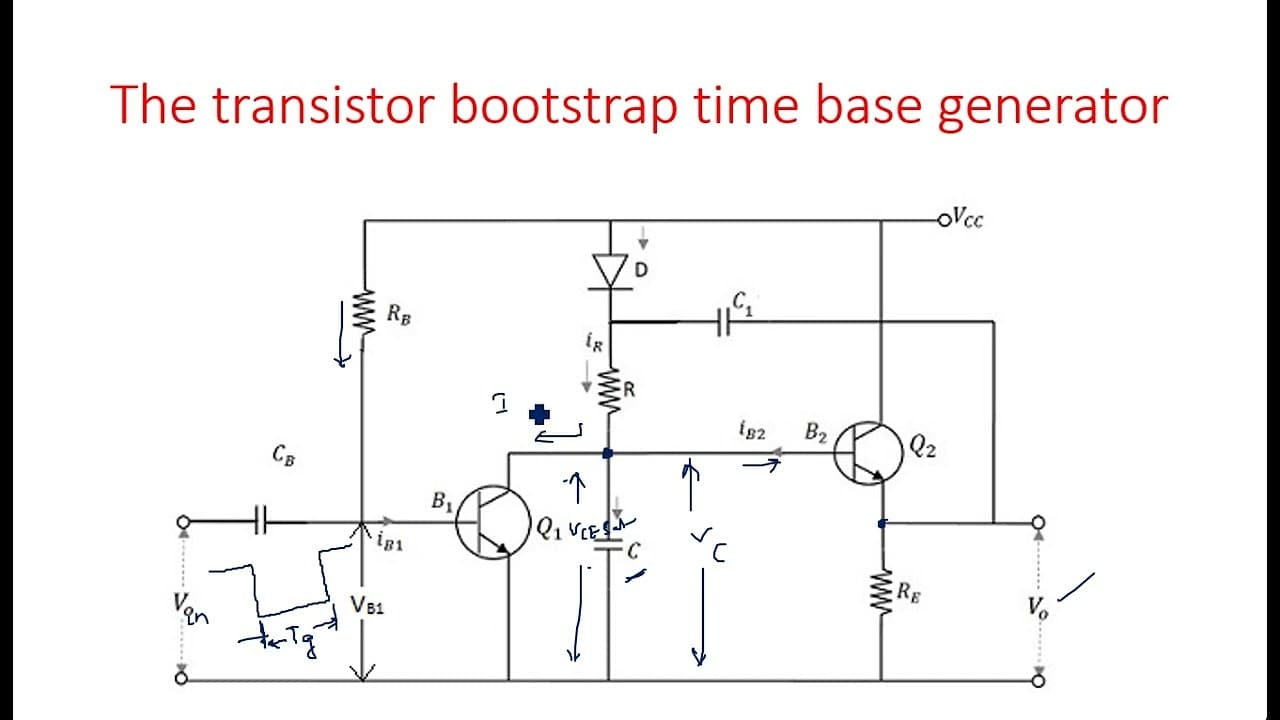
This video explains the construction and functioning of bootstrap time base generators using BJTs.
Transcript
hi everyone in this video I'm going to explain about the transistor bootstrap time basor in the previous video I have given you the explanation of transistor Miller time base generator now it is bootstrap in previous videos we have seen how bootstrap circuit is going to be generated constructed with the help of simple resistor and capacitor now how... Read More
Key Insights
- ⌛ The bootstrap time base generator effectively simplifies the traditional Miller circuits by using fewer BJTs while maintaining output integrity.
- 🛟 Saturation of BJT Q1 is critical for charging the capacitor, which serves as the time base in the circuit.
- 💗 The gating pulse is essential for controlling transitions between charging and discharging phases of the capacitor.
- ⌛ The relationship between TO and RC is crucial in ensuring the capacitor charges to the necessary voltage within designated time constraints.
- 👻 The emitter follower configuration in this circuit allows for a unity gain, meaning output voltage closely mirrors the input from the capacitor.
- 🈸 Understanding the behavior during both the sweep and retrace periods is crucial for accurately employing this circuit in practical applications.
- 💐 The design condition RB<VCC/HF*R is vital for robust circuit function, ensuring the input resistance permits adequate current flow.
Install to Summarize YouTube Videos and Get Transcripts
Explore YouTube Video Summarizer or Get YouTube Transcript Extractor
Questions & Answers
Q: What is the main difference between the bootstrap time base generator and the Miller circuit?
The bootstrap time base generator employs only two BJTs compared to three in the Miller circuit. This difference simplifies the design while still achieving the necessary functionality. The choice of components affects the circuit's performance in generating accurate time bases.
Q: How do BJTs operate in saturation and conduction states in this circuit?
In saturation, BJT Q1 remains always on when sufficient voltage is present, allowing current to flow freely through it and charge the capacitor. Conversely, in conduction, BJT Q2 allows current to flow but is dependent on the operation of Q1 and has a limited amount of input voltage, influencing the output voltage of the circuit.
Q: What are the implications of the gating pulse applied to the circuit?
The gating pulse controls the operation of transistor Q1. A negative pulse turns Q1 off, initiating the charging of the capacitor, while its absence keeps Q1 in the on state, facilitating continuous discharging. This switching affects the timing characteristics of the circuit, allowing for precise time base generation.
Q: What role do resistors and capacitors play in the bootstrap time base generator?
The resistance and capacitance values determine the time constant for charging and discharging the capacitor, influencing the duration of the sweep and retrace periods. They help shape the voltage and current profiles necessary for the time base to function accurately, as defined in the circuit's design.
Summary & Key Takeaways
-
The video discusses the configuration of a bootstrap time base generator, highlighting the use of two BJTs instead of the three used in a Miller circuit.
-
It explains the operational principles of BJTs in saturation and conduction states, detailing the pathways for current flow and the effects of gating pulses on charging a capacitor.
-
Key relationships in voltage and current are analyzed, including the capacitor's charging and discharging periods, which influence the overall performance of the generator circuit.
Read in Other Languages (beta)
Share This Summary 📚
Summarize YouTube Videos and Get Video Transcripts with 1-Click
Try YouTube Summary with ChatGPT & Claude or YouTube Transcript Generator