Digital readout || Digital storage oscilloscopes | Electrical Instruments ( EIM ) | Lec - 37
TL;DR
This video explains digital storage oscilloscopes and digital readout oscilloscopes in detail.
Transcript
everyone in this video i am going to explain digital storage oscilloscope and digital radio test roscoper so digital storage oscilloscope is quite opposite to the analog storage oscilloscope in the previous video i have explained analog storage oscilloscope where the sinusoidal signal or any type of analog signal has been stored in mesh storage so ... Read More
Key Insights
- 🏪 Digital storage oscilloscopes utilize memory to store converted digital signals, displaying them on a visual output.
- 🍵 The conversion from analog to digital is critical in handling various input signal types accurately.
- 📡 Multiple channels in digital oscilloscopes allow for simultaneous monitoring of different signals or aspects of a single signal.
- ❓ Trigger circuits synchronize the recording of data, improving the accuracy of waveform representation.
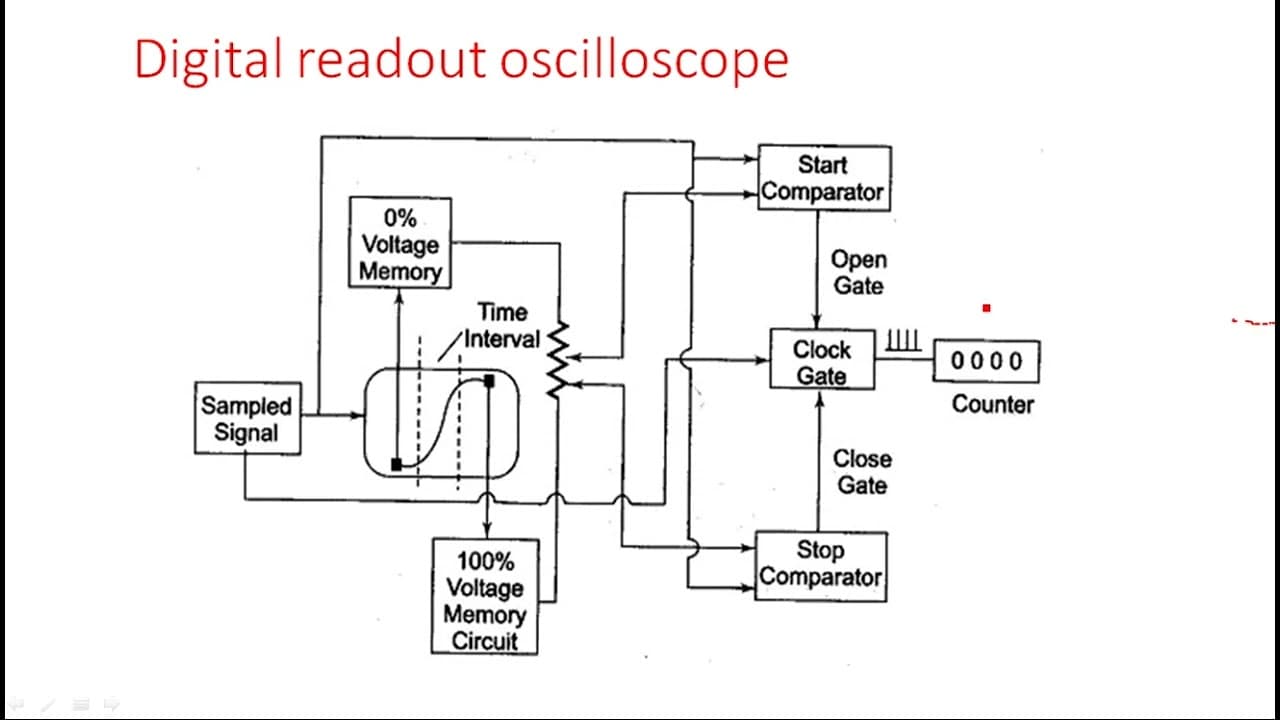
- 🎨 Digital readout oscilloscopes are designed for simple signal representation, highlighting sampling and counting functions.
- ⚡ Comparators in digital readout oscilloscopes help establish voltage levels, contributing to accurate measurement processes.
- ⚡ Potentiometers are integral to the function of digital readout oscilloscopes, assisting in voltage memory comparison.
Install to Summarize YouTube Videos and Get Transcripts
Explore YouTube Video Summarizer or Get YouTube Transcript Extractor
Questions & Answers
Q: What is the main difference between a digital storage oscilloscope and an analog storage oscilloscope?
The primary distinction lies in their data storage methods; digital storage oscilloscopes save data as binary values (ones and zeros), while analog oscilloscopes use mesh storage to hold continuous analog signals. Digital oscilloscopes require conversion from analog to digital data for processing.
Q: How does the data conversion process happen in a digital storage oscilloscope?
When an analog signal is fed to a digital storage oscilloscope, it first passes through an attenuator and an amplifier. Then, an analog-to-digital converter (ADC) transforms the analog input into a digital format for storage. This process allows the oscilloscope to efficiently record and reproduce signals for analysis.
Q: What role does the trigger circuit play in a digital storage oscilloscope?
The trigger circuit initiates the recording process by generating a pulse that activates timing and record control functionalities within the oscilloscope. This ensures that data recording occurs at precise moments, resulting in accurate representation of the input signal on the display.
Q: Can you explain how the digital readout oscilloscope functions?
A digital readout oscilloscope samples the input signal and displays it on a screen, capturing only parts of the waveform. It also utilizes comparators and potentiometers to analyze the sampled signal, counting occurrences when specific voltage levels are reached, which is displayed numerically on a counter.
Summary & Key Takeaways
-
The video compares digital storage oscilloscopes with analog storage oscilloscopes, highlighting how digital oscilloscopes store data as binary values while needing conversion from analog signals.
-
It discusses the functioning of a digital storage oscilloscope, detailing the conversion processes and components involved in storing and retrieving data signals.
-
Insights into digital readout oscilloscopes are provided, focusing on how they sample and display input signals along with counting mechanisms.
Read in Other Languages (beta)
Share This Summary 📚
Summarize YouTube Videos and Get Video Transcripts with 1-Click
Try YouTube Summary with ChatGPT & Claude or YouTube Transcript Generator