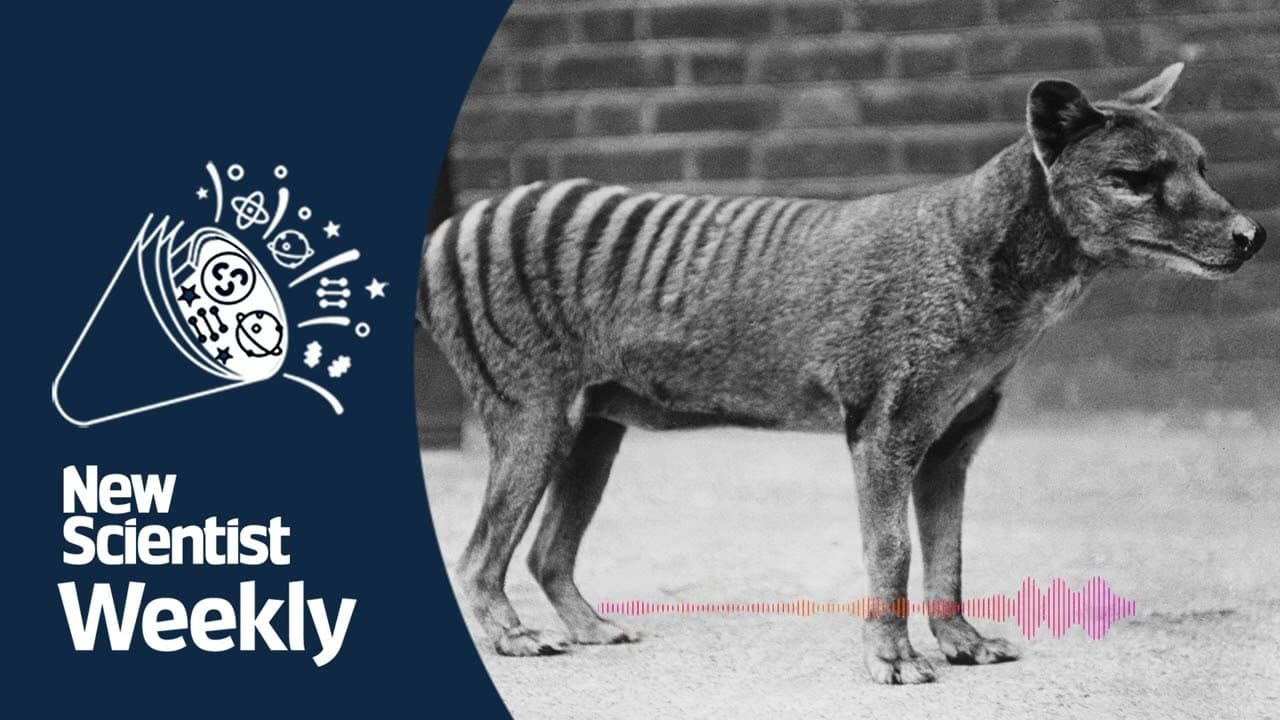
Thylacine RNA extracted from extinct animal for first time I New Scientist Weekly podcast 216
TL;DR
Neuroscientists criticize integrated information theory; RNA extracted from extinct animal; jellyfish's learning abilities; reverse vaccine for autoimmune conditions; human ancestors' wooden structures; total number of cells in the body.
Transcript
hello there welcome back to New Scientist weekly your curated selection of the week's science stories I'm Christy Taylor in New York and I'm Chelsea white in Portland Oregon this week more than 100 neuroscientists are calling a leading theory of Consciousness pseudoscience so we'll take another look at integrated information Theory plus it's a big ... Read More
Key Insights
- ❓ RNA extraction from an extinct animal offers insights into genetic potential and disease interactions.
- 🧠 Jellyfish exhibit learning abilities without a brain, showcasing the complexity of neural processes.
- 💁 Criticism of integrated information theory by neuroscientists highlights the need for empirical evidence in scientific theories.
- 💱 The discovery of wooden structures suggests early human ancestors may have settled and made environmental changes.
Install to Summarize YouTube Videos and Get Transcripts
Explore YouTube Video Summarizer or Get YouTube Transcript Extractor
Questions & Answers
Q: Why did neuroscientists criticize integrated information theory?
Neuroscientists criticized integrated information theory due to a lack of empirical evidence supporting its core ideas, labeling it as pseudoscience for being impossible to test.
Q: How does the extraction of RNA from an extinct animal help in understanding genetic potential?
Extracting RNA from extinct animals like thylacines offers insights into how they dealt with environmental stresses, utilized their genetic potential, and interacted with pathogens, providing a more nuanced understanding beyond DNA.
Q: How do jellyfish demonstrate learning abilities without a brain?
Jellyfish were found to learn to avoid obstacles in a tank, suggesting that their sight organs with complex neural activity might play a role in learning despite lacking a traditional brain structure.
Q: What potential does a reverse vaccine hold for treating autoimmune conditions?
A reverse vaccine shows promise in resetting the immune system's memory to stop attacking its cells in autoimmune conditions like multiple sclerosis and type 1 diabetes, offering a unique approach different from traditional vaccines.
Summary & Key Takeaways
-
Neuroscientists criticize integrated information theory for lack of empirical evidence.
-
RNA extracted from an extinct animal provides insights into genetic potential and disease interactions.
-
Jellyfish demonstrate learning abilities without a traditional brain structure.
Read in Other Languages (beta)
Share This Summary 📚
Summarize YouTube Videos and Get Video Transcripts with 1-Click
Try YouTube Summary with ChatGPT & Claude or YouTube Transcript Generator
Explore More Summaries from New Scientist weekly podcast 📚


Summarize YouTube Videos and Get Video Transcripts with 1-Click
Try YouTube Summary with ChatGPT & Claude or YouTube Transcript Generator