Human Eye - Passage of light through it | Don't Memorise
TL;DR
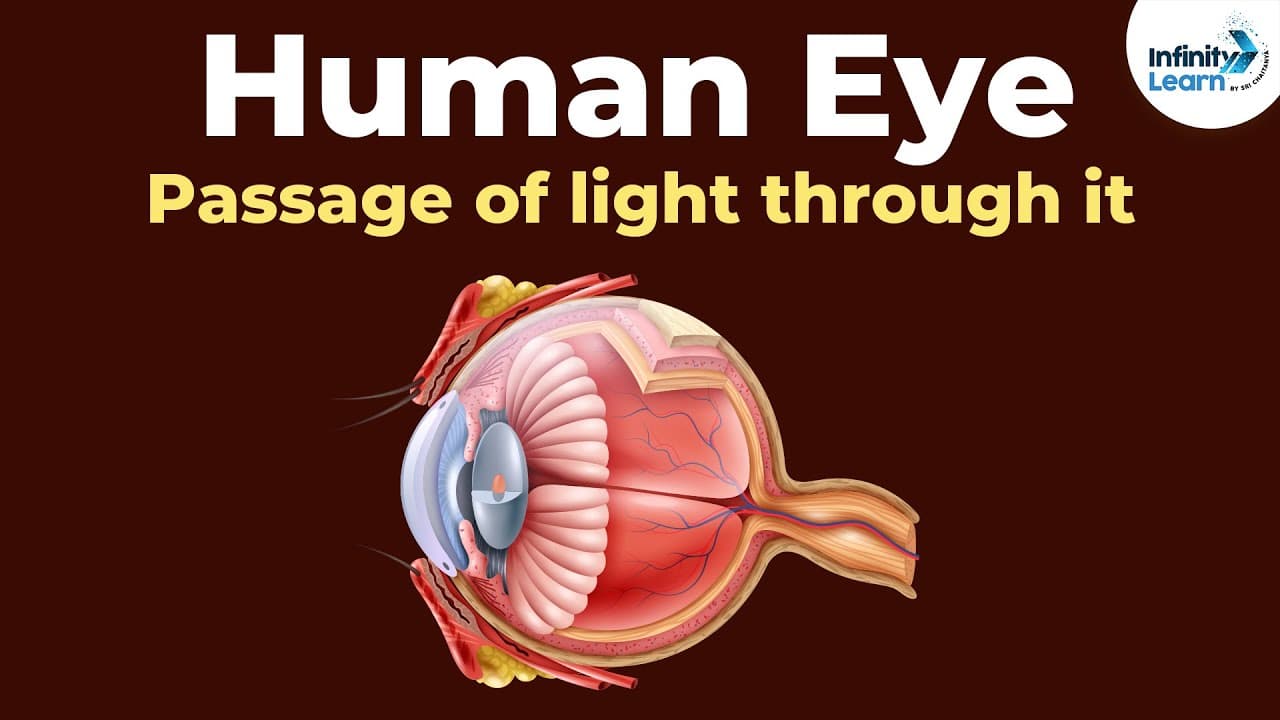
Light enters the eye, refracts through the cornea and lens, forms an image on the retina, and gets upright in the brain.
Transcript
In our previous video, we studied different parts of the human eye and their functions. In this video we are going to roughly see how light propagates inside the eye and how we are able to see the objects around us. And for that, we will consider a simplified 2 dimensional image of our eye! So how does light travel inside? Suppose we are looking at... Read More
Key Insights
- ✈️ Light undergoes multiple refractions inside the eye, primarily at the air-cornea interface.
- 😃 The lens of the eye adjusts its shape through ciliary muscles for accommodation to ensure the image is formed on the retina.
- 💁 The minimum distance for clear vision is around twenty-five centimeters to ensure the image is formed on the retina.
- ✈️ The different mediums through which light travels in the eye include air, cornea, aqueous humor, lens, and vitreous humor.
- ✈️ Light is refracted mainly at the air-cornea interface due to the significant difference in refractive indices.
- 🧠 The brain makes the inverted image upright, resulting in normal vision.
Install to Summarize YouTube Videos and Get Transcripts
Explore YouTube Video Summarizer or Get YouTube Transcript Extractor
Questions & Answers
Q: How does light enter the eye and travel to the retina?
Light enters through the cornea, refracts in the aqueous humor, falls on the lens, which focuses it on the retina.
Q: What role do the ciliary muscles play in the eye?
The ciliary muscles adjust the shape of the lens for accommodation, changing the focal length to ensure the image is formed on the retina.
Q: Why is it important for the image to be formed on the retina?
The image needs to be formed on the retina for clear vision, as an image formed in front or behind the retina would result in blurred vision.
Q: What is the minimum distance for clear vision?
The minimum distance for clear vision is around twenty-five centimeters, where the image is formed on the retina without straining the eyes.
Summary & Key Takeaways
-
Light enters the eye, refracts through the cornea and aqueous humor, and falls on the lens.
-
The lens focuses the light on the retina, forming a real and inverted image.
-
The lens adjusts its shape via ciliary muscles for accommodation to ensure the image is always formed on the retina.
Read in Other Languages (beta)
Share This Summary 📚
Summarize YouTube Videos and Get Video Transcripts with 1-Click
Try YouTube Summary with ChatGPT & Claude or YouTube Transcript Generator
Explore More Summaries from Infinity Learn NEET 📚

Summarize YouTube Videos and Get Video Transcripts with 1-Click
Try YouTube Summary with ChatGPT & Claude or YouTube Transcript Generator