Struggling toward Coeducation | Nancy Weiss Malkiel || Radcliffe Institute
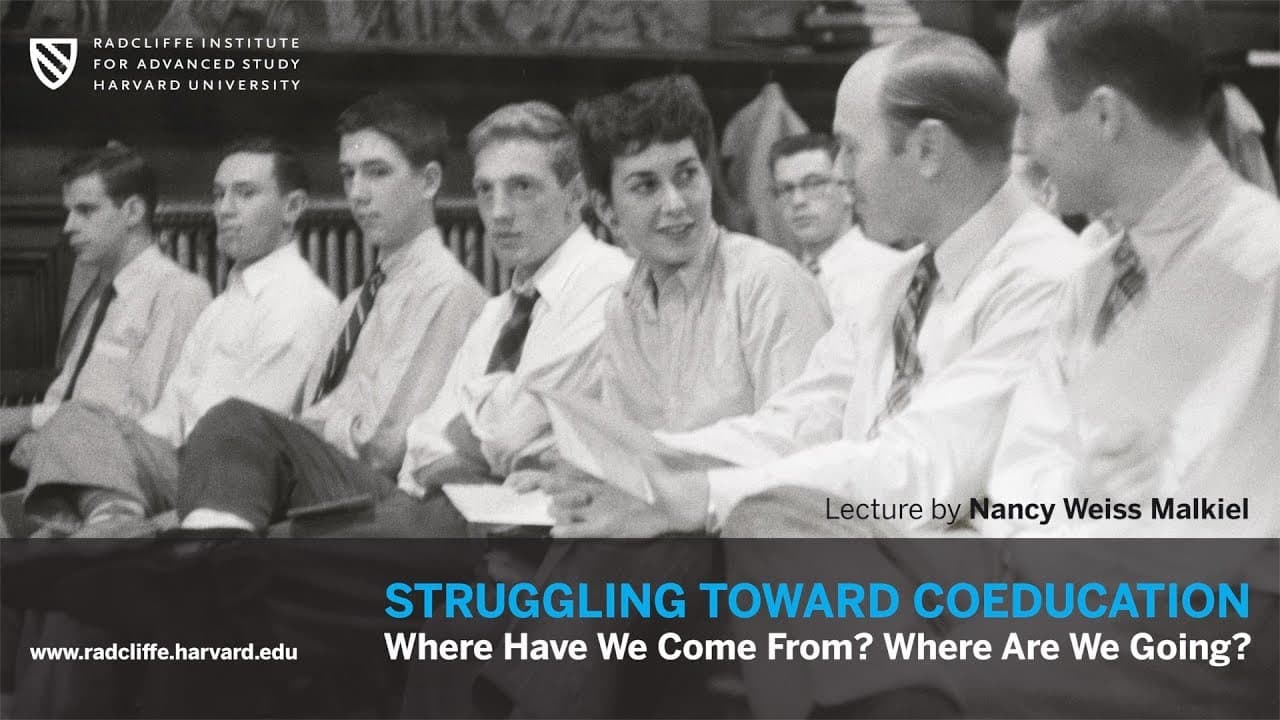
TL;DR
The introduction of coeducation at prestigious colleges and universities in the late 1960s and early 1970s was driven by a decline in applications and a desire to attract top male students. While coeducation opened up educational opportunities for women, it did not resolve issues such as gender discrimination and sexual harassment. There is still work to be done in achieving gender equality in higher education and beyond.
Transcript
[MUSIC PLAYING] - Good afternoon, everybody. I'm Jane Kamensky. I'm the Pforzheimer Foundation director of the Schlesinger Library, which is a very lucky thing to be. And my job this afternoon is to be the introducer of the introducer, to welcome you on behalf of Schlesinger, one of Radcliffe's core program and the Radcliffe Institute for Advanced ... Read More
Key Insights
- 🧑🎓 The decision for coeducation at prestigious institutions was driven by a decline in applications and a desire to attract top male students.
- 🤦♀️ Coeducation faced resistance from alumni, faculty, and some students, with opposition rooted in concerns about diluting masculinity and objectifying women.
- 🥡 The merger of Radcliffe College and Harvard took decades to complete, with preservation of Radcliffe's identity and independence being a priority.
- 🕵️♀️ Coeducation brought women into previously all-male institutions and expanded educational opportunities, but it did not solve issues such as gender discrimination, sexual harassment, and underrepresentation of women in certain fields.
Install to Summarize YouTube Videos and Get Transcripts
Explore YouTube Video Summarizer or Get YouTube Transcript Extractor
Questions & Answers
Q: Did the decision to introduce coeducation at elite colleges and universities impact the overall culture and experience of undergraduate education?
The decision to introduce coeducation did have an impact on the overall culture and experience of undergraduate education. It brought women into previously all-male institutions, creating a diverse environment and expanding the educational opportunities available to women. However, it did not necessarily change the underlying structures and traditions of these institutions.
Q: Were women students treated differently compared to male students in terms of academic and extracurricular opportunities?
Women students often faced challenges and discrimination in terms of academic and extracurricular opportunities. They were sometimes excluded or not given the same opportunities as their male counterparts. Women were also frequently asked to provide the "woman's perspective" in various courses, even if it was not relevant to the subject matter.
Q: How did the decision for coeducation at these elite colleges and universities impact the professional and public lives of women?
While coeducation opened up educational opportunities for women, it did not necessarily lead to equal access to professional and leadership positions. Women still face challenges in the professional world, including gender discrimination and the lack of representation in certain fields and positions. There is still work to be done in achieving gender equality in higher education and beyond.
Q: What can be learned from the struggle for coeducation in terms of breaking through barriers and achieving a more equitable society?
The struggle for coeducation highlights the importance of public attention, discussion, and the examination of institutional structures and practices. It also shows the need for continuous efforts and public accountability in challenging gender discrimination, improving work-life balance, and addressing gendered behaviors and norms. Education and awareness are vital in moving towards a more equitable society.
Summary & Key Takeaways
-
The decision for coeducation at elite colleges and universities was prompted by a decline in applications and a need to attract top male students. Women were added to these institutions in order to revive their prestige.
-
The process of implementing coeducation was met with resistance from alumni, faculty, and some students. Opposition ranged from concerns about diluting masculinity to derogatory and sexist behavior towards women students.
-
The merger of Radcliffe College and Harvard took decades to complete and faced skepticism from Radcliffe trustees and alumni who wanted to maintain the institution's independence and feminist legacy. Ultimately, Radcliffe became the Radcliffe Institute for Advanced Study in 1999.
-
Coeducation has opened up educational opportunities for women and led to increased diversity on campuses. However, it has not resolved issues such as sexual harassment, gendered behaviors and aspirations, and underrepresentation of women in certain fields.
Read in Other Languages (beta)
Share This Summary 📚
Summarize YouTube Videos and Get Video Transcripts with 1-Click
Try YouTube Summary with ChatGPT & Claude or YouTube Transcript Generator
Explore More Summaries from Harvard University 📚






Summarize YouTube Videos and Get Video Transcripts with 1-Click
Try YouTube Summary with ChatGPT & Claude or YouTube Transcript Generator