Combined Gas Law Problems
TL;DR
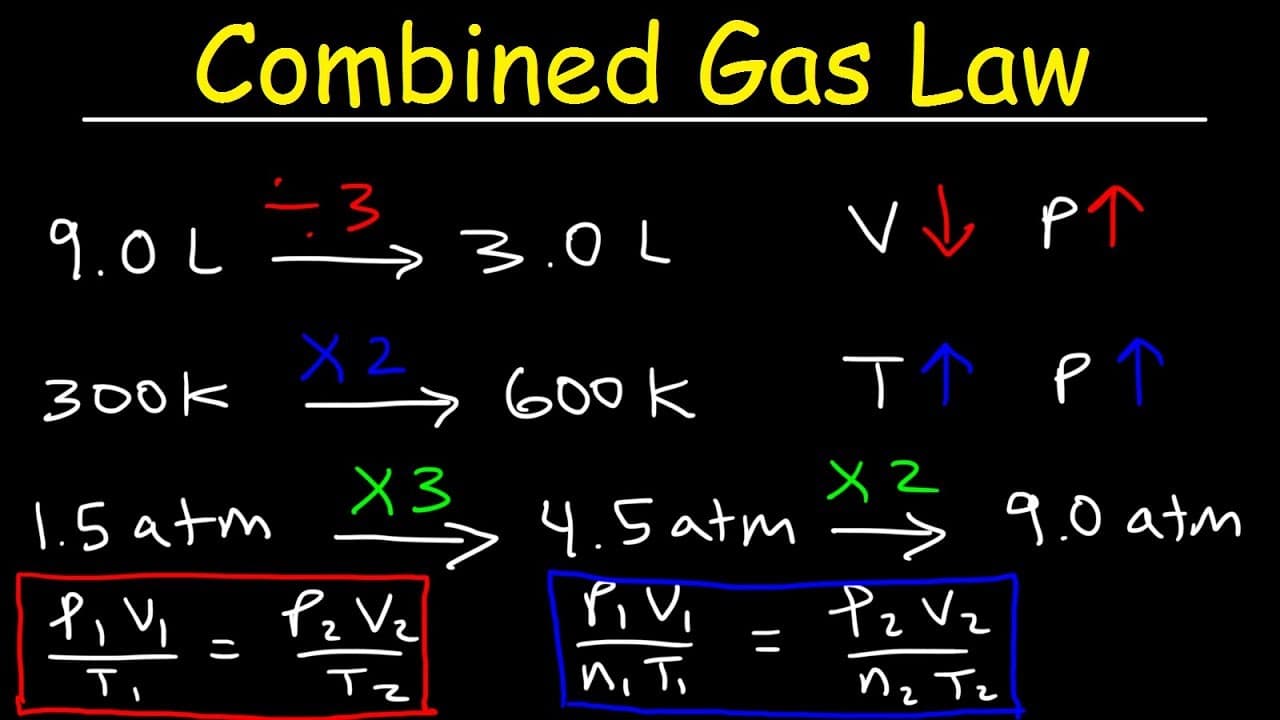
The combined gas law formula, PV/NT = R, is used to calculate the relationship between pressure, volume, temperature, and moles of gas. It can be derived from the ideal gas law or by combining other gas laws.
Transcript
in this lesson we are going to go over something known as the combined gas law which is basically a formula and it's a useful formula to know now there's two different versions of it and i'm going to show you both so first start with this equation the ideal gas law pv is equal to nrt and then isolate r divide both sides by nt so if you do that you'... Read More
Key Insights
- 🫢 The combined gas law formula, PV/NT = R, is a useful tool for calculating the relationship between pressure, volume, temperature, and moles of gas.
- 🫢 The formula can be derived from the ideal gas law equation PV = nRT or by combining other gas laws.
- 🫢 The moles of gas can determine whether to use the version with or without moles in the formula.
- 🫢 The combined gas law formula can be used to solve various gas law problems by rearranging the formula and plugging in known values.
Install to Summarize YouTube Videos and Get Transcripts
Explore YouTube Video Summarizer or Get YouTube Transcript Extractor
Questions & Answers
Q: What is the combined gas law formula and how is it derived?
The combined gas law formula is PV/NT = R. It can be derived from the ideal gas law equation PV = nRT by isolating the constant R. It can also be derived by combining other gas laws, such as Boyle's law, Charles law, Gay-Lussac's law, and Avogadro's law.
Q: What is the significance of the moles of gas in the combined gas law formula?
The moles of gas in the combined gas law formula determine whether to use the version with or without moles. If the moles remain constant, the formula P1V1/T1 = P2V2/T2 can be used. If the moles change, the formula P1V1/n1T1 = P2V2/n2T2 should be used.
Q: How can the combined gas law formula be used to solve problems?
The combined gas law formula can be used to solve problems involving changes in pressure, volume, temperature, and moles of gas. By rearranging the formula and plugging in known values, the unknown variable can be calculated.
Q: Can you explain how to use the combined gas law formula in a specific problem?
Sure, let's take the example problem of a nitrogen gas sample. By knowing the initial and final volume, temperature, and pressure, we can use the combined gas law formula to calculate the new pressure. By cross-multiplying and solving the equation algebraically, we find that the new pressure inside the container is 9 atm.
Summary & Key Takeaways
-
The combined gas law formula, PV/NT = R, is derived from the ideal gas law and can also be expressed as P1V1/n1T1 = P2V2/n2T2.
-
The formula can be used to solve problems involving changes in pressure, volume, temperature, and moles of gas, depending on whether the moles remain constant or change.
-
The formula can also be derived by combining other gas laws, such as Boyle's law, Charles law, Gay-Lussac's law, and Avogadro's law.
Read in Other Languages (beta)
Share This Summary 📚
Summarize YouTube Videos and Get Video Transcripts with 1-Click
Try YouTube Summary with ChatGPT & Claude or YouTube Transcript Generator
Explore More Summaries from The Organic Chemistry Tutor 📚


Summarize YouTube Videos and Get Video Transcripts with 1-Click
Try YouTube Summary with ChatGPT & Claude or YouTube Transcript Generator