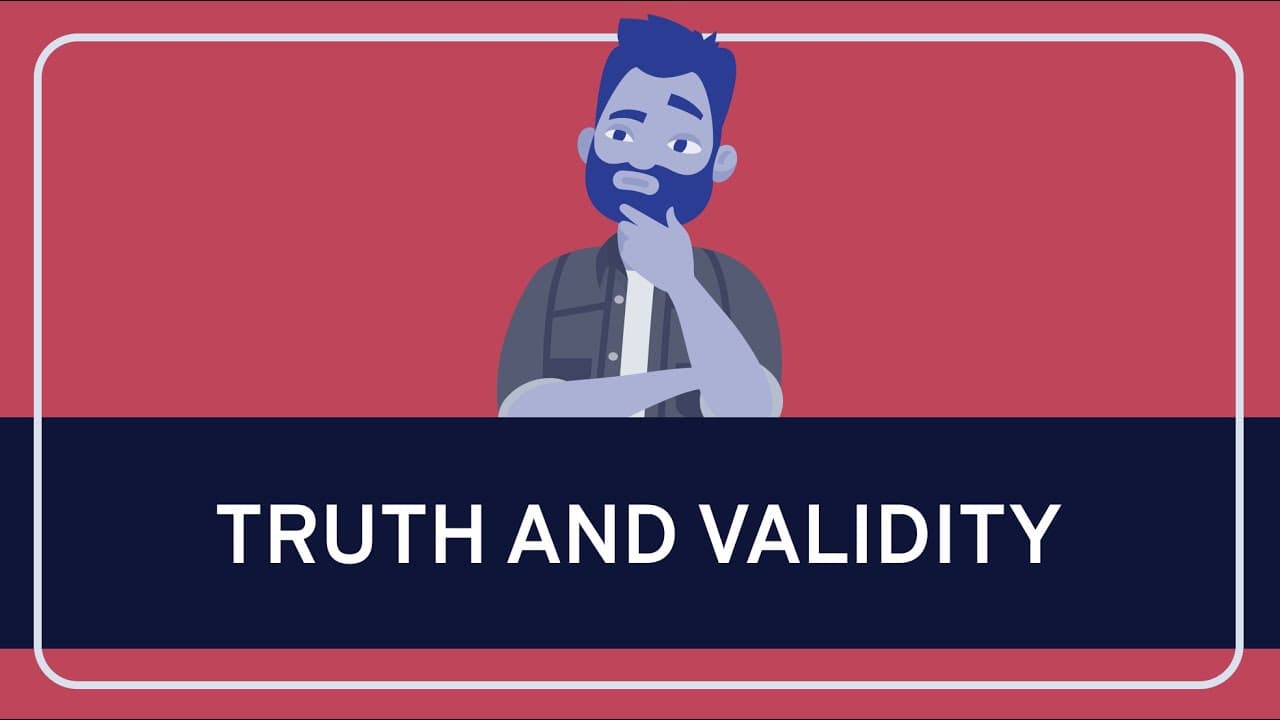
What Are Truth and Validity in Arguments?
TL;DR
Truth refers to the accuracy of premises in an argument, while validity pertains to whether the conclusion logically follows from those premises. A sound argument is both true and valid, and it's crucial to understand these concepts to evaluate claims effectively. Valid arguments can still provide insights, even if some premises are false, by helping us infer the truth of other statements.
Transcript
(intro music) Hi! My name is Julianne Chung, and I am a graduate student at Yale University. Today, I am going to talk about truth and validity. There are many different good qualities that arguments can have. For example, they can be clear, they can be interesting, they can be persuasive, and so on. In this video, however, we are going to discuss ... Read More
Key Insights
- Truth and validity are two essential qualities of arguments that determine whether their conclusions should be accepted.
- Truth is a property of statements, while validity is a property of arguments in philosophy.
- An argument is valid if its conclusion logically follows from its premises, regardless of the truth of the premises.
- A sound argument is one where the premises are true, and the reasoning is valid, leading to a true conclusion.
- Arguments can have true premises but be invalid if the conclusion does not logically follow.
- Valid arguments with false premises can still be useful for assessing the truth of claims.
- There are four combinations of truth and validity in arguments: true and valid, true and invalid, false and valid, false and invalid.
- Understanding argument validity helps in determining the truth or falsity of claims through logical inference.
Install to Summarize YouTube Videos and Get Transcripts
Explore YouTube Video Summarizer or Get YouTube Transcript Extractor
Questions & Answers
Q: What are the two essential qualities of arguments discussed in the video?
The video discusses truth and validity as the two essential qualities of arguments. Truth refers to the agreement of premises with facts, while validity refers to the logical consistency of the argument, where the conclusion follows logically from the premises. These qualities are crucial in determining whether the conclusions of arguments should be accepted.
Q: How does Julianne Chung define a valid argument?
Julianne Chung defines a valid argument as one where the conclusion logically follows from the premises. In other words, if the premises are true, the conclusion must also be true. Validity is a structural property of the argument, independent of the actual truth of the premises. This makes validity essential for logical consistency.
Q: What is a sound argument according to the video?
A sound argument, as explained in the video, is an argument that is both valid and has all true premises. This means that not only does the conclusion follow logically from the premises, but the premises themselves are in agreement with the facts. Sound arguments are the most reliable in supporting their conclusions.
Q: Why are valid arguments with false premises still of interest?
Valid arguments with false premises are of interest because they help in assessing the truth of claims. By logically inferring conclusions from false premises, one can determine that if the conclusion is false, at least one premise must also be false. This process aids in evaluating the truthfulness of statements and refining arguments.
Q: What example does Chung use to illustrate a valid argument with a false premise?
Chung uses the example of John calling his boss to say he is in bed with the flu, while he is actually seen bowling. The argument is: Premise (1): John is in bed with the flu. Premise (2): If John is in bed with the flu, he is not bowling. Conclusion: John is not bowling. This valid argument shows that if the conclusion is false, the first premise must be false.
Q: What are the four possibilities of truth and validity combinations in arguments?
The four possibilities are: 1) True premises and valid reasoning, resulting in a sound argument. 2) True premises and invalid reasoning, leading to an unsound argument. 3) False premises and valid reasoning, where conclusions may still be logically consistent. 4) False premises and invalid reasoning, resulting in an unsound argument. These combinations help in evaluating arguments.
Q: How does understanding argument validity help in determining truth?
Understanding argument validity helps in determining truth by providing a framework for logical inference. Valid arguments ensure that if the premises are true, the conclusion must be true. This logical consistency allows for the assessment of claims and the identification of false premises when conclusions are false, thereby aiding in the evaluation of truth.
Q: What additional resources does the video suggest for further understanding?
The video suggests additional resources for further understanding of validity and soundness. It recommends checking out videos by Paul Henne and Aaron Ancell from Duke University, which provide more detailed discussions on these topics. These resources are valuable for those seeking a deeper understanding of philosophical concepts related to arguments.
Summary & Key Takeaways
-
Julianne Chung from Yale University discusses the philosophical concepts of truth and validity in arguments. She explains that truth is a property of statements, while validity is a property of arguments. An argument is valid if its conclusion logically follows from its premises, regardless of the truth of the premises.
-
Chung illustrates various combinations of truth and validity in arguments, emphasizing the importance of sound arguments, where premises are true, and reasoning is valid. She also highlights the usefulness of valid arguments with false premises in assessing the truth of claims.
-
The video concludes by suggesting additional resources for more detailed discussions on validity and soundness. Chung emphasizes that understanding argument validity is crucial for determining the truth or falsity of claims through logical inference.
Read in Other Languages (beta)
Share This Summary 📚
Summarize YouTube Videos and Get Video Transcripts with 1-Click
Try YouTube Summary with ChatGPT & Claude or YouTube Transcript Generator
Explore More Summaries from Wireless Philosophy 📚
Summarize YouTube Videos and Get Video Transcripts with 1-Click
Try YouTube Summary with ChatGPT & Claude or YouTube Transcript Generator