Products
Features
YouTube Video Summarizer
Summarize YouTube videos
Web & PDF Highlighter
Highlight web pages & PDFs
Chat with PDF
Ask any PDF questions with AI
Ask AI Clone
Chat with your highlights & memories
Audio Transcriber
Transcribe audio files to text
Glasp Reader
Read and highlight articles
Kindle Highlight Export
Export your Kindle highlights
Idea Hatch
Hatch ideas from your highlights
Integrations
Obsidian Plugin
Notion Integration
Pocket Integration
Instapaper Integration
Medium Integration
Readwise Integration
Snipd Integration
Hypothesis Integration
Apps & Extensions
Chrome Extension
Safari Extension
Edge Add-ons
Firefox Add-ons
iOS App
Android App
Discover
Discover
Ideas
Discover new ideas and insights
Articles
Curated articles and insights
Books
Book recommendations by great minds
Posts
Essays and notes from readers
Quotes
Inspiring quotes collection
Videos
Curated videos and summaries
Explore Glasp
Glasp Newsletter
Weekly insights and updates
Glasp Talk
Interview series with great minds
Glasp Blog
Latest news and articles
Glasp Use Cases
Learn how others use Glasp
Build & Support
Glasp API
Access Glasp's API for developers
MCP Connector
Connect Glasp to Claude & ChatGPT
Community
Glasp Reddit Community
Students
Student discount and benefits
FAQs
Frequently Asked Questions
AboutPricing
DashboardLog inSign up

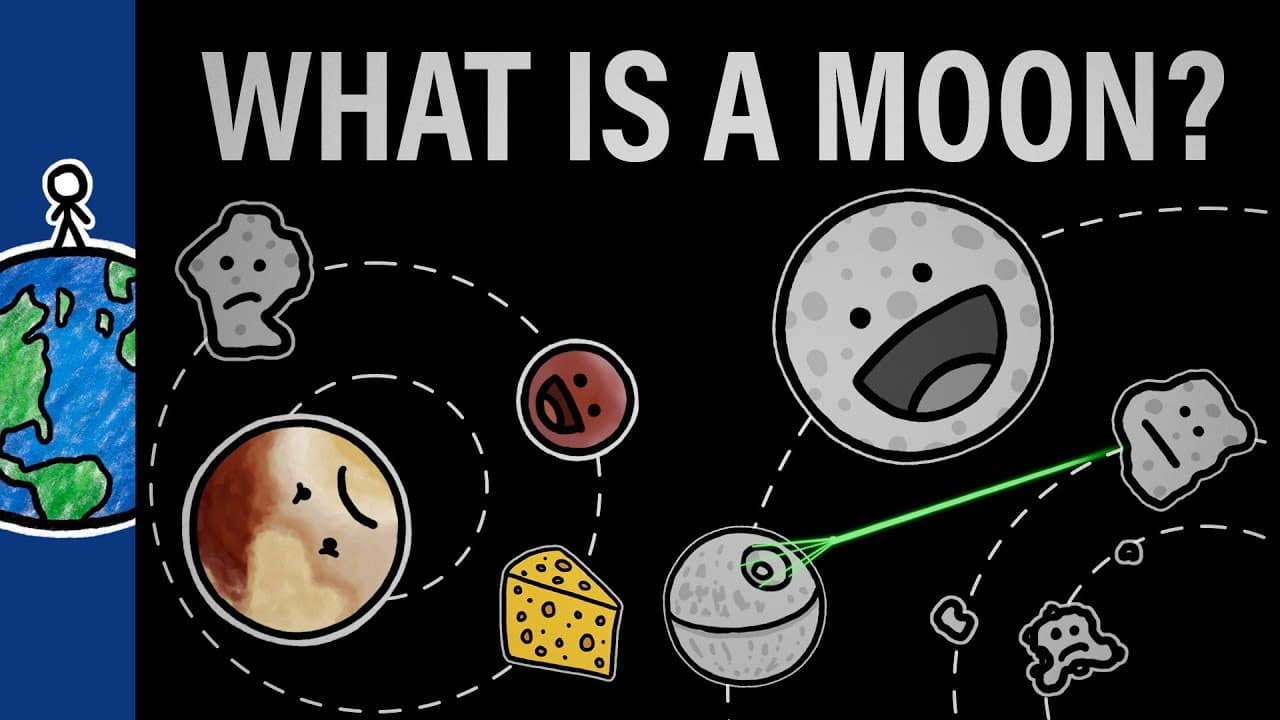
Our Definition For “Moon” Is Broken (Collab. w/ MinutePhysics)
1.1M views
•
August 15, 2017
by
MinuteEarth
YouTube video player
Our Definition For “Moon” Is Broken (Collab. w/ MinutePhysics)

TL;DR

Humans have broadened the definition of moons, leading to a debate on what truly qualifies as a moon.

Transcript

Hi, this is Kate from MinuteEarth. Until relatively recently, humans believed everything we could see in the sky was orbiting around the earth. Of course, the Moon was the only thing actually orbiting the earth, and the earth itself was orbiting a star. But there were other objects orbiting that star that also had things orbiting them, so we decide... Read More

Key Insights

  • 🥮 Moons orbit stars like Earth does, but complexities arise with defining moons of moons.
  • 😫 Setting size limits and considering barycenters are essential in classifying moons.
  • 🧑‍🏭 Factors like orbital characteristics and visibility from planets affect moon classification.
  • 🛰️ Definitions of moons in space are nebulous and may not capture the variety of orbiting objects.
  • 🖤 Objects like black holes and white dwarfs have clearer classifications compared to moons.
  • 🥮 Moons come in various sizes and shapes, challenging traditional definitions.
  • 🥮 The debate on what constitutes a moon continues due to the diversity of orbiting objects.

Install to Summarize YouTube Videos and Get Transcripts

Explore YouTube Video Summarizer or Get YouTube Transcript Extractor

Questions & Answers

Q: How has the definition of moons evolved over time?

Initially, everything in the sky was believed to orbit Earth, but we now know moons orbit stars like Earth does, broadening the term "moon."

Q: What challenges arise in categorizing smaller objects as moons?

With advancements in technology, smaller objects are identified as moons, leading to debates on setting size limits for what qualifies as a moon.

Q: How do barycenters impact the classification of moons?

Barycenters, the common center of mass for orbiting objects, play a role in determining whether objects like Pluto and Charon are considered moons.

Q: What factors complicate the identification of moons in space?

Factors like size ratios, orbital characteristics, roundness, and visibility from a planet's surface contribute to the complexity of defining moons.

Summary & Key Takeaways

  • Historically, humans thought everything in the sky orbited Earth, but moons actually orbit stars like Earth does.

  • The term "moon" includes natural satellites of satellites, but challenges arise with defining smaller objects as moons.

  • Factors like size ratios, barycenters, and orbit characteristics complicate the classification of moons in space.


Read in Other Languages (beta)

English

Share This Summary 📚

Summarize YouTube Videos and Get Video Transcripts with 1-Click

Download browser extensions on:

Try YouTube Summary with ChatGPT & Claude or YouTube Transcript Generator

Explore More Summaries from MinuteEarth 📚
Why It's Good To Have A Weak Hand thumbnail
Why It's Good To Have A Weak Hand
MinuteEarth
The Basics Of Digital Illustration thumbnail
The Basics Of Digital Illustration
MinuteEarth
Why does the north get more total eclipses? thumbnail
Why does the north get more total eclipses?
MinuteEarth
Why Do Female Hyenas Have Pseudo-Penises?! thumbnail
Why Do Female Hyenas Have Pseudo-Penises?!
MinuteEarth
The Great Acceleration thumbnail
The Great Acceleration
MinuteEarth
Why Do Cyclones Follow Unpredictable Paths? thumbnail
Why Do Cyclones Follow Unpredictable Paths?
MinuteEarth

Summarize YouTube Videos and Get Video Transcripts with 1-Click

Download browser extensions on:

Try YouTube Summary with ChatGPT & Claude or YouTube Transcript Generator

Apps & Extensions

  • Chrome Extension
  • Safari Extension
  • Edge Add-ons
  • Firefox Add-ons
  • iOS App
  • Android App

Key Features

  • YouTube Video Summarizer
  • Web & PDF Summarizer
  • Web & PDF Highlighter
  • Chat with PDF
  • Ask AI Clone
  • Audio Transcriber
  • Glasp Reader
  • Kindle Highlight Export
  • Idea Hatch

Integrations

  • Obsidian Plugin
  • Notion Integration
  • Pocket Integration
  • Instapaper Integration
  • Medium Integration
  • Readwise Integration
  • Snipd Integration
  • Hypothesis Integration

More Features

  • APIs
  • MCP Connector
  • Blog & Post
  • Embed Links
  • Image Highlight
  • Personality Test
  • Quote Shots

Company

  • About us
  • Blog
  • Community
  • FAQs
  • Job Board
  • Newsletter
  • Pricing
Terms

•

Privacy

•

Guidelines

© 2026 Glasp Inc. All rights reserved.