Minimal pairs in Vietnamese Pronunciation: AI - AY | Learn Vietnamese with TVO
TL;DR
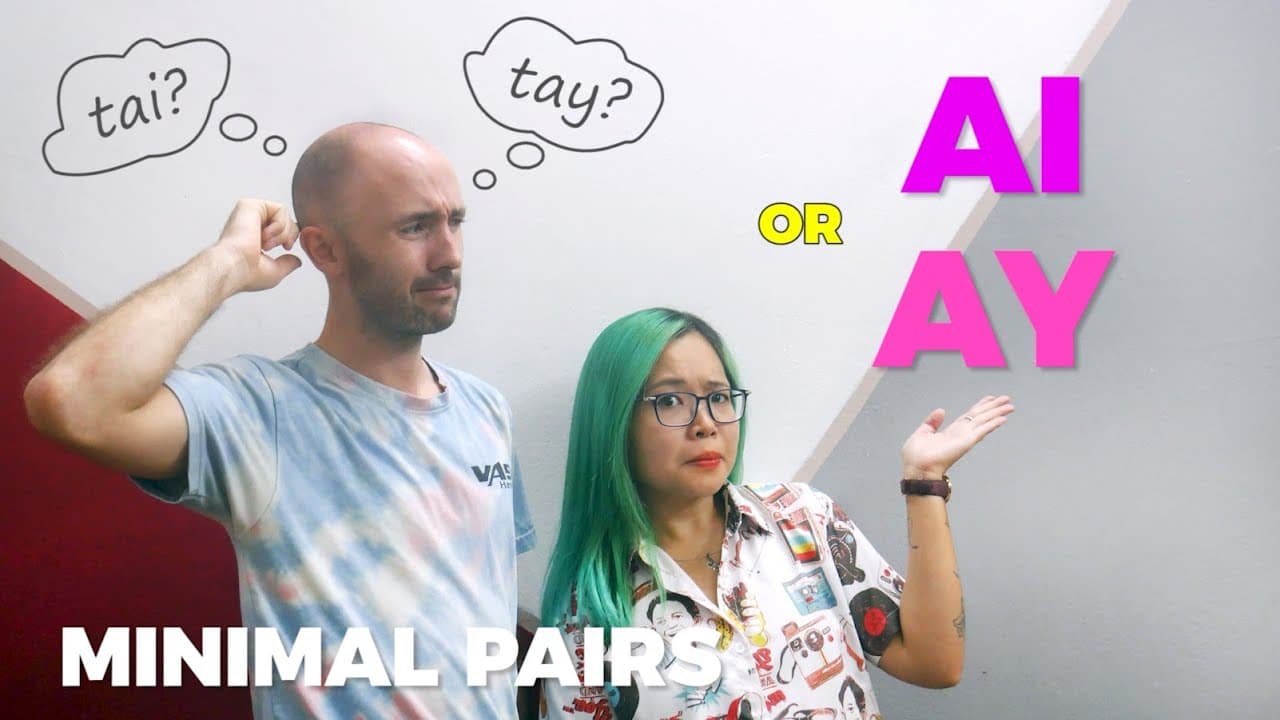
Learn to differentiate Vietnamese diphthongs 'ai' and 'ay' with exercises.
Transcript
foreign hi everyone welcome back to TVO YouTube channel I believe that a lot of Vietnamese Learners the same as our student in the clip will find it ridiculously difficult to differentiate between the two deep thongs I I so let us help you in today's video we're gonna attain to differentiate these two deep tongue through a variety of exercises and ... Read More
Key Insights
- The diphthongs 'ai' and 'ay' are difficult for Vietnamese learners due to their similarity, both containing 'a' and 'i' sounds.
- Pronunciation of 'a' involves opening the mouth wide and keeping the tongue flat, while 'i' requires stretching the mouth sideways.
- The distinction between 'ai' and 'ay' lies in the focus on different vowel sounds; 'ai' emphasizes 'a', and 'ay' lengthens the 'i'.
- The letter 'e' in Vietnamese is called 'e nan' (short e) and 'izai' (long e), helping to differentiate the sounds.
- The video includes exercises where learners hear words with these diphthongs and identify which is used.
- Visual exercises are also provided, showing pictures of words containing 'ai' or 'ay' for identification.
- Additional practice is available through Patreon, offering more comprehensive exercises and sentence-level identification.
- The video aims to make learning fun and practical, encouraging learners to subscribe for more content.
Install to Summarize YouTube Videos and Get Transcripts
Explore YouTube Video Summarizer or Get YouTube Transcript Extractor
Questions & Answers
Q: What makes the diphthongs 'ai' and 'ay' difficult to differentiate?
The diphthongs 'ai' and 'ay' are challenging because they both contain the vowels 'a' and 'i', which sound similar. The key difference is that 'ai' emphasizes the 'a' sound, while 'ay' elongates the 'i'. This subtle distinction can be difficult for learners to perceive without practice.
Q: How does the video suggest pronouncing the vowel 'a'?
To pronounce the vowel 'a', the video suggests opening your mouth wide and keeping your tongue flat. This positioning helps achieve the correct sound, which is foundational for distinguishing the diphthongs 'ai' and 'ay'. Proper pronunciation of individual vowels is essential for mastering diphthongs.
Q: What exercises are included in the video to practice these diphthongs?
The video includes auditory exercises where learners listen to words containing 'ai' or 'ay' and identify which diphthong is used. Additionally, visual exercises show pictures of words with these sounds, requiring learners to decide between 'ai' or 'ay'. These activities aim to reinforce understanding through practice.
Q: What is the significance of the letters 'e' in Vietnamese pronunciation?
In Vietnamese, the letter 'e' is referred to as 'e nan' (short e) and 'izai' (long e). This distinction is important for differentiating the diphthongs 'ai' and 'ay', as it helps learners focus on the length and emphasis of the vowel sounds. Understanding these subtleties is crucial for accurate pronunciation.
Q: How can learners access more advanced practice for these diphthongs?
Learners can access more advanced practice by becoming patrons of TVO on Patreon. This platform offers additional exercises, including sentence-level identification of 'ai' and 'ay', providing a deeper understanding of these sounds. Supporting the channel on Patreon also helps sustain the creation of educational content.
Q: What is the purpose of the video in terms of language learning?
The video aims to make learning Vietnamese pronunciation accessible and enjoyable, focusing on practical communication skills. By teaching learners to differentiate between 'ai' and 'ay', the video helps improve pronunciation accuracy, which is essential for effective communication in Vietnamese. It encourages a fun and engaging approach to language learning.
Q: What additional resources does the channel offer for Vietnamese learners?
The channel offers a range of resources for Vietnamese learners, including other videos on minimal pairs and pronunciation topics. Links to related videos are provided, covering various sounds in Vietnamese. The channel also offers group classes, both online and face-to-face, and personalized lessons for learners seeking more structured instruction.
Q: How does the video encourage viewer engagement and support?
The video encourages viewer engagement by inviting learners to like and subscribe for more content. It also promotes support through Patreon, where learners can access exclusive practice materials. By offering additional resources and fostering a community of learners, the channel seeks to build a supportive and interactive learning environment.
Summary & Key Takeaways
-
This video from TVO YouTube channel helps Vietnamese learners differentiate between the diphthongs 'ai' and 'ay'. Exercises are provided to practice these sounds, focusing on the pronunciation of the vowels 'a' and 'i'. Additional resources are available for patrons seeking more advanced practice.
-
The video explains that the diphthongs 'ai' and 'ay' are similar because they share the vowels 'a' and 'i'. However, 'ai' emphasizes the 'a' sound, while 'ay' lengthens the 'i'. Exercises include listening to words and visual identification to reinforce learning.
-
Learners are encouraged to subscribe for more videos and can access further practice through Patreon. The content aims to make Vietnamese pronunciation accessible and enjoyable, with a focus on practical communication skills. The video concludes with an invitation to join future lessons and support the channel.
Read in Other Languages (beta)
Share This Summary 📚
Summarize YouTube Videos and Get Video Transcripts with 1-Click
Try YouTube Summary with ChatGPT & Claude or YouTube Transcript Generator
Explore More Summaries from Tieng Viet Oi - Vietnamese Lessons 📚

Summarize YouTube Videos and Get Video Transcripts with 1-Click
Try YouTube Summary with ChatGPT & Claude or YouTube Transcript Generator