Current Transformer vs Voltage Transformer : What’s the Difference ? TheElectricalGuy
TL;DR
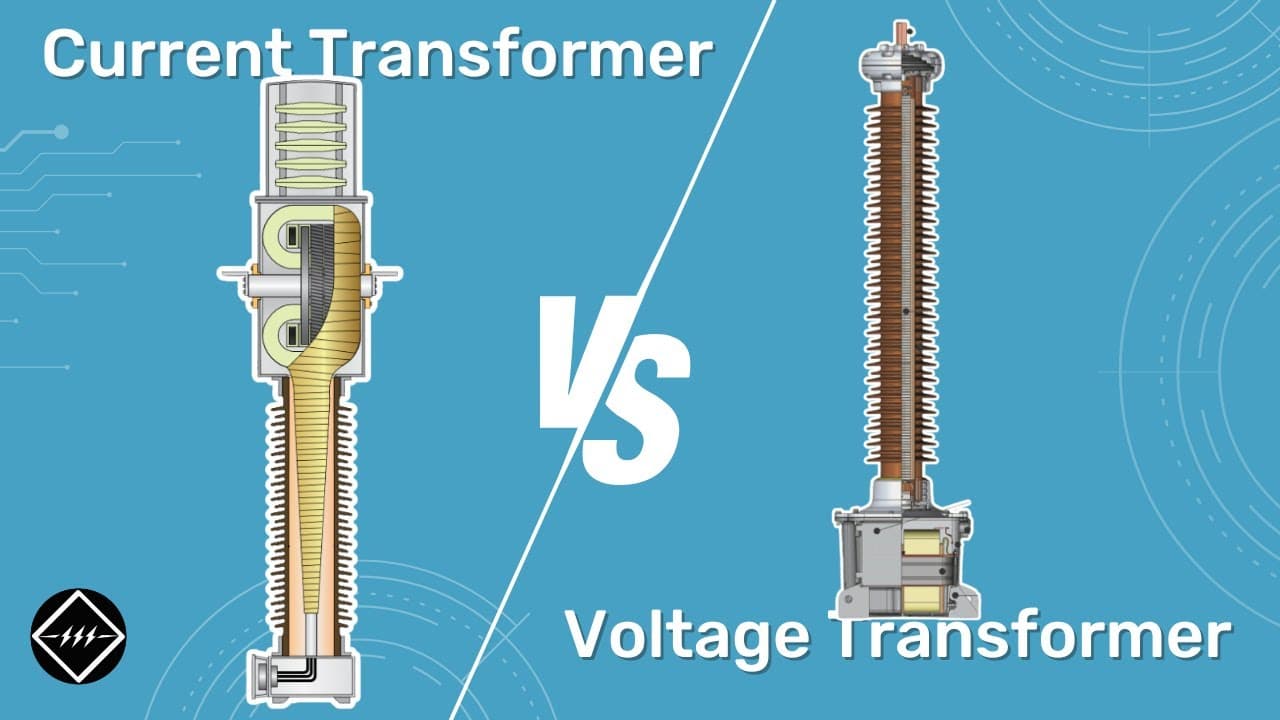
Comparison of current and voltage transformers using six key parameters.
Transcript
current and voltage Transformer are the two types of instrument Transformer which plays a very important role in power system and in today's video we are going to have a comparison between voltage and current Transformer with the help of these six important parameters the video is really going to be an interesting one so make sure you watch... Read More
Key Insights
- Current transformers (CT) and voltage transformers (VT) are essential in power systems for measuring current and voltage, respectively, and are used for both metering and protection purposes.
- CTs step down high currents to manageable levels for metering and protection, while VTs reduce high voltages for similar applications.
- CTs lack a dedicated primary winding, using the conductor itself as the primary, whereas VTs have dedicated primary and secondary windings.
- CTs are connected in series with the system, while VTs are connected phase to earth, allowing for easy identification based on connection type.
- The primary current in CTs is independent of the secondary circuit, while in VTs, the primary is affected by changes in the secondary circuit.
- CTs and VTs have different accuracy classes for metering and protection, with CTs having classes like PS, 5p, 10p, and VTs having 3p, 6p for protection.
- The construction of CTs is typically simpler with limited turns, while VTs may have variations like capacitive voltage transformers (CVT) for high voltage applications.
- Understanding the differences in construction, connection, and operation helps in identifying and applying CTs and VTs effectively in electrical systems.
Install to Summarize YouTube Videos and Get Transcripts
Explore YouTube Video Summarizer or Get YouTube Transcript Extractor
Questions & Answers
Q: What is the primary purpose of a current transformer?
The primary purpose of a current transformer (CT) is to step down high currents to a lower, manageable level for measurement and protection purposes. This allows for accurate metering and monitoring of current in power systems, ensuring that the current is within safe and operational limits.
Q: How do current transformers differ from voltage transformers in construction?
Current transformers differ from voltage transformers in that they typically do not have a dedicated primary winding; instead, the conductor itself acts as the primary. In contrast, voltage transformers have dedicated primary and secondary windings. CTs often have simpler construction with limited turns, whereas VTs may include variations like capacitive voltage transformers for specific applications.
Q: How are current transformers connected in a power system?
Current transformers are connected in series with the power system. This means they are placed directly in line with the conductor whose current is to be measured. This series connection is crucial because it allows the CT to accurately measure the current flowing through the conductor, which is vital for both metering and protection purposes.
Q: What is the effect of secondary circuit changes on the primary current in voltage transformers?
In voltage transformers, changes in the secondary circuit can affect the primary current. This dependency means that any load or circuit alterations on the secondary side can influence the primary operation, which is different from current transformers where the primary current is independent of the secondary circuit.
Q: What are the accuracy classes for current transformers?
Current transformers have different accuracy classes for protection and metering, as defined by IEC standards. For protection, the classes include PS, 5p, and 10p, while for metering, they include 0.2s, 0.2, 0.5, and 1. The 0.2s class is considered the most accurate for metering purposes.
Q: How can you identify a current transformer without looking at its nameplate?
A current transformer can be identified by its series connection in the system. It will have dedicated incoming and outgoing connections, indicating that it is measuring the current flowing through a conductor. This series configuration is a distinguishing feature of current transformers compared to voltage transformers.
Q: What is a capacitive voltage transformer and where is it used?
A capacitive voltage transformer (CVT) is a type of voltage transformer that uses capacitors to divide the voltage for measurement. It is commonly used in high and extra-high voltage substations. CVTs also facilitate power line carrier communication through wave traps, making them suitable for complex electrical systems.
Q: Why is it important not to leave the secondary of a current transformer open-circuited?
It is important not to leave the secondary of a current transformer open-circuited because the primary current is independent of the secondary circuit. An open secondary can cause dangerously high voltages to develop, potentially damaging the transformer and posing safety hazards. Proper secondary circuit management ensures safe and effective operation.
Summary & Key Takeaways
-
Current transformers (CTs) and voltage transformers (VTs) are crucial in power systems for measuring current and voltage. CTs step down high currents, while VTs reduce high voltages, both serving metering and protection purposes.
-
CTs lack dedicated primary windings, using conductors as primaries, and are connected in series. VTs have dedicated windings and connect phase to earth, aiding in easy identification.
-
CTs have independent primary current, while VTs' primary is affected by secondary changes. Both transformers have specific accuracy classes for metering and protection, crucial for system applications.
Read in Other Languages (beta)
Share This Summary 📚
Summarize YouTube Videos and Get Video Transcripts with 1-Click
Try YouTube Summary with ChatGPT & Claude or YouTube Transcript Generator
Explore More Summaries from Gaurav J - TheElectricalGuy 📚


Summarize YouTube Videos and Get Video Transcripts with 1-Click
Try YouTube Summary with ChatGPT & Claude or YouTube Transcript Generator