How Do You Break the Sound Barrier in an F-16?
TL;DR
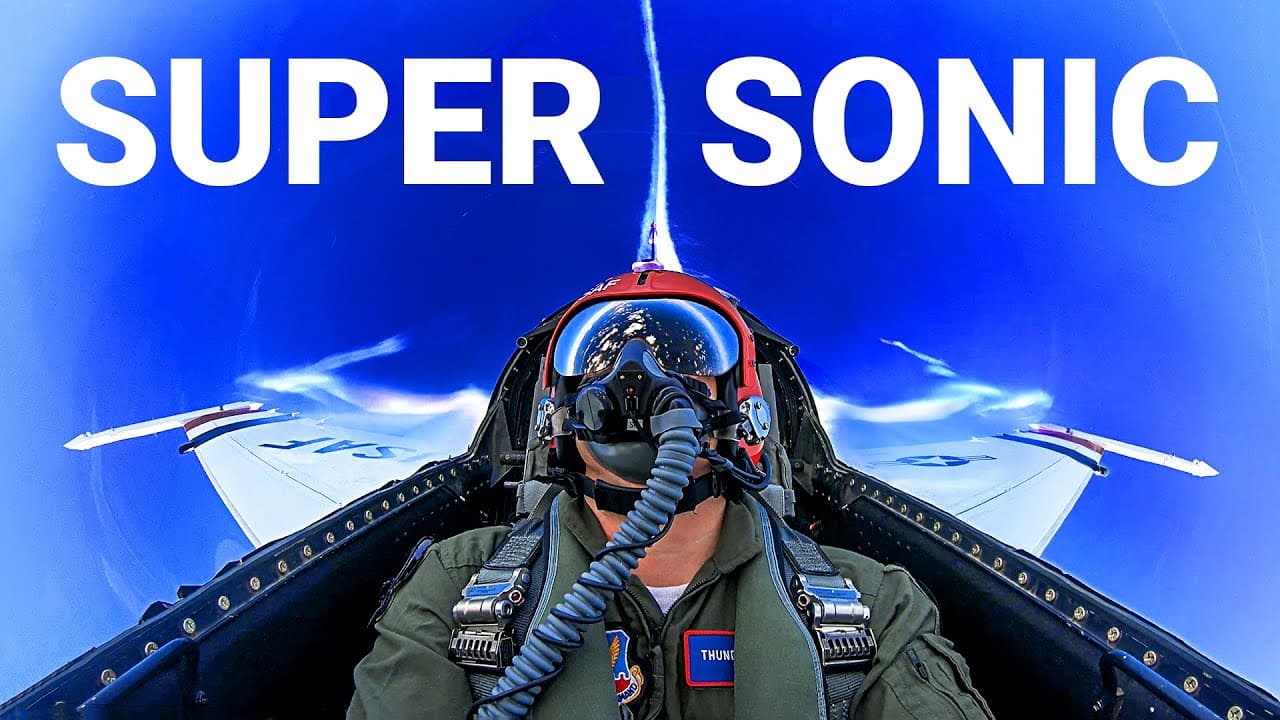
To break the sound barrier in an F-16, pilots must reach a critical airspeed and utilize afterburners. During the experience, Destin achieved supersonic flight at 1.02 Mach without realizing it initially, as there were no significant sensations aside from gauge changes, highlighting the complexities of supersonic aerodynamics.
Transcript
DESTIN: Hey, it's me, Destin. Welcome back to Smarter Every Day. Today, we're going to hang out with the Thunderbirds of the US Air Force. We're going to see if we can break the sound barrier. The temptation, when you're making a video about yourself flying in an F-16, is to use the power of editing to make yourself look as awesome as possible. Do ... Read More
Key Insights
- 😤 The Thunderbirds are a highly skilled aerial maneuver team of the US Air Force, showcasing precision maneuvers and the capabilities of high-performance aircraft.
- 💥 Supersonic flight over land is restricted due to sonic booms, but Destin had the opportunity to break the sound barrier over approved airspace.
- ✋ The F-16 airframe is incredibly maneuverable, with the human body being the limiting factor in performing high G-force maneuvers.
- 👻 The Prandtl-Glauert Singularity is a theoretical concept that does not occur in practice, allowing aircraft to break the sound barrier.
- 🧪 Pitot tubes measure airspeed by comparing stagnation pressure and static pressure, while shockwaves and altitude changes affect instrument readings.
- 🧑✈️ Flying with the Thunderbirds requires a balance of confidence and humility, as pilots undergo rigorous training to handle extreme maneuvers.
Install to Summarize YouTube Videos and Get Transcripts
Explore YouTube Video Summarizer or Get YouTube Transcript Extractor
Questions & Answers
Q: How do Pitot tubes measure airspeed in aircraft?
Pitot tubes measure airspeed by using the stagnation pressure of air molecules as they ram inside a small hole in the tube. This pressure is then compared to the static pressure to calculate airspeed.
Q: What is the Prandtl-Glauert Singularity?
The Prandtl-Glauert Singularity is a theoretical concept that suggests aircraft would experience infinite air pressures as they approach the speed of sound (Mach 1). However, in reality, this singularity does not occur.
Q: How does flying faster than the speed of sound create shockwaves?
When an object moves faster than the speed of sound, a shockwave is created. The pressure on the front of the shockwave is higher, while the pressure behind the shockwave is lower. Instruments can register these pressure changes.
Q: How does the human vestibular system handle high G-forces during maneuvers?
The semi-circular canals in the inner ear help the vestibular system sense rotation and acceleration. However, high G-forces can lead to disorientation, loss of vision, and difficulty in thinking due to the fluid movement within these canals.
Summary & Key Takeaways
-
Destin goes on a familiarization flight with the Thunderbirds, a precision aerial maneuver team of the US Air Force, to experience flying in an F-16 and break the sound barrier.
-
He learns about the physical effects of G-forces on the cardiovascular system, experiencing up to 7.2 G's and understanding the limitations of the human body.
-
The video explores the mechanics of supersonic flight, including Pitot tubes for measuring airspeed, the Prandtl-Glauert Singularity, and the effects of shockwaves on instruments.
Read in Other Languages (beta)
Share This Summary 📚
Summarize YouTube Videos and Get Video Transcripts with 1-Click
Try YouTube Summary with ChatGPT & Claude or YouTube Transcript Generator
Explore More Summaries from SmarterEveryDay 📚





Summarize YouTube Videos and Get Video Transcripts with 1-Click
Try YouTube Summary with ChatGPT & Claude or YouTube Transcript Generator