How Can Farmers Transition to Sustainable Practices?
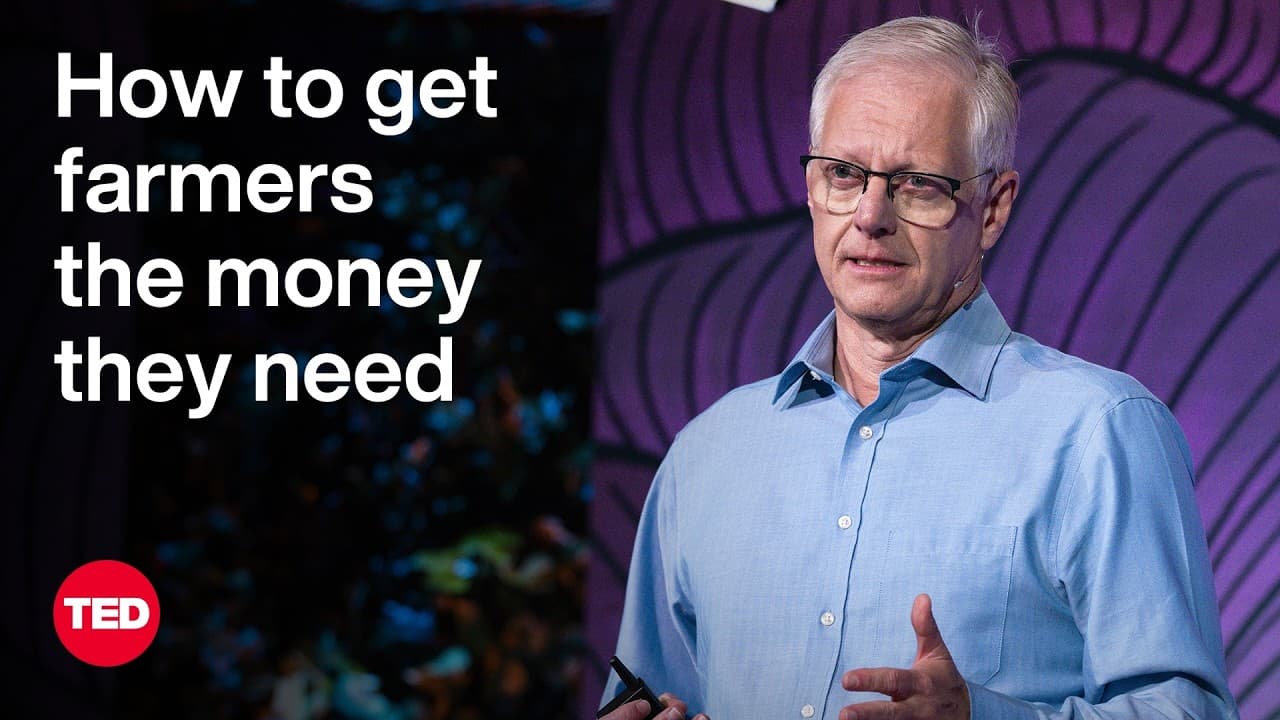
TL;DR
Farmers can transition to sustainable practices by receiving financial incentives tied to carbon and biodiversity credits. However, challenges include high upfront costs, lengthy adoption periods, and market uncertainties. Successful initiatives like Project Acorn show that with proper support, farmers can profit from eco-friendly practices while improving their financial stability.
Transcript
Well, at the farm, cash is king. It's a business. I'm a farmer myself. I raise cattle, grow corn, I bale hay. But I'm also a banker. And I've financed farmers for more than 30 years. I actually had the honor to sit at the kitchen table of large and small farmers on all continents except Antarctica -- not many farmers there. (Laughter) Well, one thi... Read More
Key Insights
- Farming is inherently risky due to unpredictable weather and market conditions, making profit margins small and sustainability investments challenging.
- Agriculture contributes significantly to greenhouse gas emissions and biodiversity loss, yet it holds potential solutions through carbon sequestration and sustainable practices.
- Transitioning to sustainable farming requires time, financial investment, and overcoming biological process variability and consumer price resistance.
- Current systems for carbon and biodiversity credits lack standard metrics, ownership clarity, and price transparency, hindering their scalability and effectiveness.
- Successful transitions involve income or risk mitigation strategies, as demonstrated by projects like Acorn, which uses satellite imaging to calculate carbon storage.
- Project Acorn has successfully issued carbon credits to smallholder farmers, reaching over 310,000 farmers and generating substantial income from carbon sales.
- The future of farming envisions a dual-income model where farmers earn from both produce and eco services, facilitated by improved trading systems for carbon credits.
- Standardizing carbon and biodiversity credits is essential for creating a viable market, similar to the evolution of commodities and stock exchanges.
Install to Summarize YouTube Videos and Get Transcripts
Explore YouTube Video Summarizer or Get YouTube Transcript Extractor
Questions & Answers
Q: What are the main challenges farmers face in transitioning to sustainable practices?
Farmers face several challenges in transitioning to sustainable practices, including the high costs of new equipment and labor, the time required for biological processes to take effect, and the variability of these processes due to weather conditions. Additionally, there is a lack of consumer willingness to pay higher prices for sustainable products, making it financially risky for farmers to invest in eco-friendly methods without guaranteed returns.
Q: How does agriculture contribute to greenhouse gas emissions?
Agriculture contributes to over 20% of global greenhouse gas emissions through various activities, including deforestation, the use of chemical fertilizers, emissions from livestock, and the operation of machinery like tractors. These activities not only release carbon dioxide but also other potent greenhouse gases such as methane and nitrous oxide, significantly impacting the environment.
Q: What role do carbon credits play in sustainable farming?
Carbon credits serve as a financial incentive for farmers to adopt sustainable practices by compensating them for reducing or sequestering carbon emissions. These credits can be sold on international markets, providing an additional income stream for farmers who implement eco-friendly methods. However, the effectiveness of carbon credits is currently limited by a lack of standardization and transparency in the market.
Q: What is Project Acorn and how does it benefit farmers?
Project Acorn is an initiative designed to pay smallholder farmers for eco services by issuing certified carbon credits. It uses satellite imaging and mobile phone data to calculate the carbon stored on farms, which is then sold on the international market. This project has reached over 310,000 farmers, providing them with substantial income, especially in regions where farmers live on very low daily wages.
Q: Why is there a lack of scalability in current carbon credit systems?
Current carbon credit systems lack scalability due to the absence of standard metrics for measuring carbon at the farm level, unclear ownership of credits, and a lack of price transparency. Additionally, there is no standardized legal framework or minimum price benchmark, making it difficult for farmers to reliably earn and trade these credits, thus limiting their adoption and effectiveness.
Q: How can governments support the transition to sustainable farming?
Governments can support the transition to sustainable farming by establishing clear legal frameworks for carbon and biodiversity credits, setting minimum price benchmarks, and providing insurance schemes to protect farmers against environmental variability. These measures would create a more stable and predictable market for eco services, encouraging farmers to invest in sustainable practices.
Q: What future does Berry Marttin envision for farming?
Berry Marttin envisions a future where farmers are compensated not only for their agricultural produce but also for their eco services, such as carbon sequestration. This dual-income model would be supported by improved trading systems for carbon credits, allowing farmers to make financially viable decisions about their operations. In this future, sustainable farming becomes both profitable and essential for environmental stewardship.
Q: How does the variability of biological processes impact sustainable farming?
The variability of biological processes, influenced by factors such as weather, fire, and drought, makes sustainable farming unpredictable and risky. These processes take time to show results, often requiring five to ten years to improve soil quality or change livestock herds. This uncertainty deters farmers from investing in sustainable practices without assurances of financial stability or risk mitigation strategies.
Summary & Key Takeaways
-
Berry Marttin discusses the financial challenges farmers face in transitioning to sustainable practices, emphasizing the need for better systems around carbon and biodiversity credits. He highlights the potential of agriculture to mitigate climate change through carbon sequestration and improved land management.
-
Despite the environmental benefits, farmers lack financial incentives to adopt eco-friendly methods due to high costs, time requirements, and market uncertainties. Marttin proposes solutions like standardized metrics and legal frameworks to support carbon credit systems.
-
Project Acorn exemplifies a successful initiative providing income to smallholder farmers through carbon credits. Marttin envisions a future where farmers profit from both produce and eco services, facilitated by improved trading systems and government support.
Read in Other Languages (beta)
Share This Summary 📚
Summarize YouTube Videos and Get Video Transcripts with 1-Click
Try YouTube Summary with ChatGPT & Claude or YouTube Transcript Generator
Explore More Summaries from TED 📚






Summarize YouTube Videos and Get Video Transcripts with 1-Click
Try YouTube Summary with ChatGPT & Claude or YouTube Transcript Generator