What Russia's war means for the International Space Station
TL;DR
Russia's war impacts ISS collaboration, future uncertain post-2024.
Transcript
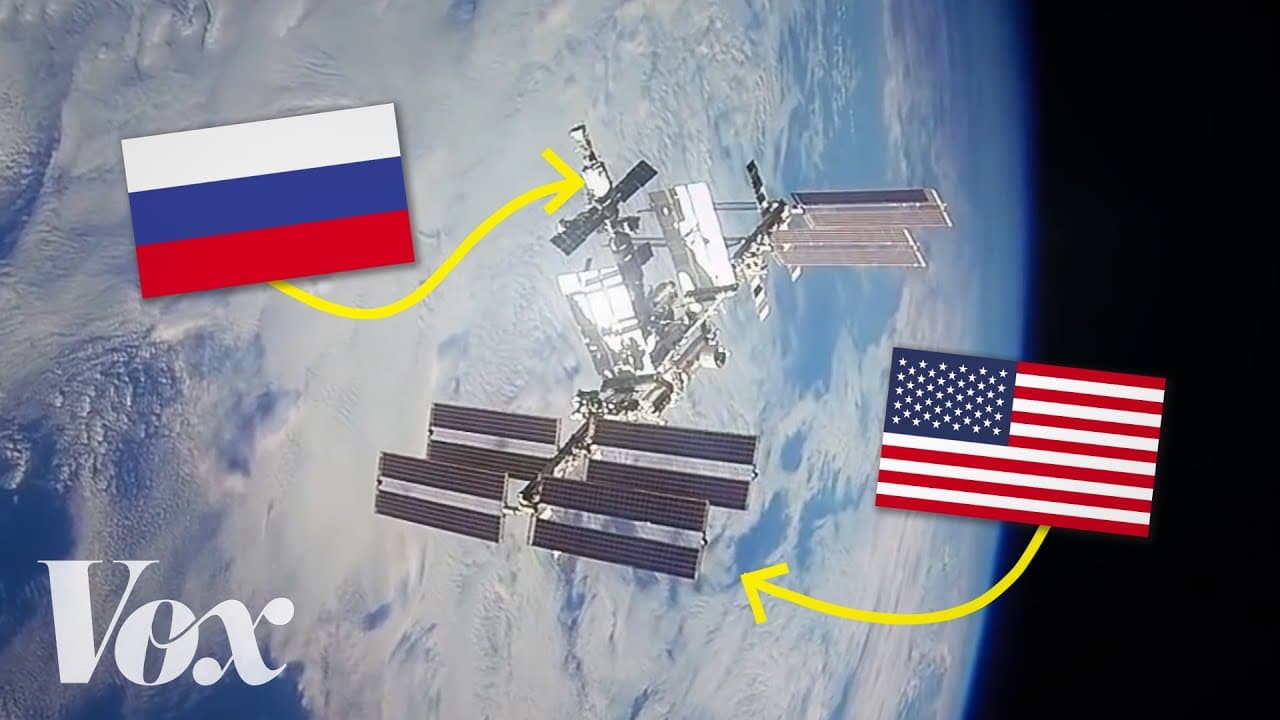
This is the International Space Station. It orbits the earth 16 times a day, 250 miles up. It’s where astronauts from more than a dozen different countries have been living since the year 2000 mostly Russians and Americans. And for the last 10 years, basically the only way anyone got up or down was in a Russian Soyuz. At least in space, countries ... Read More
Key Insights
- The International Space Station (ISS) is a collaborative effort primarily between the US and Russia, orbiting Earth since 2000, and has been largely insulated from geopolitical tensions until recently.
- The invasion of Ukraine by Russia has resulted in heightened tensions and sanctions from the US, which could impact future collaborations on the ISS.
- The ISS was originally designed to last until 2015, but its operational life has been extended multiple times, with current agreements only lasting until 2024.
- The US is looking to extend the ISS's operations until 2030, but Russia has not yet committed to this timeline, creating uncertainty about the station's future.
- Private companies like SpaceX have reduced the US's reliance on Russian Soyuz rockets for transporting astronauts, altering the dynamics of space collaboration.
- Russia and China are developing their own space stations, indicating a shift in international space cooperation dynamics, with potential new alliances forming.
- Despite geopolitical tensions, the ISS continues to function as a symbol of international cooperation, with astronauts from various countries working together in space.
- The future of international space collaboration may see new configurations, with private companies playing a more significant role and traditional partnerships evolving.
Install to Summarize YouTube Videos and Get Transcripts
Explore YouTube Video Summarizer or Get YouTube Transcript Extractor
Summary & Key Takeaways
-
The International Space Station, a symbol of US-Russia collaboration, faces an uncertain future due to geopolitical tensions following Russia's invasion of Ukraine. The station, operational since 2000, has agreements in place until 2024, but beyond that, the continuation of this partnership is unclear.
-
As the US seeks to extend the ISS's life until 2030, Russia's commitment remains uncertain. Meanwhile, private companies like SpaceX are changing the landscape of space travel, reducing reliance on Russian technology and potentially altering future collaborations.
-
With Russia and China developing their own space stations, the dynamics of international space cooperation are shifting. The ISS, while still a testament to human cooperation, may see its role and partnerships evolve as geopolitical tensions influence future collaborations.
Read in Other Languages (beta)
Share This Summary 📚
Summarize YouTube Videos and Get Video Transcripts with 1-Click
Try YouTube Summary with ChatGPT & Claude or YouTube Transcript Generator
Explore More Summaries from Vox 📚




Summarize YouTube Videos and Get Video Transcripts with 1-Click
Try YouTube Summary with ChatGPT & Claude or YouTube Transcript Generator