Products
Features
YouTube Video Summarizer
Summarize YouTube videos
Web & PDF Highlighter
Highlight web pages & PDFs
Chat with PDF
Ask any PDF questions with AI
Ask AI Clone
Chat with your highlights & memories
Audio Transcriber
Transcribe audio files to text
Glasp Reader
Read and highlight articles
Kindle Highlight Export
Export your Kindle highlights
Idea Hatch
Hatch ideas from your highlights
Integrations
Obsidian Plugin
Notion Integration
Pocket Integration
Instapaper Integration
Medium Integration
Readwise Integration
Snipd Integration
Hypothesis Integration
Apps & Extensions
Chrome Extension
Safari Extension
Edge Add-ons
Firefox Add-ons
iOS App
Android App
Discover
Discover
Ideas
Discover new ideas and insights
Articles
Curated articles and insights
Books
Book recommendations by great minds
Posts
Essays and notes from readers
Quotes
Inspiring quotes collection
Videos
Curated videos and summaries
Explore Glasp
Glasp Story
How we grew from 0 to 3 million users
Glasp Newsletter
Weekly insights and updates
Glasp Talk
Interview series with great minds
Glasp Blog
Latest news and articles
Glasp Use Cases
Learn how others use Glasp
Build & Support
Glasp API
Access Glasp's API for developers
MCP Connector
Connect Glasp to Claude & ChatGPT
Community
Glasp Reddit Community
Students
Student discount and benefits
FAQs
Frequently Asked Questions
AboutPricing
DashboardLog inSign up

How Does Avogadro's Number Relate to the Mole?
December 13, 2023
by
Khan Academy
YouTube video player
How Does Avogadro's Number Relate to the Mole?

TL;DR

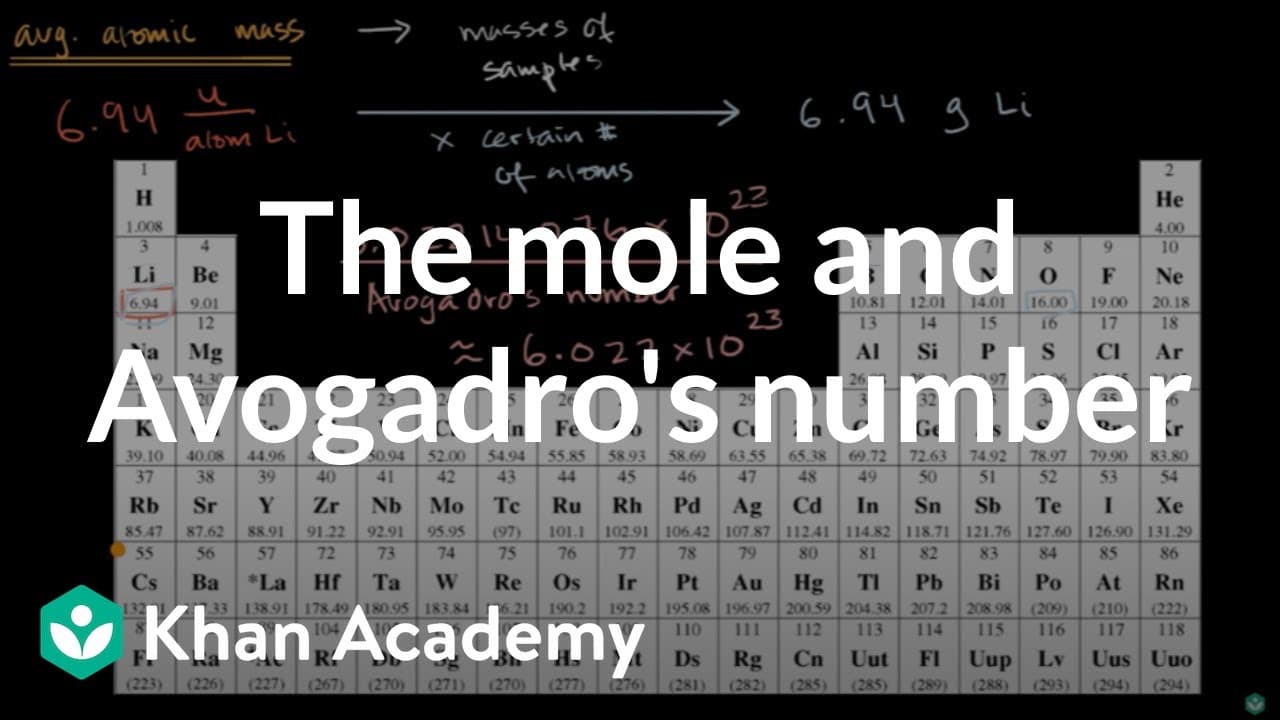
Avogadro's Number, approximately 6.022 x 10²³, connects atomic mass to grams in the lab. A mole represents this specific quantity of atoms, making it easier to transition from atomic scale calculations to practical lab measurements.

Transcript

  • [Narrator] In a previous video, we introduced ourselves to the idea of average atomic mass, which we began to realize could be a very useful way of thinking about a mass at an atomic level or at a molecular level. But what we're gonna do in this video is connect it to the masses that we might actually see in a chemistry lab. You're very unlikely ... Read More

Key Insights

  • 💆 Average atomic mass can be converted to the mass of a substance in grams using Avogadro's Number.
  • ✊ Avogadro's Number, approximately 6.022 times 10 to the 23rd power, is a useful tool in chemistry for mass conversions.
  • ✊ The concept of a mole represents a specific amount of substance and is equivalent to 6.022 times 10 to the 23rd power of particles.
  • #️⃣ Avogadro's Number and the concept of a mole allow for easy calculations involving mass and the number of atoms or molecules.
  • ⚖️ Avogadro's Number is a fundamental constant in chemistry, enabling the connection between atomic scale masses and laboratory scale masses.
  • 🫢 Avogadro's Number was named in honor of the Italian chemist Amedeo Avogadro, who made significant contributions to understanding the behavior of gases.
  • 🍉 The term "mole" is derived from its relation to the word "molecule" and signifies a specific quantity of a substance.

Install to Summarize YouTube Videos and Get Transcripts

Explore YouTube Video Summarizer or Get YouTube Transcript Extractor

Summary & Key Takeaways

  • The video explains how to connect the average atomic mass of an element to the mass of a substance in a chemistry lab.

  • Avogadro's Number, approximately 6.022 times 10 to the 23rd power, represents the number of atoms needed to have the same mass as the average atomic mass of the element in grams.

  • The concept of a mole is introduced, where a mole of an element represents 6.022 times 10 to the 23rd power of that element's atoms.


Read in Other Languages (beta)

English

Share This Summary 📚

Summarize YouTube Videos and Get Video Transcripts with 1-Click

Download browser extensions on:

Try YouTube Summary with ChatGPT & Claude or YouTube Transcript Generator

Explore More Summaries from Khan Academy 📚

Blue forehead room solution | Puzzles | Math for fun and glory | Khan Academy thumbnail
Blue forehead room solution | Puzzles | Math for fun and glory | Khan Academy
Khan Academy
What Is the Laplace Transform of sin(at)? thumbnail
What Is the Laplace Transform of sin(at)?
Khan Academy
Graphs of absolute value functions | Functions and their graphs | Algebra II | Khan Academy thumbnail
Graphs of absolute value functions | Functions and their graphs | Algebra II | Khan Academy
Khan Academy
How to Prove Sequence Convergence to Zero thumbnail
How to Prove Sequence Convergence to Zero
Khan Academy
How price controls reallocate surplus | APⓇ Microeconomics | Khan Academy thumbnail
How price controls reallocate surplus | APⓇ Microeconomics | Khan Academy
Khan Academy
Life in traffic question 5 thumbnail
Life in traffic question 5
Khan Academy

Summarize YouTube Videos and Get Video Transcripts with 1-Click

Download browser extensions on:

Try YouTube Summary with ChatGPT & Claude or YouTube Transcript Generator

Apps & Extensions

  • Chrome Extension
  • Safari Extension
  • Edge Add-ons
  • Firefox Add-ons
  • iOS App
  • Android App

Key Features

  • YouTube Video Summarizer
  • Web & PDF Summarizer
  • Web & PDF Highlighter
  • Chat with PDF
  • Ask AI Clone
  • Audio Transcriber
  • Glasp Reader
  • Kindle Highlight Export
  • Idea Hatch

Integrations

  • Obsidian Plugin
  • Notion Integration
  • Pocket Integration
  • Instapaper Integration
  • Medium Integration
  • Readwise Integration
  • Snipd Integration
  • Hypothesis Integration

More Features

  • APIs
  • MCP Connector
  • Blog & Post
  • Embed Links
  • Image Highlight
  • Personality Test
  • Quote Shots

Company

  • About us
  • Our Story
  • Blog
  • Community
  • FAQs
  • Job Board
  • Newsletter
  • Pricing
Terms

•

Privacy

•

Guidelines

© 2026 Glasp Inc. All rights reserved.