Solvent Effects on Sn1 and Sn2 Reactions
TL;DR
Sn1 reactions involve a stepwise process and require stable carbocations, while Sn2 reactions occur in one step and require strong nucleophiles. The choice of solvent is important, with polar protic solvents favoring Sn1 reactions and aprotic solvents favoring Sn2 reactions.
Transcript
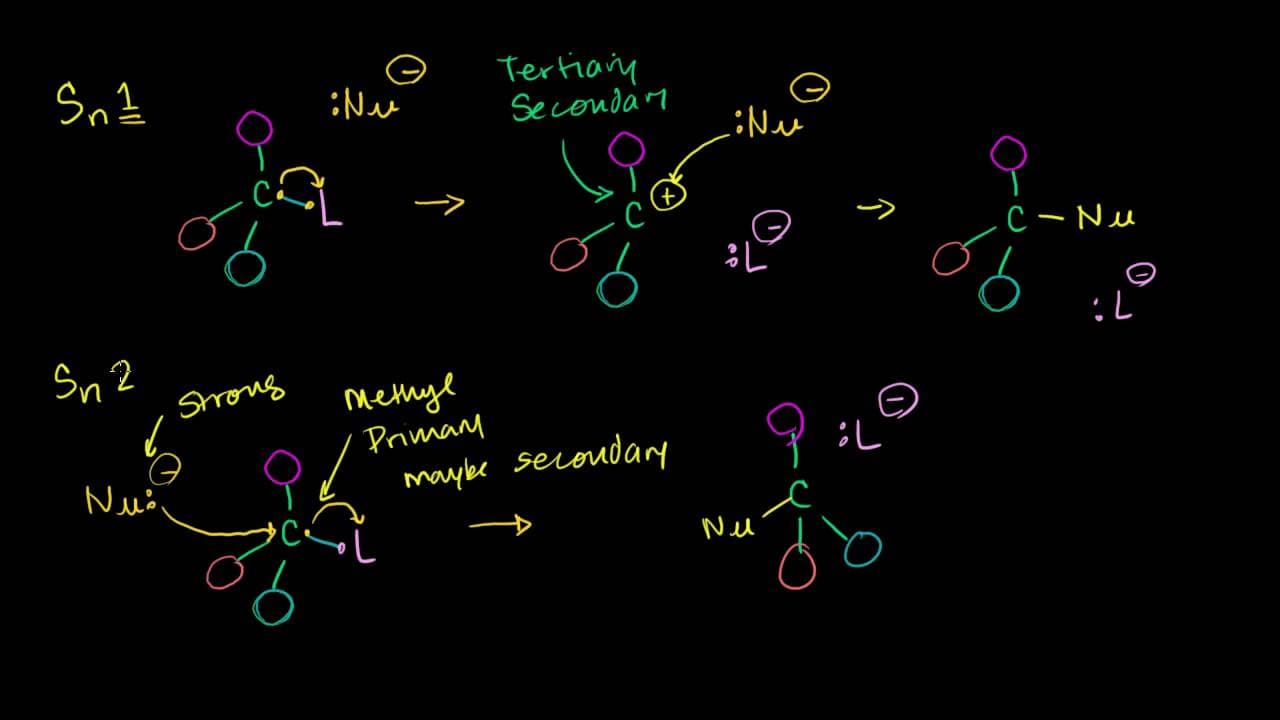
Let's talk a little bit more about the comparison between Sn1 and Sn2 reactions, and maybe we can also talk about what type of conditions make one or the other more favorable, especially the solvent. We've talked about it a little bit, but we'll go into a little bit more detail. So just as a bit of a review, an Sn1 reaction, you might have some typ... Read More
Key Insights
- 👥 Sn1 reactions involve a stepwise process with the leaving group departing first, while Sn2 reactions occur in a single step with simultaneous attack by the nucleophile and departure of the leaving group.
- 💦 Sn1 reactions require stable carbocations, specifically tertiary or secondary carbons, while Sn2 reactions work best with methyl or primary carbons.
- 🐻❄️ The choice of solvent is critical, with polar protic solvents favoring Sn1 reactions and aprotic solvents favoring Sn2 reactions.
- 🐻❄️ Polar solvents are preferred for both types of reactions due to their ability to solvate and stabilize charged species.
- 💪 Sn1 reactions are more favorable in the presence of weak nucleophiles and in polar protic solvents, while Sn2 reactions are favored by strong nucleophiles and aprotic solvents.
- 👊 Steric hindrance can hinder the nucleophile's attack in Sn2 reactions, so tertiary carbons are generally avoided in Sn2 reactions.
Install to Summarize YouTube Videos and Get Transcripts
Explore YouTube Video Summarizer or Get YouTube Transcript Extractor
Questions & Answers
Q: What is the main difference between Sn1 and Sn2 reactions?
The main difference is that Sn1 reactions occur in a stepwise process, while Sn2 reactions occur in a single step. In Sn1 reactions, the leaving group departs before the nucleophile reacts, whereas in Sn2 reactions, the nucleophile attacks the carbon simultaneously as the leaving group leaves.
Q: What factors determine whether an Sn1 or Sn2 reaction is more favorable?
The stability of the carbocation is crucial for Sn1 reactions, so tertiary or secondary carbons are ideal. For Sn2 reactions, a strong nucleophile and minimal steric hindrance are important, making methyl or primary carbons more favorable. Additionally, the choice of solvent plays a role, with polar protic solvents favoring Sn1 and aprotic solvents favoring Sn2.
Q: Why are polar solvents preferred for both Sn1 and Sn2 reactions?
Polar solvents are preferred because they can dissolve and stabilize the charged ions involved in both Sn1 and Sn2 reactions. Charged species are more soluble in polar solvents due to the ability of polar molecules to interact with other charged species.
Q: How does the choice of solvent influence the reaction mechanism?
In Sn1 reactions, the use of polar protic solvents, such as water or alcohols, helps stabilize the carbocation intermediate and facilitate the reaction. In Sn2 reactions, aprotic solvents like diethyl ether prevent the protonation of the nucleophile, allowing it to attack the carbon without competition from protons.
Summary & Key Takeaways
-
Sn1 reactions involve a stepwise process, where the nucleophile waits for the leaving group to leave before reacting with the carbocation.
-
Sn2 reactions occur in a single step, with the nucleophile attacking the carbon simultaneously as the leaving group departs.
-
Sn1 reactions require a stable carbocation, ideally with tertiary or secondary carbons, while Sn2 reactions work best with methyl or primary carbons.
-
The choice of solvent is crucial, with polar protic solvents (such as water) favoring Sn1 reactions and aprotic solvents (such as diethyl ether) favoring Sn2 reactions.
Read in Other Languages (beta)
Share This Summary 📚
Summarize YouTube Videos and Get Video Transcripts with 1-Click
Try YouTube Summary with ChatGPT & Claude or YouTube Transcript Generator
Explore More Summaries from Khan Academy 📚



Summarize YouTube Videos and Get Video Transcripts with 1-Click
Try YouTube Summary with ChatGPT & Claude or YouTube Transcript Generator