Products
Features
YouTube Video Summarizer
Summarize YouTube videos
Web & PDF Highlighter
Highlight web pages & PDFs
Chat with PDF
Ask any PDF questions with AI
Ask AI Clone
Chat with your highlights & memories
Audio Transcriber
Transcribe audio files to text
Glasp Reader
Read and highlight articles
Kindle Highlight Export
Export your Kindle highlights
Idea Hatch
Hatch ideas from your highlights
Integrations
Obsidian Plugin
Notion Integration
Pocket Integration
Instapaper Integration
Medium Integration
Readwise Integration
Snipd Integration
Hypothesis Integration
Apps & Extensions
Chrome Extension
Safari Extension
Edge Add-ons
Firefox Add-ons
iOS App
Android App
Discover
Discover
Ideas
Discover new ideas and insights
Articles
Curated articles and insights
Books
Book recommendations by great minds
Posts
Essays and notes from readers
Quotes
Inspiring quotes collection
Videos
Curated videos and summaries
Explore Glasp
Glasp Newsletter
Weekly insights and updates
Glasp Talk
Interview series with great minds
Glasp Blog
Latest news and articles
Glasp Use Cases
Learn how others use Glasp
Build & Support
Glasp API
Access Glasp's API for developers
MCP Connector
Connect Glasp to Claude & ChatGPT
Community
Glasp Reddit Community
Students
Student discount and benefits
FAQs
Frequently Asked Questions
AboutPricing
DashboardLog inSign up

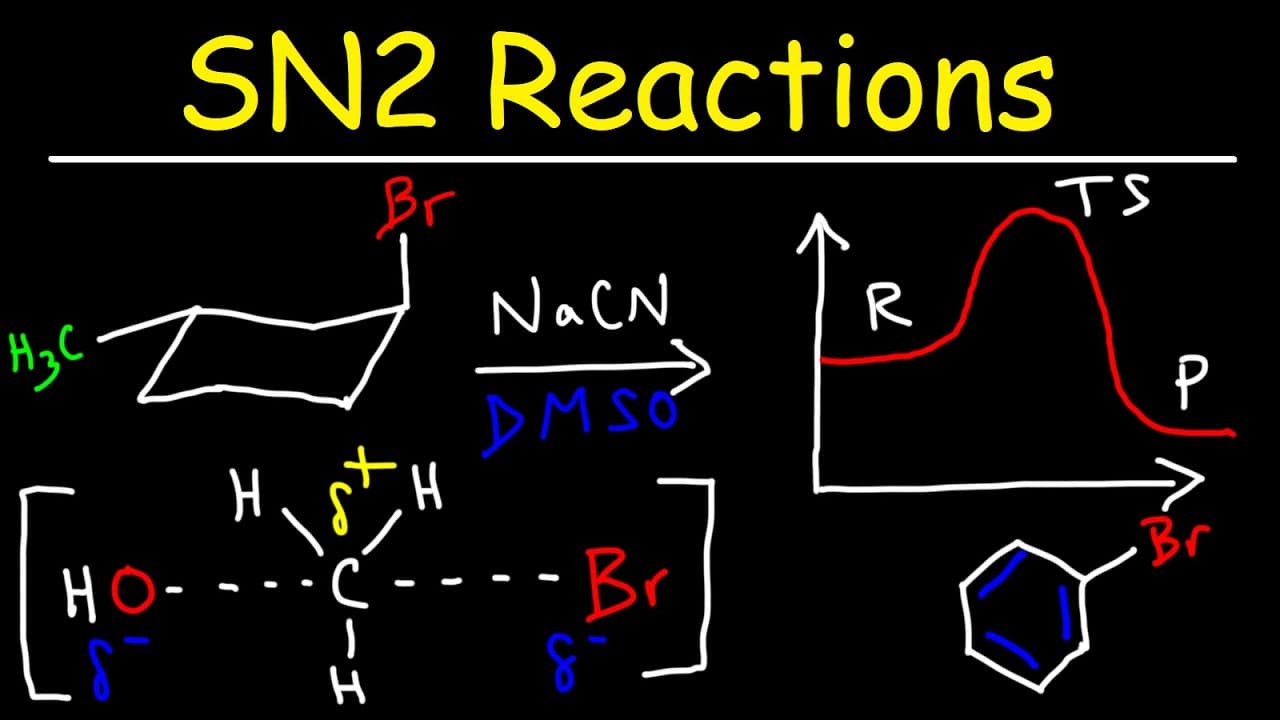
SN2 Reaction Mechanisms
February 24, 2021
by
The Organic Chemistry Tutor
YouTube video player
SN2 Reaction Mechanisms

TL;DR

SN2 reaction involves a nucleophile attacking the substrate, resulting in the expulsion of a leaving group. The reaction proceeds through a concerted mechanism, with the rate depending on the substrate and nucleophile concentration. Primary alkyl halides are the most reactive in SN2 reactions.

Transcript

in this video we're going to go over the sn2 reaction mechanism so in this reaction we have a nucleophile reacting with the substrate the nucleophile is hydroxide it has a negative charge and the substrate is the alkyl halide bromine is more electronegative than carbon so bromine bears a partial negative charge carbon bears a partial positive charg... Read More

Key Insights

  • 🥺 SN2 reactions involve a nucleophile attacking an alkyl halide, leading to the expulsion of a leaving group and formation of a product.
  • ☠️ The rate of an SN2 reaction depends on the concentration of the substrate and nucleophile, with primary alkyl halides being the most reactive.
  • ❓ Steric hindrance affects the reactivity of alkyl halides in SN2 reactions, with tertiary alkyl halides being the least reactive.
  • 🐻‍❄️ Choice of solvent, such as polar protic or polar aprotic solvents, can influence the outcome of SN2 reactions. Polar aprotic solvents enhance SN2 reactions.
  • 👻 Protonation of alcohols can convert them into good leaving groups, allowing them to undergo SN2 reactions and form alkyl halides.
  • 💨 Stronger nucleophiles react faster in SN2 reactions compared to weaker nucleophiles.

Install to Summarize YouTube Videos and Get Transcripts

Explore YouTube Video Summarizer or Get YouTube Transcript Extractor

Summary & Key Takeaways

  • The SN2 reaction mechanism involves a nucleophile attacking the partially positive carbon atom of an alkyl halide, leading to the expulsion of a leaving group and formation of a product.

  • Nucleophiles approach the carbon atom from the back due to electrostatic repulsion between the nucleophile and the electronegative halide atom.

  • SN2 reactions can occur in various solvents, and the reactivity of alkyl halides depends on their substitution, with primary alkyl halides being the most reactive.


Read in Other Languages (beta)

English

Share This Summary 📚

Summarize YouTube Videos and Get Video Transcripts with 1-Click

Download browser extensions on:

Try YouTube Summary with ChatGPT & Claude or YouTube Transcript Generator

Explore More Summaries from The Organic Chemistry Tutor 📚

Integral of tan^5(x) thumbnail
Integral of tan^5(x)
The Organic Chemistry Tutor
Molarity Dilution Problems Solution Stoichiometry Grams, Moles, Liters Volume Calculations Chemistry thumbnail
Molarity Dilution Problems Solution Stoichiometry Grams, Moles, Liters Volume Calculations Chemistry
The Organic Chemistry Tutor
Photoelectric Effect, Work Function, Threshold Frequency, Wavelength, Speed & Kinetic Energy, Electr thumbnail
Photoelectric Effect, Work Function, Threshold Frequency, Wavelength, Speed & Kinetic Energy, Electr
The Organic Chemistry Tutor
How to Solve Simple Quadratic Equations Step by Step thumbnail
How to Solve Simple Quadratic Equations Step by Step
The Organic Chemistry Tutor
How to Calculate Work and Power in Rotational Motion thumbnail
How to Calculate Work and Power in Rotational Motion
The Organic Chemistry Tutor
Integration By Parts Formula Derivation thumbnail
Integration By Parts Formula Derivation
The Organic Chemistry Tutor

Summarize YouTube Videos and Get Video Transcripts with 1-Click

Download browser extensions on:

Try YouTube Summary with ChatGPT & Claude or YouTube Transcript Generator

Apps & Extensions

  • Chrome Extension
  • Safari Extension
  • Edge Add-ons
  • Firefox Add-ons
  • iOS App
  • Android App

Key Features

  • YouTube Video Summarizer
  • Web & PDF Summarizer
  • Web & PDF Highlighter
  • Chat with PDF
  • Ask AI Clone
  • Audio Transcriber
  • Glasp Reader
  • Kindle Highlight Export
  • Idea Hatch

Integrations

  • Obsidian Plugin
  • Notion Integration
  • Pocket Integration
  • Instapaper Integration
  • Medium Integration
  • Readwise Integration
  • Snipd Integration
  • Hypothesis Integration

More Features

  • APIs
  • MCP Connector
  • Blog & Post
  • Embed Links
  • Image Highlight
  • Personality Test
  • Quote Shots

Company

  • About us
  • Blog
  • Community
  • FAQs
  • Job Board
  • Newsletter
  • Pricing
Terms

•

Privacy

•

Guidelines

© 2026 Glasp Inc. All rights reserved.