Properties of the transpose of a matrix, linear algebra tutorial
TL;DR
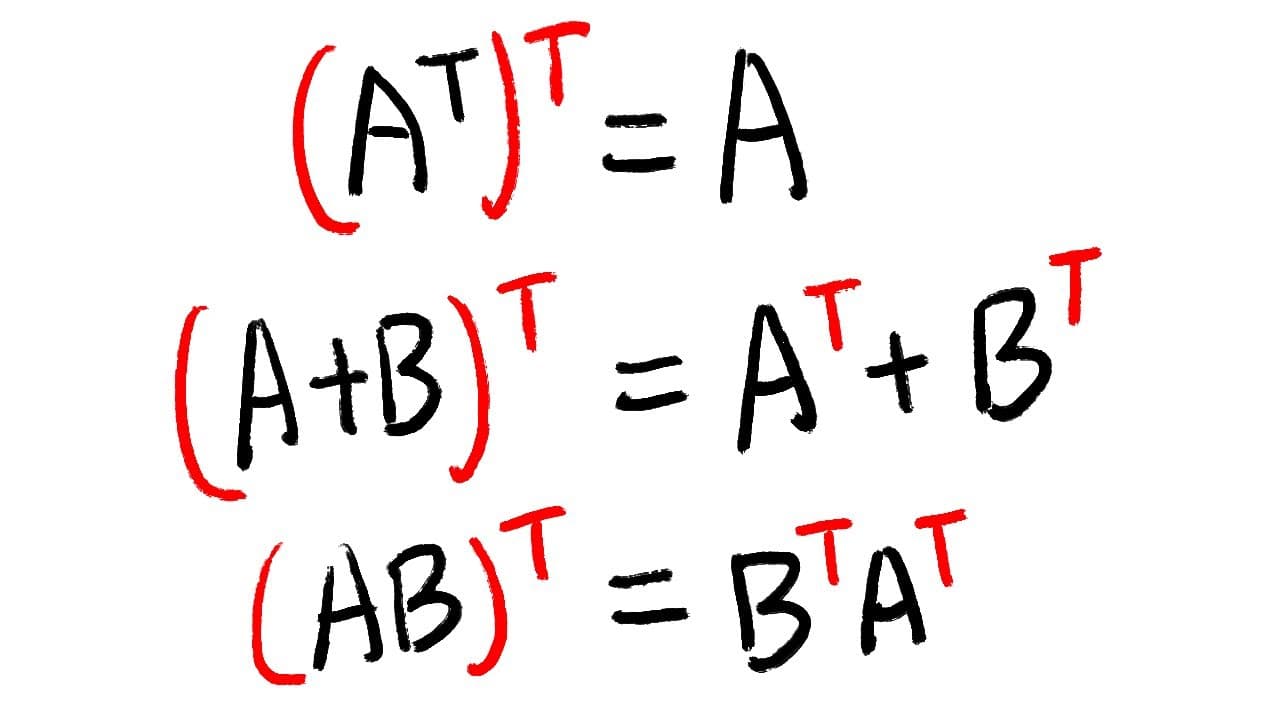
Transposing a matrix involves interchanging its rows and columns, and it has various properties that can be proven.
Transcript
hello algebra today let's talk about the transpose of a matrix and this right here is actually not so bad to do because the only thing i have to do is to interchange the rows of a matrix with columns and that's it and let me give you guys an example real quick and this right here works for any size matrix so let me say a is equal to a two by four m... Read More
Key Insights
- 🤨 The transpose of a matrix involves interchanging its rows and columns.
- ❓ Transposing a transpose results in the original matrix.
- 🪜 Adding two matrices and then transposing the sum is the same as transposing each matrix and then adding them.
- ✖️ Transposing a matrix multiplied by a constant is equivalent to multiplying the transpose by the constant.
- ✖️ Matrix multiplication does not commute with transposition.
Install to Summarize YouTube Videos and Get Transcripts
Explore YouTube Video Summarizer or Get YouTube Transcript Extractor
Summary & Key Takeaways
-
The transpose of a matrix can be obtained by interchanging its rows and columns.
-
The transpose works for any size matrix and can transform a 2x4 matrix into a 4x2 matrix, for example.
-
Notation is important in the transpose, with entries denoted as i j where i represents the row number and j represents the column number.
Read in Other Languages (beta)
Share This Summary 📚
Summarize YouTube Videos and Get Video Transcripts with 1-Click
Try YouTube Summary with ChatGPT & Claude or YouTube Transcript Generator
Explore More Summaries from blackpenredpen 📚


Summarize YouTube Videos and Get Video Transcripts with 1-Click
Try YouTube Summary with ChatGPT & Claude or YouTube Transcript Generator