Properties of the transpose of a matrix, linear algebra tutorial
TL;DR
Transposing a matrix involves interchanging its rows and columns, and it has various properties that can be proven.
Transcript
hello algebra today let's talk about the transpose of a matrix and this right here is actually not so bad to do because the only thing i have to do is to interchange the rows of a matrix with columns and that's it and let me give you guys an example real quick and this right here works for any size matrix so let me say a is equal to a two by four m... Read More
Key Insights
- 🤨 The transpose of a matrix involves interchanging its rows and columns.
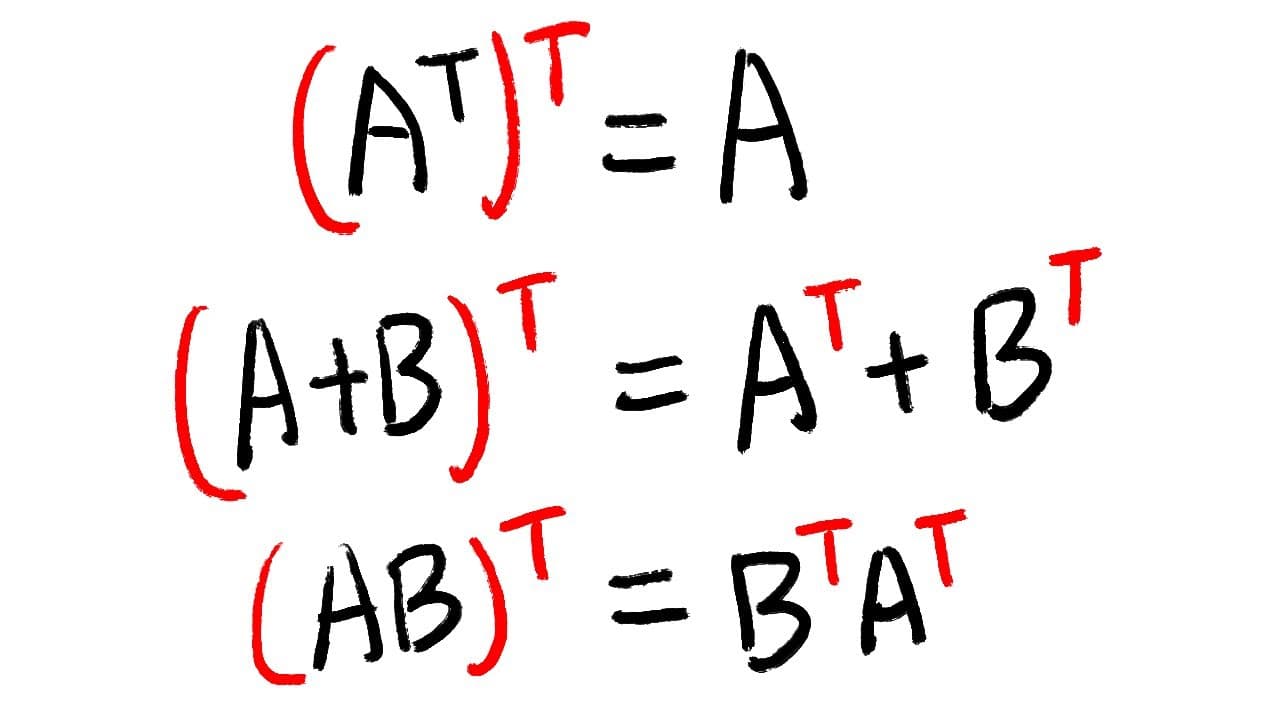
- ❓ Transposing a transpose results in the original matrix.
- 🪜 Adding two matrices and then transposing the sum is the same as transposing each matrix and then adding them.
- ✖️ Transposing a matrix multiplied by a constant is equivalent to multiplying the transpose by the constant.
- ✖️ Matrix multiplication does not commute with transposition.
Install to Summarize YouTube Videos and Get Transcripts
Explore YouTube Video Summarizer or Get YouTube Transcript Extractor
Questions & Answers
Q: What is the transpose of a matrix?
The transpose of a matrix involves interchanging its rows with columns, resulting in a new matrix.
Q: Does the transpose work for any size matrix?
Yes, the transpose works for any size matrix, whether it is square or not.
Q: What is the notation used in the transpose?
The notation for the transpose involves denoting entries as i j, where i represents the row number and j represents the column number.
Q: Are there any properties of matrix transposition?
Yes, there are several properties of matrix transposition, including the ability to transpose a transpose to obtain the original matrix.
Q: What happens when you add two matrices and then transpose the sum?
If you add two matrices together and then transpose the sum, it is equivalent to transposing each matrix first and then adding them.
Q: Is it possible to multiply a matrix by a constant and then transpose the result?
Yes, you can multiply a matrix by a constant and then transpose the result, or you can transpose the matrix first and then multiply by the constant.
Q: How does matrix multiplication interact with transposition?
Matrix multiplication does not commute with transposition, meaning that the order of transposing the matrices affects the result.
Q: Are there any properties related to determinants and transposition?
Yes, the determinant of a matrix remains the same when its transpose is taken.
Summary & Key Takeaways
-
The transpose of a matrix can be obtained by interchanging its rows and columns.
-
The transpose works for any size matrix and can transform a 2x4 matrix into a 4x2 matrix, for example.
-
Notation is important in the transpose, with entries denoted as i j where i represents the row number and j represents the column number.
Read in Other Languages (beta)
Share This Summary 📚
Summarize YouTube Videos and Get Video Transcripts with 1-Click
Try YouTube Summary with ChatGPT & Claude or YouTube Transcript Generator
Explore More Summaries from blackpenredpen 📚






Summarize YouTube Videos and Get Video Transcripts with 1-Click
Try YouTube Summary with ChatGPT & Claude or YouTube Transcript Generator