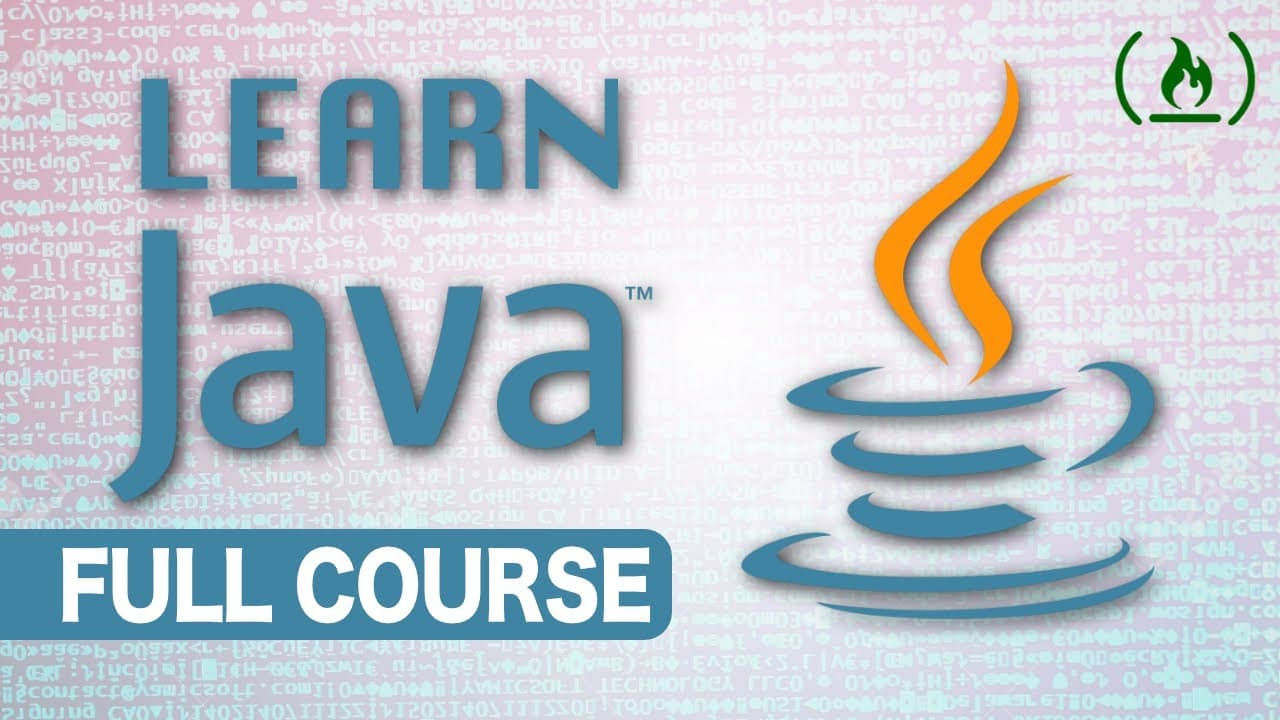
Intro to Java Programming - Course for Absolute Beginners
TL;DR
Getting started with Java begins by downloading the Eclipse IDE (64-bit is recommended for beginners), then creating a new project via File > New > Java Project and adding a class with a public static void main method. All of your code goes inside main's curly brackets, and you print to the screen with System.out.println(), ending each line with a semicolon. From there the series builds up to variables, data types, comparison operators, the scanner for user input, and if-else logic.
Transcript
Hey guys, and welcome to a brand new tutorial series. So in this series, I'm going to be teaching you Java from the beginning. So starting at the absolute basics, setting up an environment, how to create variables, methods, like all that stuff, and then move the old way up into the advanced stuff. This is a beginner tutorial series. So I'... Read More
Key Insights
- 👉 First, we download an IDE called Eclipse to write Java code. Eclipse is recommended for beginners.
- 🖥️ To start a new project in Eclipse, we need to go to File, New, and select Java project.
- 🔧 Within the project, we can create a new class by right-clicking, selecting New, and then Class.
- 💻 Inside the class, our code will be written within the main method.
- 💡 To print something to the screen in Java, we use the System.out.println() method.
- ✍️ Variables in Java must be declared with a data type and can be assigned values using the = operator.
- 🔢 Java supports different data types such as int, double, boolean, char, and string.
- ️ Operators in Java allow us to perform mathematical operations and compare values using different conditions.
Install to Summarize YouTube Videos and Get Transcripts
Explore YouTube Video Summarizer or Get YouTube Transcript Extractor
Summary & Key Takeaways
-
The tutorial series teaches Java from the beginning, starting with the absolute basics and gradually progressing to more advanced topics.
-
The content covers setting up the programming environment, creating variables of different data types (int, double, Boolean, char, and string), and using comparison operators for conditional statements.
-
The tutorial also introduces the scanner object for getting user input and demonstrates how to use if-else statements to perform different actions based on user input.
Read in Other Languages (beta)
Share This Summary 📚
Summarize YouTube Videos and Get Video Transcripts with 1-Click
Try YouTube Summary with ChatGPT & Claude or YouTube Transcript Generator
Explore More Summaries from freeCodeCamp.org 📚


Summarize YouTube Videos and Get Video Transcripts with 1-Click
Try YouTube Summary with ChatGPT & Claude or YouTube Transcript Generator