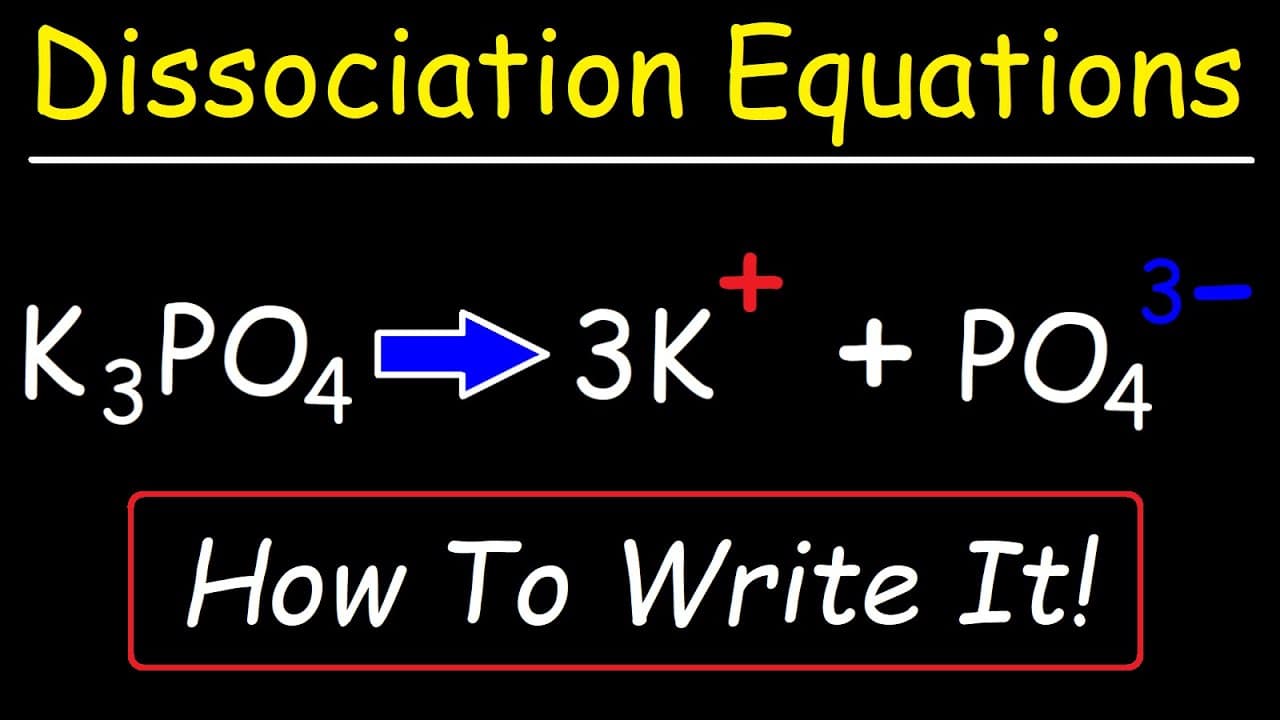
How To Write The Dissociation Equations of Ionic Compounds
TL;DR
Learn how to write dissociation equations for ionic compounds, including polyatomic ions and determining charges.
Transcript
in this video we're going to talk about how to write dissociation equations for ionic compounds so let's start with a simple example let's use sodium chloride and let's dissolve it in water now it's important to know the charges when these elements become ions so we have one sodium and one chloride ion we're going to put them in the aqueous phase a... Read More
Key Insights
- 🈂️ Group 1 metals like sodium typically have a +1 charge as ions, while halogens like chlorine have a -1 charge.
- 😑 Polyatomic ions, such as nitrate and carbonate, have specific charges that need to be considered in dissociation equations.
- 🌍 Alkaline earth metals like calcium and magnesium have a +2 charge as ions.
- 🈂️ Writing an equation and setting the net charge to zero can help determine the charge on unknown metal ions.
- 💳 The subscript in a compound indicates the number of ions present in the dissociation equation.
- 💦 Aqueous phase means the compound is dissolved in water.
Install to Summarize YouTube Videos and Get Transcripts
Explore YouTube Video Summarizer or Get YouTube Transcript Extractor
Summary & Key Takeaways
-
Sodium chloride and ammonium bromide are used as simple examples for writing dissociation equations.
-
The charges for ions can be determined based on their position in the periodic table.
-
Polyatomic ions, such as nitrate and carbonate, also need to be considered when writing dissociation equations.
Read in Other Languages (beta)
Share This Summary 📚
Summarize YouTube Videos and Get Video Transcripts with 1-Click
Try YouTube Summary with ChatGPT & Claude or YouTube Transcript Generator
Explore More Summaries from The Organic Chemistry Tutor 📚

Summarize YouTube Videos and Get Video Transcripts with 1-Click
Try YouTube Summary with ChatGPT & Claude or YouTube Transcript Generator