Products
Features
YouTube Video Summarizer
Summarize YouTube videos
Web & PDF Highlighter
Highlight web pages & PDFs
Chat with PDF
Ask any PDF questions with AI
Ask AI Clone
Chat with your highlights & memories
Audio Transcriber
Transcribe audio files to text
Glasp Reader
Read and highlight articles
Kindle Highlight Export
Export your Kindle highlights
Idea Hatch
Hatch ideas from your highlights
Integrations
Obsidian Plugin
Notion Integration
Pocket Integration
Instapaper Integration
Medium Integration
Readwise Integration
Snipd Integration
Hypothesis Integration
Apps & Extensions
Chrome Extension
Safari Extension
Edge Add-ons
Firefox Add-ons
iOS App
Android App
Discover
Discover
Ideas
Discover new ideas and insights
Articles
Curated articles and insights
Books
Book recommendations by great minds
Posts
Essays and notes from readers
Quotes
Inspiring quotes collection
Videos
Curated videos and summaries
Explore Glasp
Glasp Newsletter
Weekly insights and updates
Glasp Talk
Interview series with great minds
Glasp Blog
Latest news and articles
Glasp Use Cases
Learn how others use Glasp
Build & Support
Glasp API
Access Glasp's API for developers
MCP Connector
Connect Glasp to Claude & ChatGPT
Community
Glasp Reddit Community
Students
Student discount and benefits
FAQs
Frequently Asked Questions
AboutPricing
DashboardLog inSign up

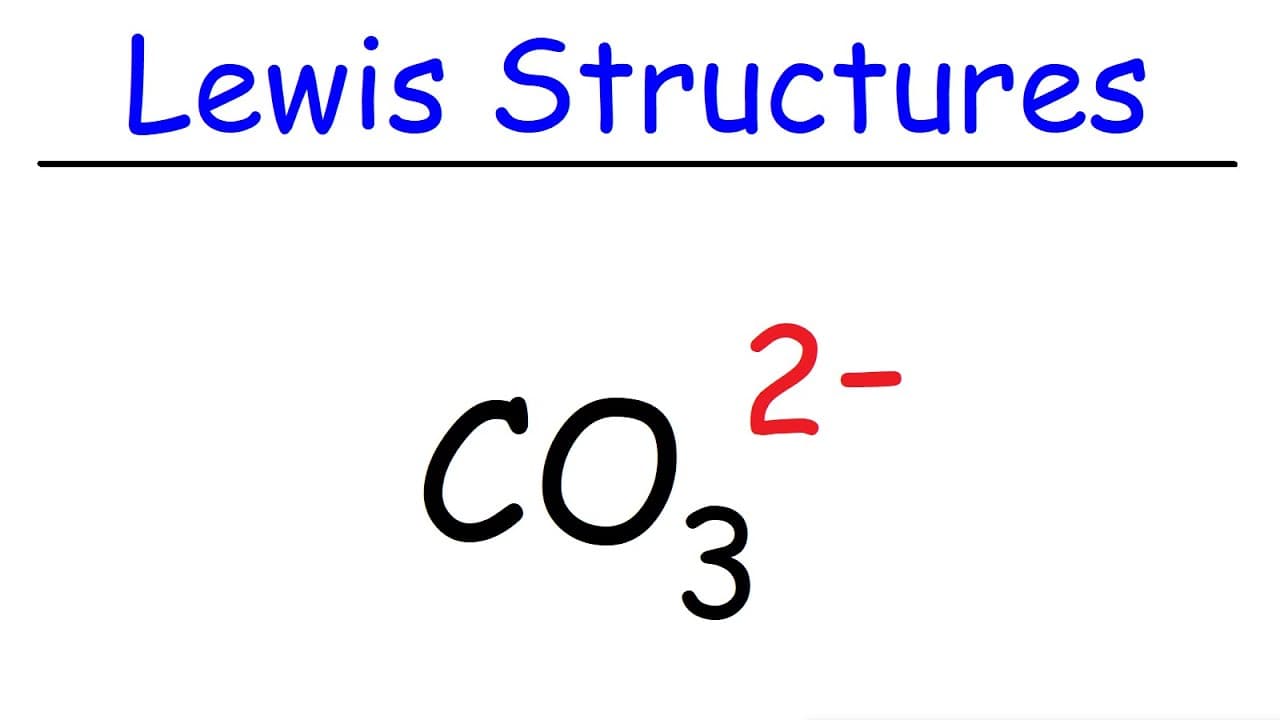
How To Draw The Lewis Structure of CO3 2- (Carbonate Ion) - Chemistry
June 27, 2020
by
The Organic Chemistry Tutor
YouTube video player
How To Draw The Lewis Structure of CO3 2- (Carbonate Ion) - Chemistry

TL;DR

This video explains how to draw the Lewis structure of the carbonate ion (CO3^2-) and discusses its molecular geometry, resonance, and hybridization.

Transcript

in this video we're going to talk about how to draw the lewis structure of co32 minus the carbonate ion so the first thing that we need to do is that we need to add up the valence electrons of this polyatomic ion carbon has four valence electrons it's found in group 4a of the periodic table oxygen is a calcagen in group 6 i mean group 6a and it has... Read More

Key Insights

  • 😑 The Lewis structure of the carbonate ion is determined by adding up the valence electrons of carbon and oxygen.
  • ‼️ The double bond in the carbonate ion can be moved among the oxygen atoms, creating resonance structures.
  • ‼️ The real structure of the carbonate ion is a resonance hybrid, with the double bond shared equally among the three oxygen atoms.
  • 😑 The molecular geometry of the carbonate ion is trigonal planar, with a bond angle of approximately 120 degrees.

Install to Summarize YouTube Videos and Get Transcripts

Explore YouTube Video Summarizer or Get YouTube Transcript Extractor

Summary & Key Takeaways

  • The valence electrons of the carbon and oxygen atoms in the carbonate ion are added up, considering the 2- overall charge of the ion.

  • Carbon in the carbonate ion forms four bonds to fulfill the octet rule, requiring one of the oxygen atoms to be double bonded to carbon.

  • The resonance structures of the carbonate ion show that the double bond is shared equally among all three oxygen atoms.


Read in Other Languages (beta)

English

Share This Summary 📚

Summarize YouTube Videos and Get Video Transcripts with 1-Click

Download browser extensions on:

Try YouTube Summary with ChatGPT & Claude or YouTube Transcript Generator

Explore More Summaries from The Organic Chemistry Tutor 📚
Distance, Displacement, Average Speed, Average Velocity - Physics thumbnail
Distance, Displacement, Average Speed, Average Velocity - Physics
The Organic Chemistry Tutor
How to Calculate Work and Power in Rotational Motion thumbnail
How to Calculate Work and Power in Rotational Motion
The Organic Chemistry Tutor
Standing Waves on a String, Fundamental Frequency, Harmonics, Overtones, Nodes, Antinodes, Physics thumbnail
Standing Waves on a String, Fundamental Frequency, Harmonics, Overtones, Nodes, Antinodes, Physics
The Organic Chemistry Tutor
Integration By Parts Formula Derivation thumbnail
Integration By Parts Formula Derivation
The Organic Chemistry Tutor
Photoelectric Effect, Work Function, Threshold Frequency, Wavelength, Speed & Kinetic Energy, Electr thumbnail
Photoelectric Effect, Work Function, Threshold Frequency, Wavelength, Speed & Kinetic Energy, Electr
The Organic Chemistry Tutor
How To Find The Amount of Excess Reactant That Is Left Over - Chemistry thumbnail
How To Find The Amount of Excess Reactant That Is Left Over - Chemistry
The Organic Chemistry Tutor

Summarize YouTube Videos and Get Video Transcripts with 1-Click

Download browser extensions on:

Try YouTube Summary with ChatGPT & Claude or YouTube Transcript Generator

Apps & Extensions

  • Chrome Extension
  • Safari Extension
  • Edge Add-ons
  • Firefox Add-ons
  • iOS App
  • Android App

Key Features

  • YouTube Video Summarizer
  • Web & PDF Summarizer
  • Web & PDF Highlighter
  • Chat with PDF
  • Ask AI Clone
  • Audio Transcriber
  • Glasp Reader
  • Kindle Highlight Export
  • Idea Hatch

Integrations

  • Obsidian Plugin
  • Notion Integration
  • Pocket Integration
  • Instapaper Integration
  • Medium Integration
  • Readwise Integration
  • Snipd Integration
  • Hypothesis Integration

More Features

  • APIs
  • MCP Connector
  • Blog & Post
  • Embed Links
  • Image Highlight
  • Personality Test
  • Quote Shots

Company

  • About us
  • Blog
  • Community
  • FAQs
  • Job Board
  • Newsletter
  • Pricing
Terms

•

Privacy

•

Guidelines

© 2026 Glasp Inc. All rights reserved.