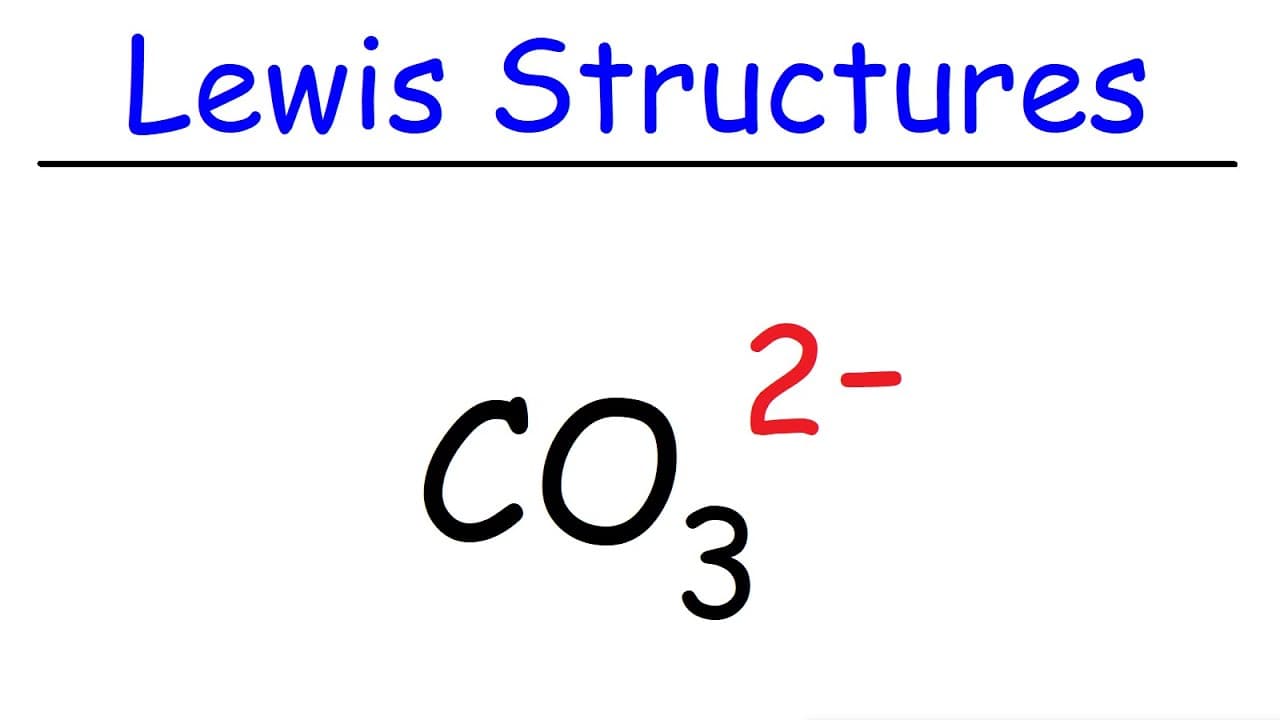
How To Draw The Lewis Structure of CO3 2- (Carbonate Ion) - Chemistry
TL;DR
This video explains how to draw the Lewis structure of the carbonate ion (CO3^2-) and discusses its molecular geometry, resonance, and hybridization.
Transcript
in this video we're going to talk about how to draw the lewis structure of co32 minus the carbonate ion so the first thing that we need to do is that we need to add up the valence electrons of this polyatomic ion carbon has four valence electrons it's found in group 4a of the periodic table oxygen is a calcagen in group 6 i mean group 6a and it has... Read More
Key Insights
- 😑 The Lewis structure of the carbonate ion is determined by adding up the valence electrons of carbon and oxygen.
- ‼️ The double bond in the carbonate ion can be moved among the oxygen atoms, creating resonance structures.
- ‼️ The real structure of the carbonate ion is a resonance hybrid, with the double bond shared equally among the three oxygen atoms.
- 😑 The molecular geometry of the carbonate ion is trigonal planar, with a bond angle of approximately 120 degrees.
Install to Summarize YouTube Videos and Get Transcripts
Explore YouTube Video Summarizer or Get YouTube Transcript Extractor
Questions & Answers
Q: How are the valence electrons of carbon and oxygen considered when drawing the Lewis structure of the carbonate ion?
The valence electrons of carbon and oxygen are added up, including two additional electrons due to the 2- charge of the carbonate ion. In this case, there are a total of 24 valence electrons.
Q: Why does carbon in the carbonate ion form four bonds and require one oxygen to be double-bonded?
Carbon in the carbonate ion wants to have eight electrons around it. Since each bond represents two electrons, carbon receives four bonds. One of the oxygen atoms needs to be double-bonded to carbon to satisfy the octet rule.
Q: What is a resonance structure, and how does it apply to the carbonate ion?
A resonance structure is a representation of a molecule or ion where one or more electrons can be delocalized or move among different atoms. In the case of the carbonate ion, the double bond can be moved among the three oxygen atoms, creating different resonance structures.
Q: What is the molecular geometry of the carbonate ion?
The carbonate ion has a trigonal planar molecular geometry, meaning that the three oxygen atoms and the central carbon atom all lie in the same plane.
Summary & Key Takeaways
-
The valence electrons of the carbon and oxygen atoms in the carbonate ion are added up, considering the 2- overall charge of the ion.
-
Carbon in the carbonate ion forms four bonds to fulfill the octet rule, requiring one of the oxygen atoms to be double bonded to carbon.
-
The resonance structures of the carbonate ion show that the double bond is shared equally among all three oxygen atoms.
Read in Other Languages (beta)
Share This Summary 📚
Summarize YouTube Videos and Get Video Transcripts with 1-Click
Try YouTube Summary with ChatGPT & Claude or YouTube Transcript Generator
Explore More Summaries from The Organic Chemistry Tutor 📚






Summarize YouTube Videos and Get Video Transcripts with 1-Click
Try YouTube Summary with ChatGPT & Claude or YouTube Transcript Generator