What Is the Hall Effect and How Is It Calculated?
TL;DR
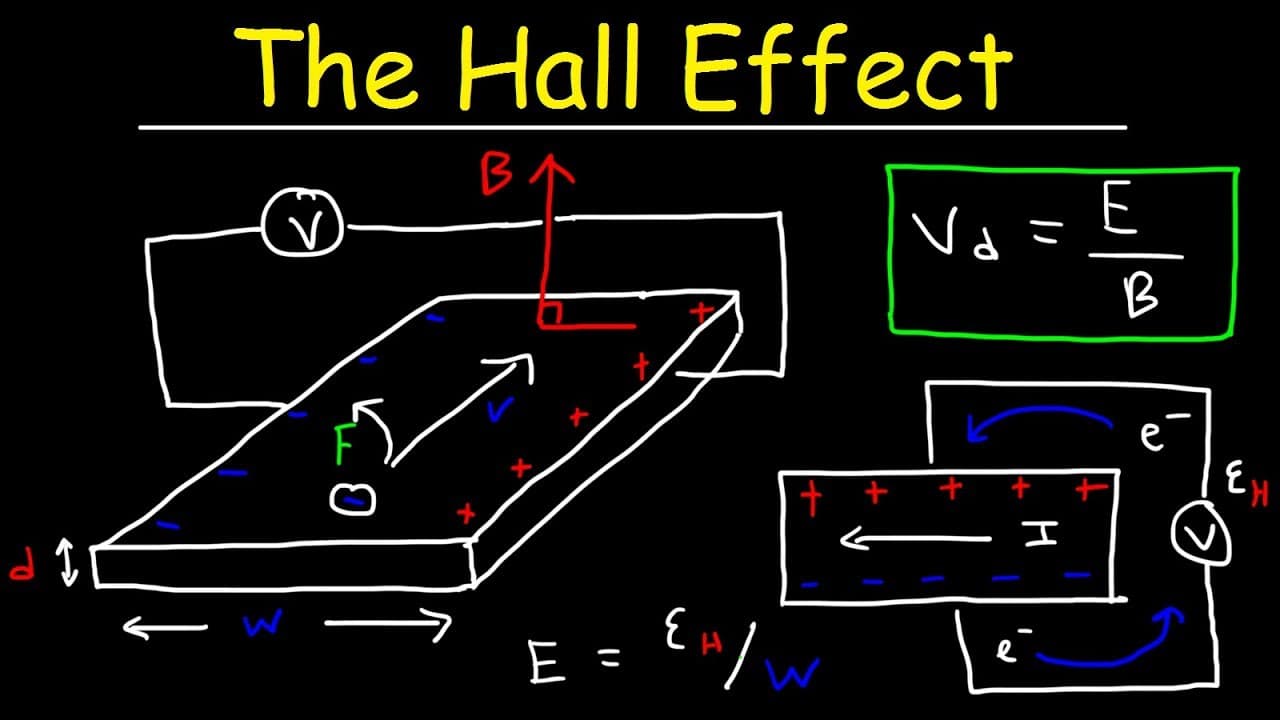
The Hall Effect occurs when a current flows through a conductor in a magnetic field, generating a voltage called Hall emf. This effect allows for the calculation of the electric field, drift velocity of electrons, charge density, and the magnetic field strength within the conductor using specific formulas related to current and geometry.
Transcript
a conductor that is five centimeters wide and one centimeter tall has a current of 30 amps flowing through it a magnetic field of 15 tesla is directed into the page and the hall emf of 1.2 microvolts is produced calculate the electric field in this conductor that is perpendicular to the current so let's start with a picture so we have an electron a... Read More
Key Insights
- 🏑 The Hall Effect describes the relationship between current, magnetic field, and electric field in a conductor.
- 🫱 The right hand rule can be used to determine the direction of the electric field in the conductor.
- 🏑 The electric field in the conductor can be calculated using the Hall emf and the width of the conductor.
- 🔌 The drift velocity of electrons can be determined by balancing the electric and magnetic forces on the electrons.
- 🈶 The charge density of free electrons in the conductor can be calculated using the current, drift velocity, and cross-sectional area of the conductor.
- 🧭 The magnitude of the magnetic field passing through a conductor can be determined using the Hall emf, charge density, thickness of the conductor, and current.
- 🧭 The Hall Effect can be used to measure the magnetic field passing through a conductor by measuring the Hall emf and knowing the charge density and current.
Install to Summarize YouTube Videos and Get Transcripts
Explore YouTube Video Summarizer or Get YouTube Transcript Extractor
Summary & Key Takeaways
-
The Hall Effect occurs when a current flows through a conductor in the presence of a magnetic field, resulting in a voltage called the Hall emf.
-
By applying the right hand rule and considering the movement of electrons, the direction of the electric field in the conductor can be determined.
-
The electric field can be calculated using the Hall emf and the width of the conductor.
-
The drift velocity of electrons in the conductor can be determined by balancing the electric and magnetic forces.
-
The charge density of free electrons in the conductor can be calculated using the current, drift velocity, and the cross-sectional area of the conductor.
-
The magnitude of the magnetic field passing through a conductor can be calculated using the Hall emf, charge density, thickness, and current.
Read in Other Languages (beta)
Share This Summary 📚
Summarize YouTube Videos and Get Video Transcripts with 1-Click
Try YouTube Summary with ChatGPT & Claude or YouTube Transcript Generator
Explore More Summaries from The Organic Chemistry Tutor 📚




Summarize YouTube Videos and Get Video Transcripts with 1-Click
Try YouTube Summary with ChatGPT & Claude or YouTube Transcript Generator