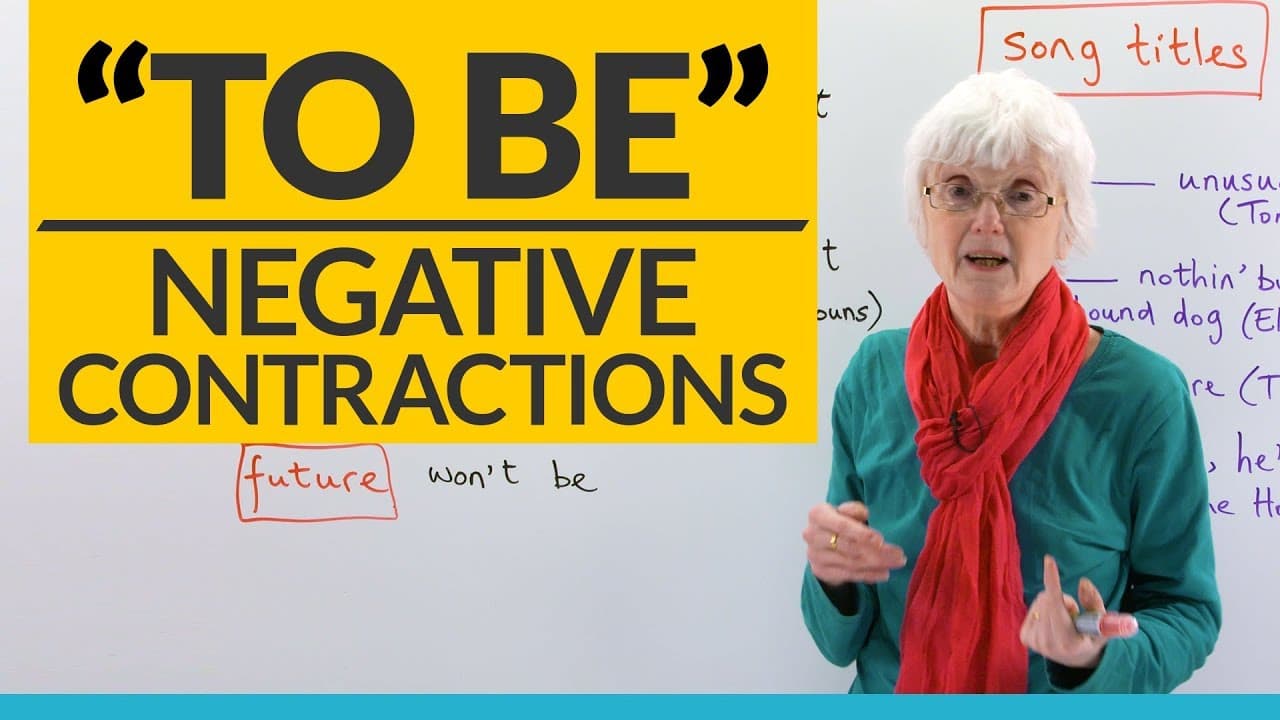
English Grammar: Negative contractions of the verb "TO BE"
TL;DR
Learn about negative contractions in English, including examples and non-standard forms like "ain't."
Transcript
Hello. I'm Gill at engVid, and today's lesson is on negative contractions or abbreviations, so this is something you will hear a lot when people speak because people use these abbreviations or contractions all the time, in informal speech especially because it's quicker. Okay? So we're looking at some contractions using the negative because the way... Read More
Key Insights
- 😯 Negative contractions are commonly used in informal speech to make speaking quicker.
- 💁 Different persons in English have different contracted forms for negative statements.
- 😯 "Ain't" is a non-standard contraction often used in the UK and in informal speech.
- 💁 The verb "to be" has different contracted forms for different tenses, including the present, past, and future.
- 🔔 Non-standard contractions like "ain't" should be used sparingly as they sound casual and informal.
- 🥰 Negative contractions are widely used and may be heard in various forms of media.
- ❎ Quiz yourself on negative contractions by visiting www.engvid.com.
Install to Summarize YouTube Videos and Get Transcripts
Explore YouTube Video Summarizer or Get YouTube Transcript Extractor
Summary & Key Takeaways
-
Negative contractions are commonly used in informal speech to make speaking quicker.
-
The verb "to be" has different contracted forms for negative statements in different persons.
-
Non-standard contraction "ain't" is often used in informal speech, especially in the UK.
Read in Other Languages (beta)
Share This Summary 📚
Summarize YouTube Videos and Get Video Transcripts with 1-Click
Try YouTube Summary with ChatGPT & Claude or YouTube Transcript Generator
Explore More Summaries from Learn English with Gill · engVid 📚




Summarize YouTube Videos and Get Video Transcripts with 1-Click
Try YouTube Summary with ChatGPT & Claude or YouTube Transcript Generator