What Is Corollary 3 of Euler's Theorem and Its Proof?
TL;DR
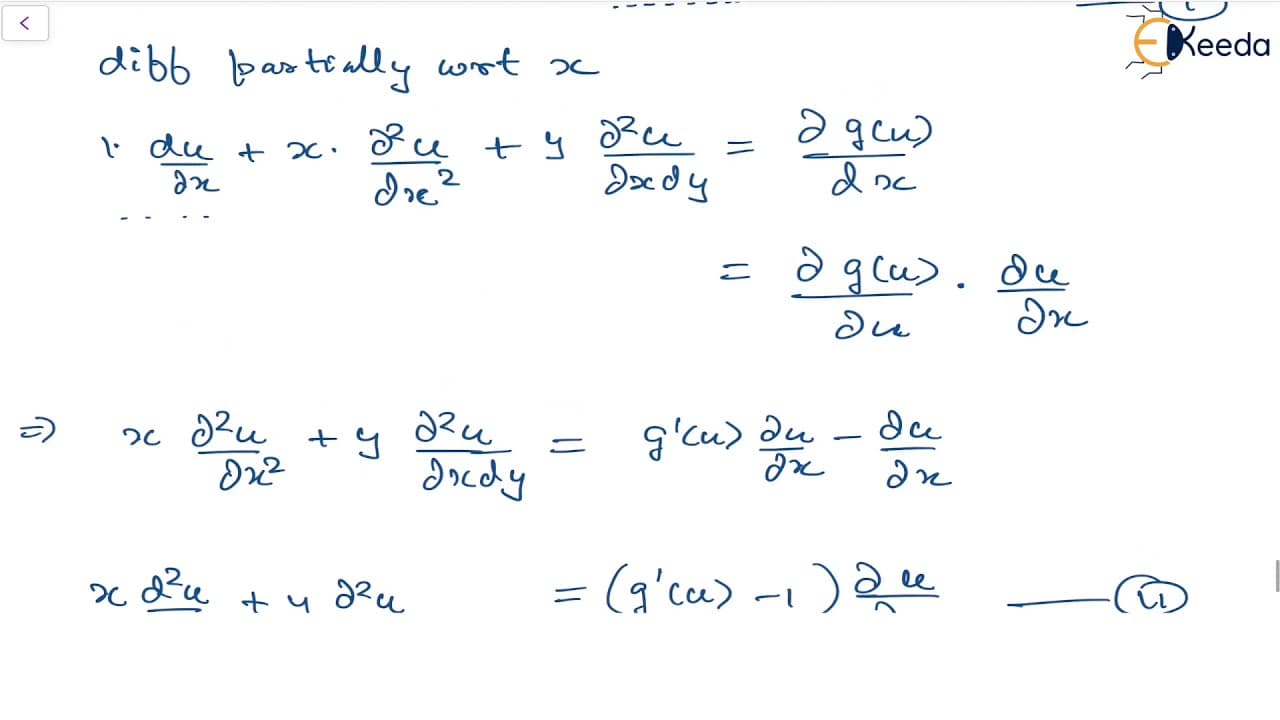
Corollary 3 of Euler's Theorem establishes that if a function u in x and y has degree n and a function z based on u is homogeneous of degree n, then the equation involving partial derivatives holds. The proof involves differentiating two key equations and simplifying the results, leading to a relationship between second derivatives of u with respect to x and y.
Transcript
hello in this session we'll see corollary 3 of euler's theorem its formula and proof so let's say if there is a function u in x and y with degree n where u may not be a homogeneous function but possibly there is a function z in terms of u which is homogeneous in x and y with degree n then in that case euler's theorem says that x d z by d x plus y d... Read More
Key Insights
- ✖️ Corollary 3 of Euler's Theorem is applicable when a function u in x and y with degree n has a function z in terms of u that is homogeneous in x and y with degree n, providing a relationship between partial derivatives and the function z.
- 🫡 The proof for Corollary 3 involves differentiating two equations obtained from applying the product rule and differentiating the first equation with respect to y.
- ☺️ The result of Corollary 3 simplifies to a partial differential equation involving second derivatives of u with respect to x and y.
- 😄 Corollary 3 can be derived from Corollary 2, which focuses on functions of u that may not be homogeneous.
Install to Summarize YouTube Videos and Get Transcripts
Explore YouTube Video Summarizer or Get YouTube Transcript Extractor
Summary & Key Takeaways
-
Corollary 3 of Euler's Theorem states that if there is a function u in x and y with degree n and a function z in terms of u that is homogeneous with degree n in x and y, then a certain partial differential equation holds.
-
The proof for Corollary 3 involves differentiating two key equations, one obtained from applying the product rule and the other obtained from differentiating the first equation with respect to y.
-
Finally, combining these equations and simplifying leads to the result provided by Corollary 3 of Euler's Theorem.
Read in Other Languages (beta)
Share This Summary 📚
Summarize YouTube Videos and Get Video Transcripts with 1-Click
Try YouTube Summary with ChatGPT & Claude or YouTube Transcript Generator
Explore More Summaries from Ekeeda 📚

Summarize YouTube Videos and Get Video Transcripts with 1-Click
Try YouTube Summary with ChatGPT & Claude or YouTube Transcript Generator