What Are Mutant Plurals and How Do They Form?
TL;DR
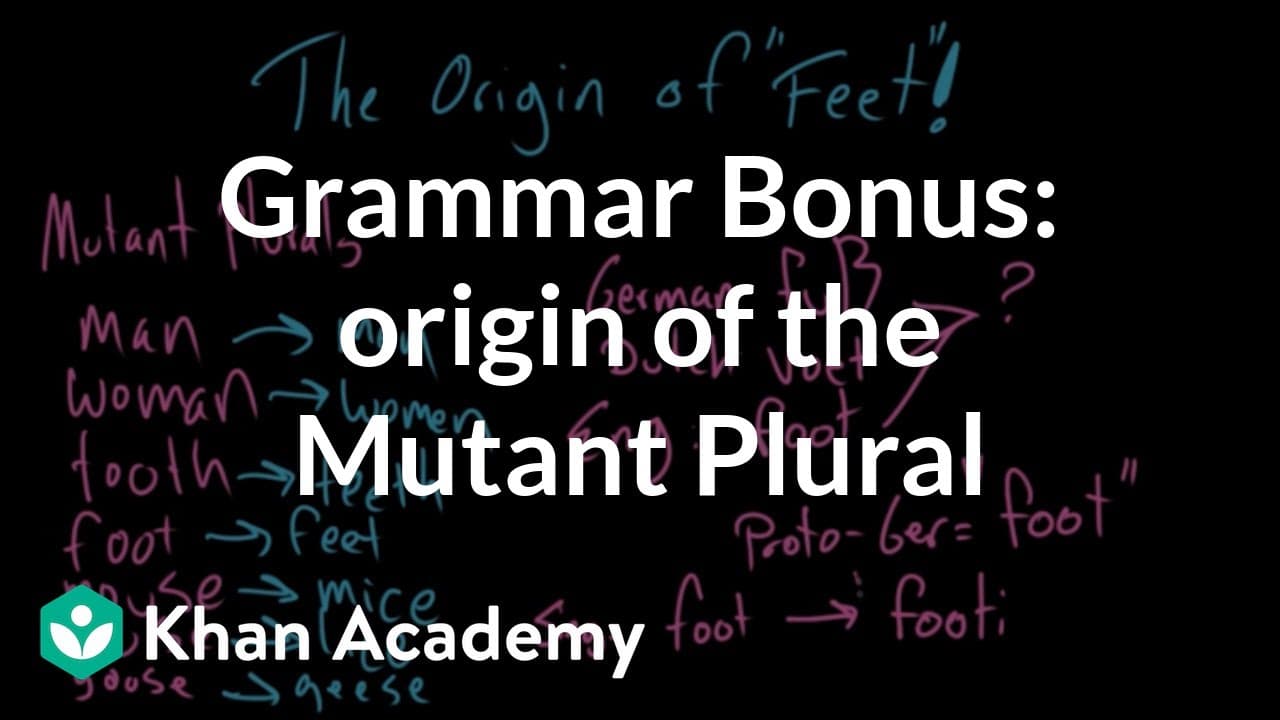
Mutant plurals in English, like man/men and tooth/teeth, change their vowel sound instead of following standard pluralization rules. These forms trace back to Proto-Germanic roots and involve historical vowel harmony, where sounds like the 'u' in foot evolved into 'ü' before transforming into modern plural forms. This illustrates the complexities of English language evolution.
Transcript
- [Voiceover] Hello, grammarians! I wanted to talk to you again about mutant plurals. So to review a mutant plural is, there are only seven of them in English, and they all change sound when they pluralize. You don't add an -s, you don't add an -en, you don't change the ending, you change the vowel, and there are only seven to go like this. There's... Read More
Key Insights
- 💅 Mutant plurals in English include man/men, tooth/teeth, and goose/geese.
- 👂 These plurals have their roots in Proto-Germanic words with a different pluralization pattern involving the addition of an -i sound.
- 👂 Vowel harmony in Germanic languages influenced the transformation of vowel sounds, resulting in the ü sound in words like foot and the ai sound in words like mouse during the Great Vowel Shift.
- 🦶 The ü sound in these plurals disappeared in English, leaving behind the modern plurals feet and mice.
- 🆘 Understanding the origins of mutant plurals helps explain the irregularities in English pluralization.
- 👂 Linguists study and analyze the changes in language sounds over time.
- 🫥 Umlaut mutation, also known as i-mutation, refers to the process where double dots over a vowel change its sound and meaning.
Install to Summarize YouTube Videos and Get Transcripts
Explore YouTube Video Summarizer or Get YouTube Transcript Extractor
Summary & Key Takeaways
-
Mutant plurals are words in English that change their vowel sound when they become plural, including man/men, tooth/teeth, and goose/geese.
-
Linguist Jake explains that these mutant plurals can be traced back to Proto-Germanic words and a historical process of vowel harmony.
-
The u sound in words like foot and mouse transformed into an ü sound before eventually disappearing in English, leading to the modern plurals feet and mice.
Read in Other Languages (beta)
Share This Summary 📚
Summarize YouTube Videos and Get Video Transcripts with 1-Click
Try YouTube Summary with ChatGPT & Claude or YouTube Transcript Generator
Explore More Summaries from Khan Academy 📚




Summarize YouTube Videos and Get Video Transcripts with 1-Click
Try YouTube Summary with ChatGPT & Claude or YouTube Transcript Generator