Is this a paradox? (the best way of resolving the painter paradox)
TL;DR
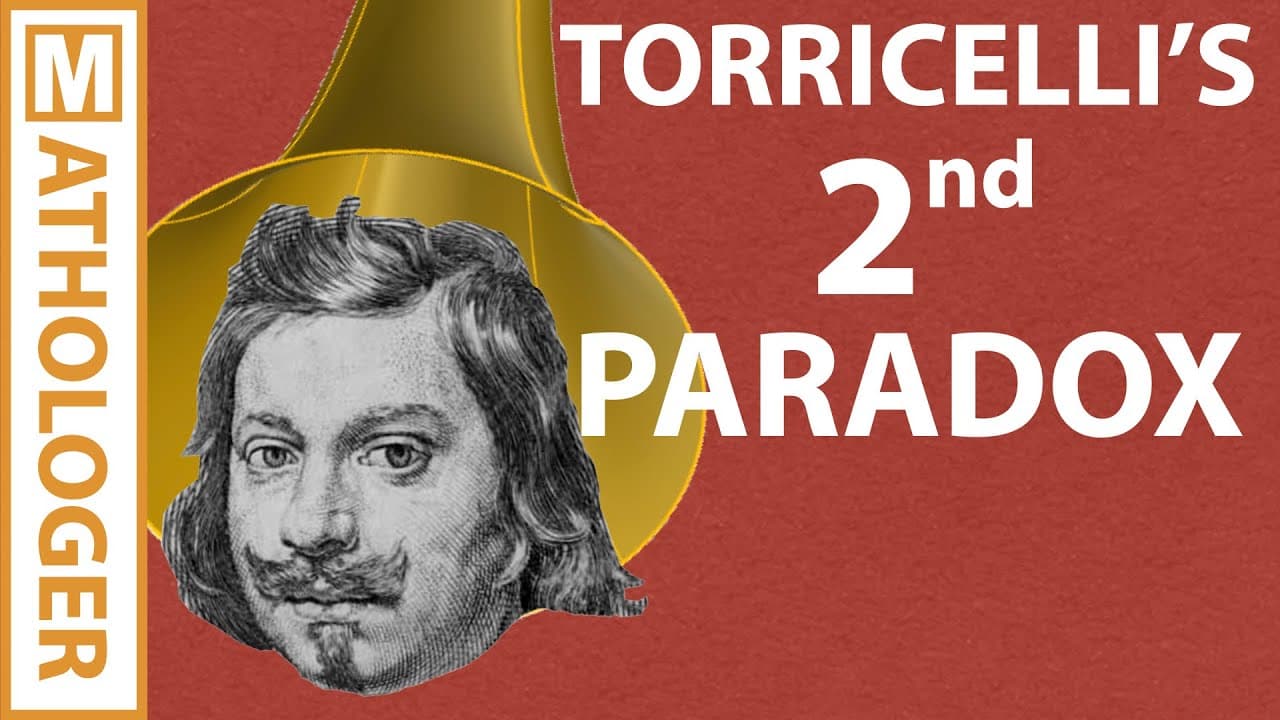
Torricelli's horn has a paradoxical property - it has a finite volume (8 liters) but an infinite surface area. This paradox can be explained without using calculus.
Transcript
Welcome to another Mathologer video. Are you familiar with this strange infinitely long horn over there. It first made the news 400 years ago and it turned its discoverer Evangilista Torricelli into a mathematical superstar. Why? Well, Torricelli's horn has a very paradoxical property. Suppose you've got 8 litres of paint. Then you can fi... Read More
Key Insights
- 😈 Torricelli's horn, a shape with a finite volume and infinite surface area, has intrigued mathematicians for centuries.
- 😈 The surface area of the horn is determined by an infinite sum, known as the harmonic series.
- 😈 The volume of the horn can be shown to be finite using a mathematical trick involving cylinders and disks.
- 😈 Understanding Torricelli's horn does not necessarily require calculus, as a simple algebraic trick can suffice.
- 😈 The existence of Torricelli's horn is purely theoretical, as it is an ideal mathematical object with zero thickness.
- 🧑🎓 Torricelli, a student of Galileo, made significant contributions to mathematics and physics, including the invention of the barometer.
Install to Summarize YouTube Videos and Get Transcripts
Explore YouTube Video Summarizer or Get YouTube Transcript Extractor
Questions & Answers
Q: How can Torricelli's horn have a finite volume but an infinite surface area?
The surface area of the horn is determined by an infinite sum, while the volume is shown to be finite using a mathematical trick involving cylinders and disks.
Q: What is the significance of the harmonic series in understanding the surface area of the horn?
The harmonic series, which describes the sum of the reciprocals of positive integers, plays a role in calculating the surface area of Torricelli's horn.
Q: How does the trick involving reciprocals of powers of 2 help determine the volume of the horn?
By using the reciprocals of powers of 2, it is possible to show that the volume of the horn is less than the sum of the volumes of a series of cylinders.
Q: Why is Torricelli's horn considered paradoxical?
The paradox arises from the fact that the horn has a finite volume but an infinite surface area, which seems contradictory.
Summary & Key Takeaways
-
Torricelli's horn is a shape with a finite volume (8 liters) and an infinite surface area.
-
The surface area of the horn is determined by an infinite sum called the harmonic series.
-
The volume of the horn is shown to be finite using a trick involving the summation of reciprocals of powers of 2.
Read in Other Languages (beta)
Share This Summary 📚
Summarize YouTube Videos and Get Video Transcripts with 1-Click
Try YouTube Summary with ChatGPT & Claude or YouTube Transcript Generator
Explore More Summaries from Mathologer 📚




Summarize YouTube Videos and Get Video Transcripts with 1-Click
Try YouTube Summary with ChatGPT & Claude or YouTube Transcript Generator