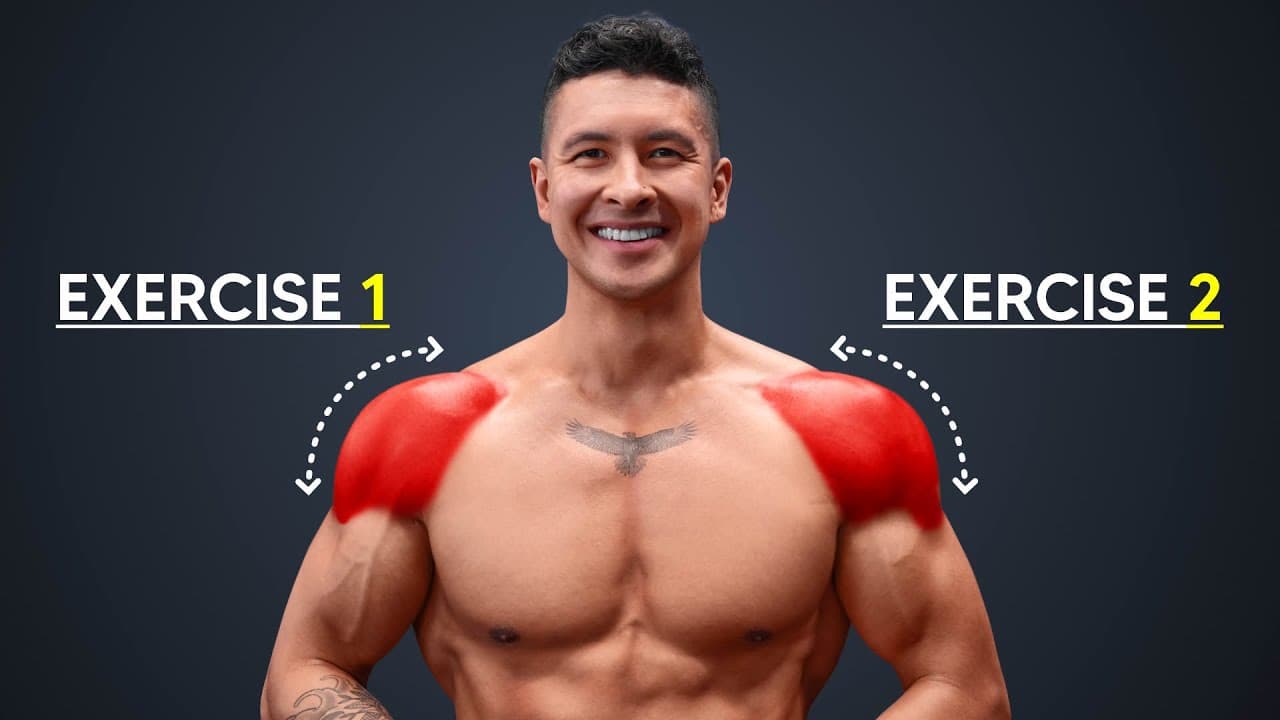
The ONLY 2 Exercises You Need For Wide Shoulders
TL;DR
Focus on two exercises to effectively widen your shoulders.
Transcript
with so many shoulder exercises out there it's hard to know which ones actually work but the truth is you're probably doing too many and focusing on the wrong areas in fact after cutting out all the fluff and focusing on just two science backed exercises my shoulders grew bigger and wider than they've ever been and with the right form the same will... Read More
Key Insights
- The side delts are crucial for achieving wider shoulders, yet most people focus too much on front delts, leading to imbalanced development.
- Lateral raises, particularly using cables, are more effective than dumbbells for targeting the side delts due to the greater stretch they provide.
- Adjusting the arm path during lateral raises can optimize muscle activation in the side delts, enhancing shoulder width.
- Incorporating cable lateral raises with the arm moving behind the body can maximize the stretch and effectively target the side delts.
- Research suggests that both dumbbell and cable lateral raises are effective, but cables might offer slight advantages in muscle growth.
- Progression in lateral raises can be achieved by increasing weights or reps, with smaller weight increments for cables to maintain form.
- The rear portion of the side delts can be targeted by adjusting the angle of lateral raises, contributing to a fuller shoulder appearance.
- Proper programming of exercises, with adequate volume and recovery, is essential for effective shoulder development.
Install to Summarize YouTube Videos and Get Transcripts
Explore YouTube Video Summarizer or Get YouTube Transcript Extractor
Questions & Answers
Q: What is the primary muscle group to focus on for wider shoulders?
The primary muscle group to focus on for achieving wider shoulders is the side delts. Emphasizing the side delts helps create the appearance of broader shoulders, contributing to the classic V-shape. Most people tend to overdevelop the front delts, which can lead to imbalances and a lack of width.
Q: Why are cable lateral raises preferred over dumbbell lateral raises?
Cable lateral raises are preferred over dumbbell lateral raises because they offer a greater stretch to the side delts. This stretch is crucial for muscle growth, as exercises that challenge muscles in a stretched position tend to lead to better development. Cables also allow for a more consistent tension throughout the movement.
Q: How can progression be achieved in lateral raises?
Progression in lateral raises can be achieved by either increasing the weight or the number of repetitions. It's important to maintain proper form, so smaller weight increments are recommended, especially with cables, to avoid compromising technique. A broad rep range of 10-20 is suggested, moving up in weight once 15 controlled reps are achieved.
Q: What is a key principle to apply before starting lateral raises?
A key principle to apply before starting lateral raises is understanding the impact of small weight increments. A minor increase in weight, like 5 lbs on dumbbells or a pin on cables, can significantly affect form. Therefore, gradual progression is crucial to avoid form breakdown and ensure continuous muscle growth.
Q: How can the rear portion of the side delts be targeted?
The rear portion of the side delts can be targeted by adjusting the angle of lateral raises. For cables, setting the cable at wrist height and rotating the body towards the cable by about 45 degrees helps focus on the rear side delts. This adjustment enhances the tension on the muscle, promoting development in that area.
Q: What role does muscle activation research play in shoulder exercises?
Muscle activation research highlights that shoulders might have multiple heads, each independently activated. This implies that small adjustments in lateral raise techniques can target different areas of the side delts, enhancing overall shoulder development. Understanding these nuances allows for more effective exercise programming.
Q: What is the recommended programming for shoulder exercises?
The recommended programming for shoulder exercises involves doing 4-5 sets of each key exercise, split across different days. This approach ensures adequate recovery time for the delts, preventing overtraining and promoting optimal muscle growth. A balanced routine aids in achieving the desired shoulder width.
Q: What are the benefits of using a broad rep range in lateral raises?
Using a broad rep range, such as 10-20 reps, in lateral raises allows for flexibility in progression. It accommodates both strength gains and endurance, enabling gradual weight increase without sacrificing form. This approach ensures continuous improvement and effective muscle stimulation, essential for shoulder development.
Summary & Key Takeaways
-
Achieving wider shoulders involves focusing on the side delts through effective exercises. Most people overemphasize front delts, leading to imbalances. Lateral raises, especially with cables, can provide the necessary stretch and challenge for optimal growth.
-
Cable lateral raises are recommended over dumbbells due to their ability to stretch the side delts more effectively. Adjusting the arm path can further enhance muscle activation, contributing to wider shoulders.
-
Progressing in lateral raises involves either increasing the weight or the number of reps, with small weight increments to maintain form. Proper exercise programming, including volume and recovery, is crucial for shoulder development.
Read in Other Languages (beta)
Share This Summary 📚
Summarize YouTube Videos and Get Video Transcripts with 1-Click
Try YouTube Summary with ChatGPT & Claude or YouTube Transcript Generator
Explore More Summaries from Jeremy Ethier 📚





Summarize YouTube Videos and Get Video Transcripts with 1-Click
Try YouTube Summary with ChatGPT & Claude or YouTube Transcript Generator