What Is the Demand Curve and How Do You Read It?
TL;DR
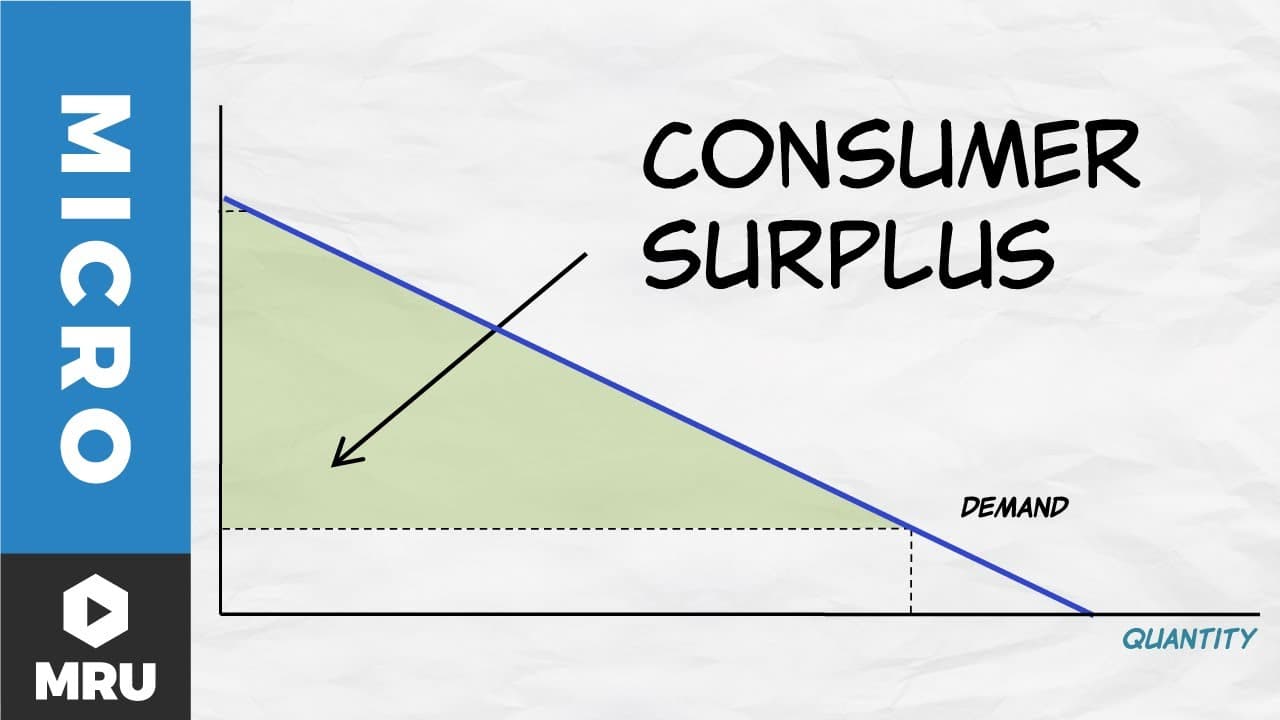
The demand curve illustrates the quantity demanded at various prices, with a downward slope indicating that lower prices lead to higher quantities demanded. It can be read both horizontally and vertically: horizontally measures the quantity purchased at a specific price, while vertically determines the maximum price consumers are willing to pay for a given quantity. Consumer surplus is the difference between what consumers are willing to pay and the market price, calculated graphically as the area under the demand curve.
Transcript
♪ [music] ♪ - [Tyler] Hi, everyone. You've already had a brief introduction to demand. We're going to recap that material quickly then we're going to look at new material including two different ways of reading the demand curve, how demand curves shift, and consumer surplus. Okay, let's go. Here's the definition. A demand curve is a function that s... Read More
Key Insights
- The demand curve is a function showing quantity demanded at various prices, illustrating buyer willingness and ability to purchase.
- Demand curves typically slope downwards, indicating that lower prices lead to higher quantities demanded, reflecting consumer behavior.
- Two methods for reading demand curves include the horizontal method (price to quantity) and the vertical method (quantity to price).
- The horizontal reading method helps determine the quantity consumers are willing to purchase at a specific price.
- The vertical reading method identifies the maximum price consumers are willing to pay for a specific quantity.
- Consumer surplus is the difference between what consumers are willing to pay and the actual market price, represented graphically as the area below the demand curve and above the price.
- Total consumer surplus is calculated by summing individual surpluses across all consumers and units, often using geometric formulas.
- Shifts in demand curves indicate changes in demand, with outward shifts representing increased demand and inward shifts representing decreased demand.
Install to Summarize YouTube Videos and Get Transcripts
Explore YouTube Video Summarizer or Get YouTube Transcript Extractor
Questions & Answers
Q: What is a demand curve?
A demand curve is a graphical representation that shows the quantity of a good that consumers are willing and able to purchase at various prices. It typically slopes downwards, indicating that as the price decreases, the quantity demanded increases, reflecting the inverse relationship between price and demand.
Q: How can the demand curve be read?
The demand curve can be read using two methods: the horizontal method and the vertical method. The horizontal method involves determining the quantity demanded at a specific price, while the vertical method identifies the maximum price consumers are willing to pay for a particular quantity. Both methods provide valuable insights into consumer behavior.
Q: What is consumer surplus?
Consumer surplus is the difference between what consumers are willing to pay for a good and what they actually pay. It represents the economic benefit to consumers from participating in the market. Graphically, it is the area below the demand curve and above the market price line, reflecting the total gain from trade.
Q: How is consumer surplus calculated?
Consumer surplus is calculated by finding the area between the demand curve and the price line, up to the quantity purchased. For linear demand curves, this area forms a triangle, and the surplus can be calculated using the formula for the area of a triangle: 0.5 * base * height, where the base is the quantity and the height is the difference between maximum willingness to pay and actual price.
Q: What causes shifts in the demand curve?
Shifts in the demand curve are caused by changes in factors other than the price of the good itself. These factors include changes in consumer preferences, income levels, prices of related goods (substitutes and complements), and expectations of future prices. An outward shift indicates increased demand, while an inward shift indicates decreased demand.
Q: Why is the demand curve downward sloping?
The demand curve is downward sloping because of the law of demand, which states that, all else equal, as the price of a good decreases, the quantity demanded increases. This inverse relationship is due to the substitution effect, where consumers switch to cheaper alternatives, and the income effect, where lower prices increase purchasing power.
Q: How does the horizontal reading of the demand curve work?
The horizontal reading of the demand curve involves starting at a specific price level on the vertical axis and moving horizontally to the demand curve to determine the corresponding quantity demanded. This method provides insights into how much of a good consumers will buy at different price points, helping to analyze market demand.
Q: What is the significance of understanding consumer surplus?
Understanding consumer surplus is significant as it measures the economic welfare and benefit consumers receive from purchasing goods at market prices lower than their maximum willingness to pay. It helps economists and policymakers assess the efficiency of markets, the impact of policies on consumer welfare, and the overall health of the economy.
Summary & Key Takeaways
-
The video provides a detailed explanation of the demand curve, a fundamental economic concept showing the relationship between price and quantity demanded. It introduces the horizontal and vertical methods for reading the demand curve, emphasizing the importance of understanding both approaches for economic analysis.
-
Consumer surplus, a key economic measure, is explained as the difference between the maximum price consumers are willing to pay and the actual market price. The video illustrates how to calculate consumer surplus using the area beneath the demand curve and above the price line.
-
The lecture concludes with a preview of future topics, including factors that cause shifts in the demand curve. Understanding these shifts is crucial for analyzing market dynamics and predicting changes in consumer behavior and demand.
Read in Other Languages (beta)
Share This Summary 📚
Summarize YouTube Videos and Get Video Transcripts with 1-Click
Try YouTube Summary with ChatGPT & Claude or YouTube Transcript Generator
Explore More Summaries from Marginal Revolution University 📚


Summarize YouTube Videos and Get Video Transcripts with 1-Click
Try YouTube Summary with ChatGPT & Claude or YouTube Transcript Generator