Steady State Error | SSE | CS | Control systems | Lec-29
TL;DR
An overview of steady-state error, its definition, characteristics, and mathematical representation in control systems.
Transcript
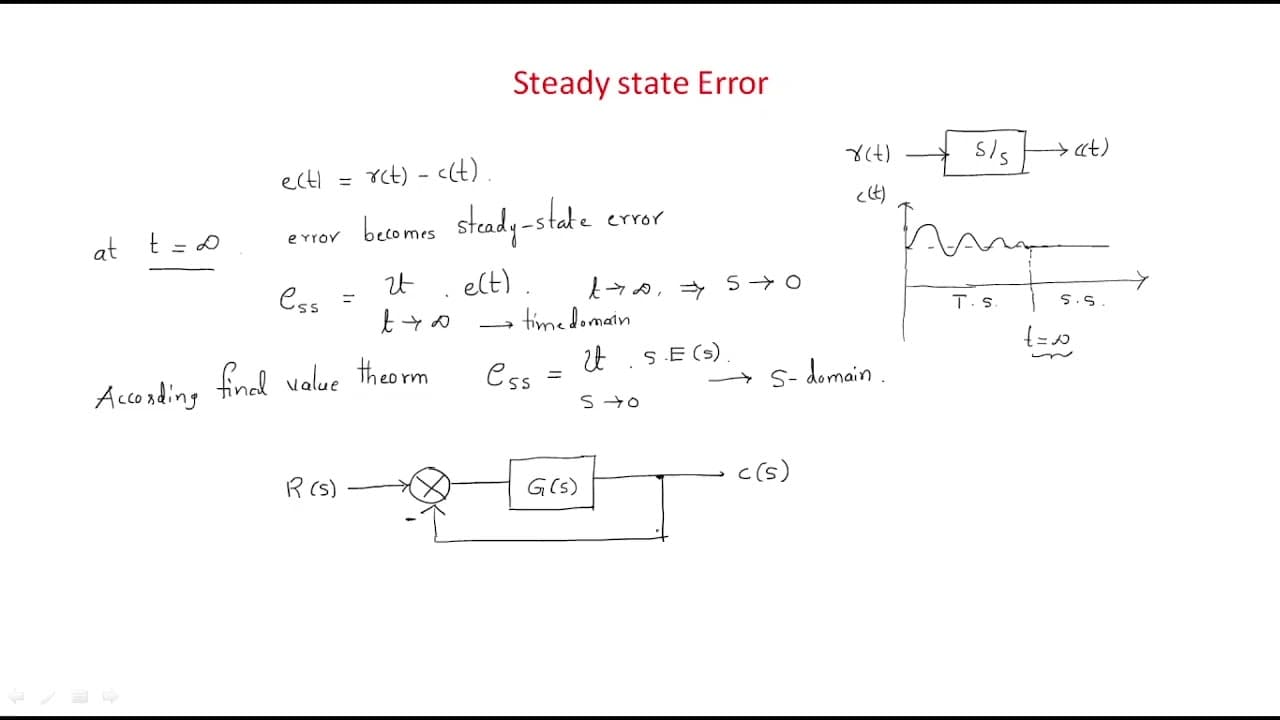
hello everyone in this session we will discuss the topic of study state error here the name itself is study state error so before that first discuss what is the error generally in any system we are giving the input we are giving the input for any system and we should take some output generally from this we can define the error error is represent li... Read More
Key Insights
- ⌛ Steady state error indicates a system's accuracy in reaching desired output over time.
- ⌛ The convergence of error to a steady state occurs only when time reaches infinity.
- 🎮 Mathematical techniques like the final value theorem are crucial for analyzing system behavior in control engineering.
- 😒 Control systems use feedback mechanisms to minimize steady state error effectively.
- 🎮 The transfer function relating input to error is fundamental for understanding control performance.
- 📡 Analyzing steady state error involves considering both the type of input signal and the system configuration.
- ❓ Transient and steady state behaviors are distinct phases in system response, impacting overall performance analysis.
Install to Summarize YouTube Videos and Get Transcripts
Explore YouTube Video Summarizer or Get YouTube Transcript Extractor
Questions & Answers
Q: What is steady state error, and how is it defined?
Steady state error is the difference between the expected output and actual output of a control system as time approaches infinity. Mathematically, it's expressed as e(t) = r(t) - c(t), where e(t) becomes constant when t reaches infinity. This error represents how well the system tracks the desired input in steady conditions.
Q: How can steady state error be analyzed using the final value theorem?
The final value theorem allows transitioning from the time domain to the frequency domain by stating that the steady state error can be calculated as the limit of the error signal e(t) as time approaches infinity. In the frequency domain, this is represented as the limit of s tending to zero, providing a simpler means to evaluate system performance.
Q: What methods can be used to derive the transfer function between error and input?
There are two primary methods to derive the transfer function between error and the input. The first method uses e(s) = r(s) - c(s), and through manipulation, leads to e(s)/r(s) = 1/(1 + g(s)). The second method derives this relationship from the use of feedback in systems, illustrating unity feedback's role in controlling steady state error.
Q: How do input types affect steady state error?
Different types of inputs, such as step, ramp, or parabolic inputs, can lead to varying steady state errors in a control system. The type of input determines how the system responds and tracks changes, influencing the error characteristics. More complex inputs often lead to larger steady state errors depending on the system type and its parameters.
Summary & Key Takeaways
-
Steady state error is defined as the difference between the input and output of a system as time approaches infinity, becoming a constant value.
-
It can be derived using the final value theorem, converting time domain expressions into frequency domain representations for analysis.
-
The steady-state error depends on the type of input and the characteristics of the system involved, influencing overall system performance.
Read in Other Languages (beta)
Share This Summary 📚
Summarize YouTube Videos and Get Video Transcripts with 1-Click
Try YouTube Summary with ChatGPT & Claude or YouTube Transcript Generator