BCD subtraction | 9's and 10's complement | STLD | Lec-16
TL;DR
The video explains BCD subtraction using n's and 10's complement methods.
Transcript
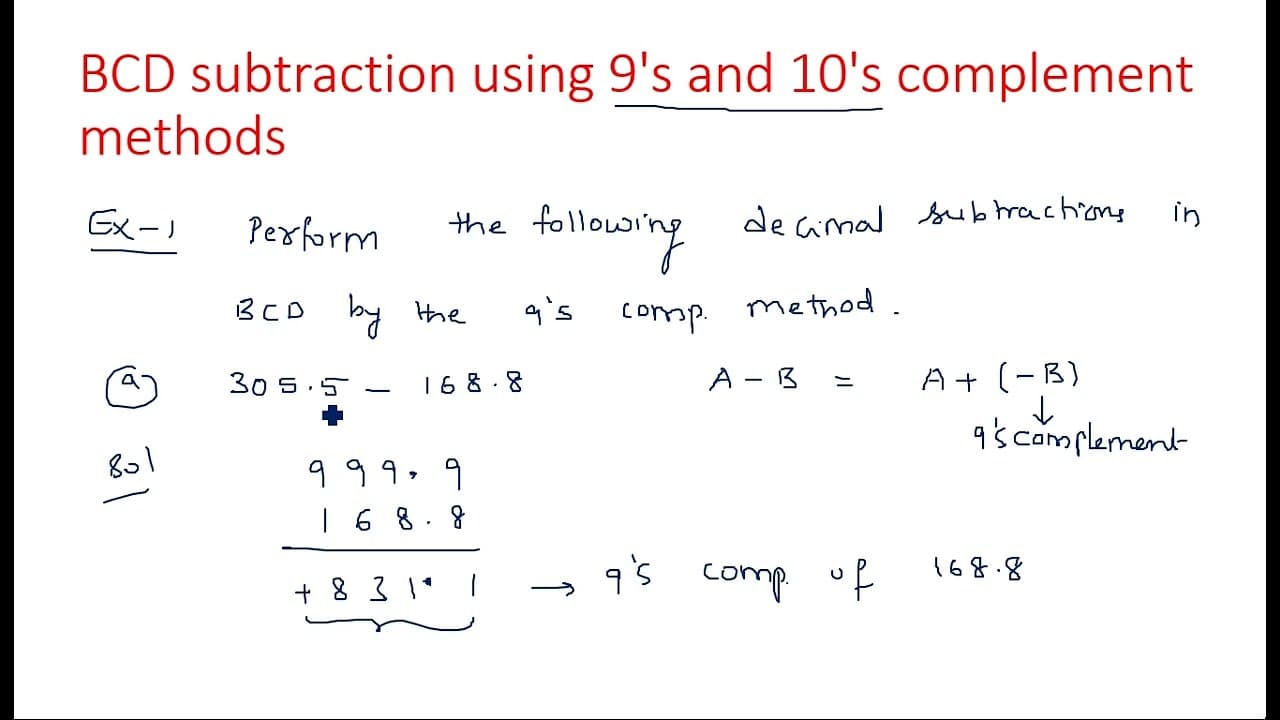
hi everyone in this video I'm going to explain about BCD subtraction using n's complement and 10's complement we know already what you mean by N's complement and 10 10 complement basically the complement method is used for subtraction n's complement is nothing but 9 minus given number and 10's complement is nothing but 9's complement plus one so in... Read More
Key Insights
- 💁 The n's complement is essential for transforming negative values into a form suitable for addition in BCD subtraction.
- 🏛️ The 10's complement method builds on n's complement, providing an additional layer of calculation through incrementing by one.
- 🪜 In BCD, any digit result exceeding 9 requires adding six to maintain valid representation.
- 🎮 Examples provided in the video clarify the stepwise approach to using complements in arithmetic problems.
- 😀 The importance of adjusting for carries varies distinctly between n's and 10's complements.
- 💁 Visualizing BCD numbers in binary form helps solidify understanding of the subtraction operations.
- #️⃣ BCD subtraction methods illustrate the broader implications of digital number representation and arithmetic operations.
Install to Summarize YouTube Videos and Get Transcripts
Explore YouTube Video Summarizer or Get YouTube Transcript Extractor
Questions & Answers
Q: What are n's and 10's complements, and why are they used in BCD subtraction?
N's complement and 10's complement are techniques used to facilitate subtraction in BCD arithmetic. N's complement involves subtracting a number from 9 (n = 9 for decimal) to convert the number into a form that can be added rather than directly subtracted. The 10's complement extends this by adding one to the n's complement result, enabling easier calculations. This method transforms the subtraction problem into an addition problem, simplifying computation.
Q: How do you perform BCD subtraction using the n's complement method?
To perform BCD subtraction using n's complement, first determine the n's complement (9 minus the number) of the value being subtracted. Then, convert this negative number into a positive form and add it to the other value in the subtraction. If the sum exceeds 9 in any BCD digit, add six to correct the result, maintaining valid BCD formatting.
Q: Can you explain the purpose of the 'end around carry' in the n's complement method?
The 'end around carry' arises when the addition of BCD digits produces an overflow past the maximum digit of 9. In the n's complement method, if this overflow occurs, the carry must be added back to the least significant digit of the result. This adjustment ensures that the final outcome conforms to BCD requirements and maintains the integrity of the digit representation.
Q: What adjustment must be made when results exceed 9 in BCD operations?
When results from the BCD addition or subtraction exceed the digit value of 9, a correction must be applied by adding six to the affected digits. This adjustment ensures that the output adheres to valid BCD representation, turning any result higher than nine back into a permissible BCD format.
Q: How are examples used in the video to clarify the BCD subtraction process?
The video uses detailed examples to illustrate both n's and 10's complement methods, performing actual computations. By walking through subtraction scenarios like 35.5 minus 168.3 and 3427 minus 108.9, it demonstrates the step-by-step application of complements and necessary adjustments, enhancing viewer understanding of theoretical concepts through practical application.
Q: Is there a difference in handling carries between the n's and 10's complement methods in BCD?
Yes, there is a significant difference. In the n's complement method, any carry produced during addition must be added back to the least significant digit. Conversely, in the 10's complement method, carries must be ignored entirely, streamlining the final output without adjusting for overflow. This differentiation is crucial for performing accurate BCD operations.
Summary & Key Takeaways
-
The video outlines the concepts of n's complement and 10's complement methods used for subtraction, specifically in binary coded decimal (BCD) contexts.
-
It provides step-by-step examples, demonstrating how to convert negative values into positive using n's and 10's complements before completing BCD subtraction.
-
The tutorial discusses necessary adjustments, such as adding six when results exceed the maximum BCD digit, ensuring compatibility with BCD formatting.
Read in Other Languages (beta)
Share This Summary 📚
Summarize YouTube Videos and Get Video Transcripts with 1-Click
Try YouTube Summary with ChatGPT & Claude or YouTube Transcript Generator