Morphology: Intro to Linguistics [video 4]
TL;DR
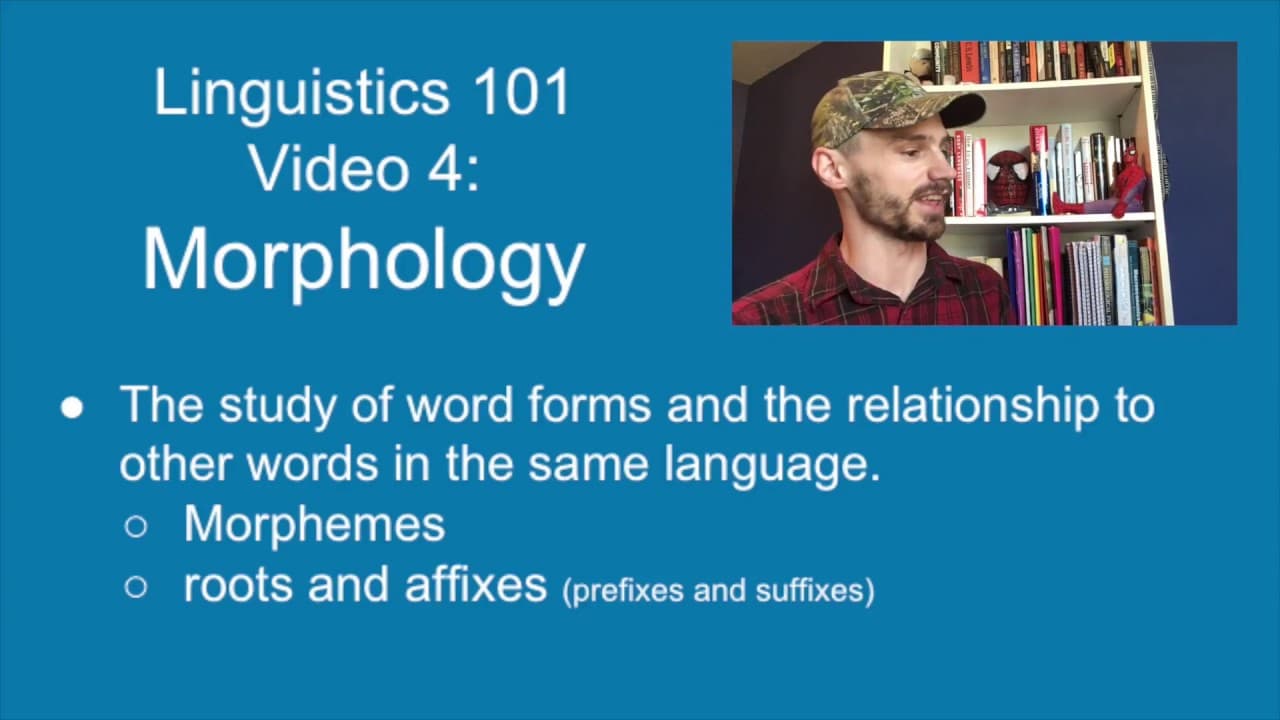
This video provides an introduction to morphology, the study of words and their components, exploring morphemes and their different types and behaviors in various languages.
Transcript
hey what's up guys this is the fourth video in my linguistics 100 video series and today we're going to talk about morphology which is basically the study of words and the components of words so if you haven't noticed yet this video series has been gradually working our way up in complexity as far as the linguistic units that were studying so we st... Read More
Key Insights
- 🛩️ Morphology is the study of words and their components, specifically morphemes, which are the smallest meaningful units in language.
- 😒 Morphemes can take different forms and behave differently in different languages, including the use of prefixes, suffixes, and infixes.
- 📏 Understanding morphology is crucial for learning and understanding foreign languages, as each language has its own rules and patterns.
- 💄 Polysynthetic languages, like Yupik, can include multiple morphemes within a single word, making the language structure more complex.
Install to Summarize YouTube Videos and Get Transcripts
Explore YouTube Video Summarizer or Get YouTube Transcript Extractor
Questions & Answers
Q: What is a morpheme?
A morpheme is the smallest unit of language that carries meaning. It can be a standalone word or a part of a word, such as a root, prefix, or suffix.
Q: How do prefixes and suffixes change the meaning of a word?
Prefixes are added to the beginning of a word and can change its meaning or create a new word altogether. Suffixes are added to the end of a word and can alter its grammatical function or create a different word.
Q: How do infixes work in language?
Infixes are morphemes that are inserted into the middle of a word. While they are rare in English, they can be found in cases like expletive insertion, where a swear word is placed within a larger word for emphasis.
Q: How do different languages handle morphemes?
Different languages differ in how they construct words using morphemes. Some languages, like English, have a more isolating structure, while others, like Yupik, are polysynthetic and include multiple morphemes within a single word.
Key Insights:
- Morphology is the study of words and their components, specifically morphemes, which are the smallest meaningful units in language.
- Morphemes can take different forms and behave differently in different languages, including the use of prefixes, suffixes, and infixes.
- Understanding morphology is crucial for learning and understanding foreign languages, as each language has its own rules and patterns.
- Polysynthetic languages, like Yupik, can include multiple morphemes within a single word, making the language structure more complex.
- Languages differ in how they handle morphemes, with some being more isolating and others being more agglutinative or fusional.
Summary & Key Takeaways
-
The video explains that morphemes are the smallest meaningful units in linguistics, and that words are made up of morphemes.
-
Different types of morphemes are discussed, including root words, prefixes, suffixes, and infixes.
-
The video explores how languages handle morphemes differently, with examples from English, Spanish, Swahili, and an Eskimo language called Yupik.
Read in Other Languages (beta)
Share This Summary 📚
Summarize YouTube Videos and Get Video Transcripts with 1-Click
Try YouTube Summary with ChatGPT & Claude or YouTube Transcript Generator
Explore More Summaries from Fingtam Languages 📚
![Phonetics: Intro to linguistics [Video 2] thumbnail](/_next/image?url=https%3A%2F%2Fi.ytimg.com%2Fvi%2FGLBsvdaR_ow%2Fhqdefault.jpg&w=750&q=75)
Summarize YouTube Videos and Get Video Transcripts with 1-Click
Try YouTube Summary with ChatGPT & Claude or YouTube Transcript Generator