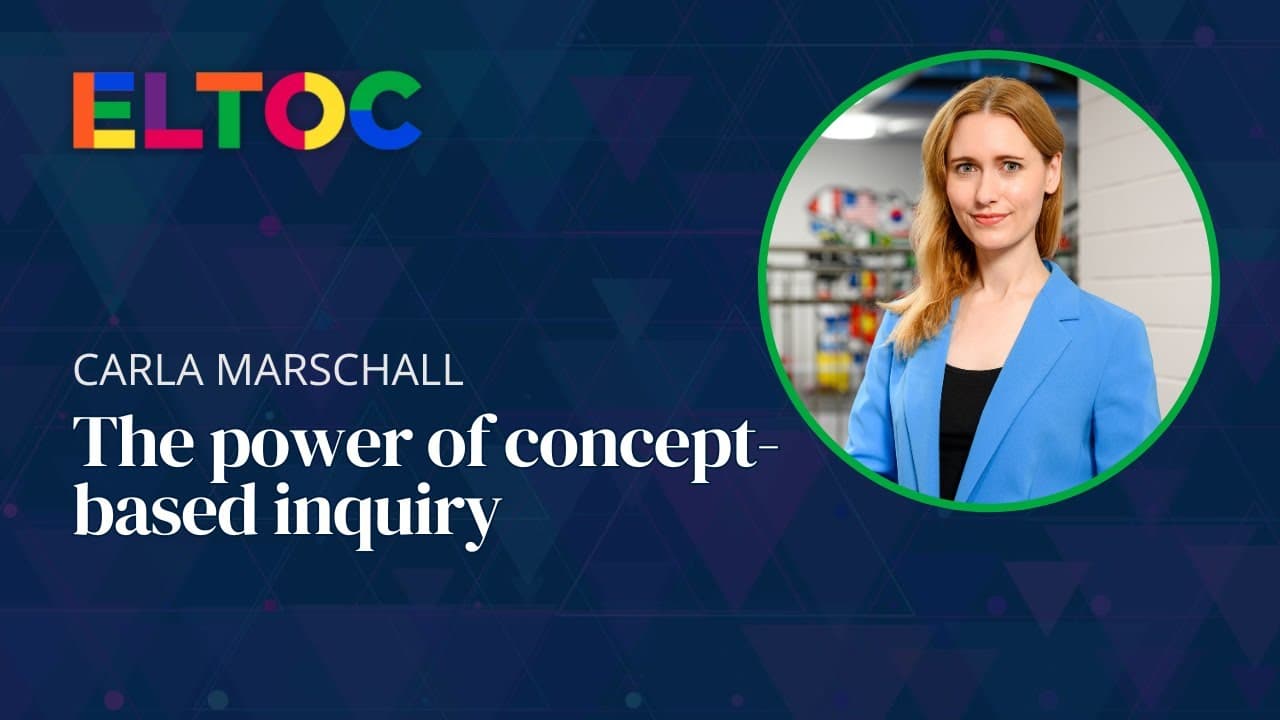
The power of concept-based inquiry | Carla Marschall
TL;DR
Concept-based inquiry enhances student understanding and adaptability in the 21st century.
Transcript
great so hello everyone really nice to see you um through the text messages you've been putting in the chat there um my name is Carla Marshall and I'm going to be presenting about concept-based inquiry today um as Sean already mentioned I am a school leader so I'm the director and CEO of dresen International School I've worked in a number of other ... Read More
Key Insights
- Concept-based inquiry emphasizes big ideas and critical thinking, enabling students to transfer knowledge across different contexts.
- The approach addresses 21st-century challenges by fostering skills like problem-solving, flexibility, and analytical thinking.
- Concepts are abstract, timeless, and transferable, unlike topics which are concrete and context-specific.
- The approach supports language learning by developing cognitive academic language proficiency, crucial for educational success.
- Inductive and deductive methods can be used flexibly in concept-based inquiry, depending on the teaching context and objectives.
- The communicative approach can be integrated with concept-based learning to enhance both fluency and conceptual understanding.
- Effective concept-based teaching involves scaffolding from factual knowledge to abstract ideas, ensuring developmental appropriateness.
- Teachers can repurpose existing strategies to develop concepts, enhancing both language skills and critical thinking.
Install to Summarize YouTube Videos and Get Transcripts
Explore YouTube Video Summarizer or Get YouTube Transcript Extractor
Questions & Answers
Q: What is concept-based inquiry and why is it powerful?
Concept-based inquiry is a pedagogical approach that focuses on developing students' understanding through big ideas and critical thinking. It is powerful because it enables students to transfer knowledge across different contexts, preparing them for the complexities of the 21st century by enhancing skills like problem-solving, flexibility, and analytical thinking.
Q: How does concept-based inquiry respond to 21st-century challenges?
Concept-based inquiry addresses 21st-century challenges by fostering skills such as problem-solving, flexibility, and analytical thinking. These skills are crucial in a world that is volatile, uncertain, complex, and ambiguous, and the approach helps students navigate these conditions by developing cognitive academic language proficiency and critical thinking.
Q: What is the difference between concepts and topics?
Concepts are abstract, timeless, and transferable, allowing students to apply them across various contexts. In contrast, topics are concrete, context-specific, and do not transfer. Concept-based inquiry emphasizes the development of concepts to enhance students' ability to think critically and apply their knowledge in new situations.
Q: How does concept-based inquiry support language learning?
Concept-based inquiry supports language learning by focusing on developing cognitive academic language proficiency, which is crucial for educational success. It enhances students' critical thinking and literacy skills, enabling them to engage with complex ideas and abstract language, thereby improving their overall language competence.
Q: What teaching methods are used in concept-based inquiry?
Concept-based inquiry uses both inductive and deductive methods flexibly, depending on the teaching context and objectives. Inductive methods involve presenting examples and encouraging students to identify patterns and form generalizations, while deductive methods involve teaching rules and applying them to specific examples. The choice of method depends on the complexity of the concept and students' prior knowledge.
Q: How can the communicative approach be integrated with concept-based learning?
The communicative approach can be integrated with concept-based learning to enhance both fluency and conceptual understanding. By using communication-based activities, students practice language skills while also engaging with big ideas and abstract concepts, thus developing both their language proficiency and critical thinking abilities.
Q: What is the role of scaffolding in concept-based teaching?
Scaffolding is crucial in concept-based teaching as it helps students build from factual knowledge to abstract ideas. Teachers provide support by using examples, guiding students to identify patterns, and facilitating the development of big ideas. This process ensures that concepts are developmentally appropriate and accessible to students, enhancing their understanding and ability to transfer knowledge.
Q: How can existing strategies be repurposed for concept-based inquiry?
Teachers can repurpose existing strategies, such as the Frayer Model, to develop concepts by focusing on critical thinking and abstract understanding. By intentionally using strategies to highlight concepts, teachers can enhance both language skills and critical thinking, making learning more meaningful and transferable for students.
Summary & Key Takeaways
-
Concept-based inquiry is a pedagogical approach that focuses on developing students' understanding through big ideas and critical thinking. It is particularly effective in preparing students for the complexities of the 21st century by enhancing skills like problem-solving and adaptability.
-
This approach distinguishes between concepts and topics, emphasizing the importance of abstract, transferable knowledge. It supports language learning by focusing on cognitive academic language proficiency, which is crucial for success in school and beyond.
-
Teachers can integrate concept-based inquiry with existing strategies, such as the communicative approach, to enhance both language skills and conceptual understanding. The approach involves scaffolding from factual knowledge to abstract ideas, using both inductive and deductive methods as appropriate.
Read in Other Languages (beta)
Share This Summary 📚
Summarize YouTube Videos and Get Video Transcripts with 1-Click
Try YouTube Summary with ChatGPT & Claude or YouTube Transcript Generator
Explore More Summaries from Teaching English with Oxford 📚
Summarize YouTube Videos and Get Video Transcripts with 1-Click
Try YouTube Summary with ChatGPT & Claude or YouTube Transcript Generator