What Is an Action Potential in Neurons?
TL;DR
An action potential is an electrical signal in neurons that occurs when the membrane potential reaches a threshold, leading to a rapid influx of sodium ions followed by an efflux of potassium ions. This process allows neurons to transmit information quickly, and is essential for communication within the nervous system.
Transcript
PROFESSOR: This is a neuron, which has four main parts. The dendrites receive information. The cell body processes and integrates that information. The axon carries the information along long distances from one part of the neuron to another. And the axon terminal transmits the information to the next cell in the chain. A bundle of axons traveling t... Read More
Key Insights
- 👻 Neurons have specialized structures that allow them to receive, process, and transmit information.
- 😑 The movement of ions across the cell membrane is crucial for neuronal signaling at rest and during action potentials.
- 😣 Resting potential, graded potentials, and action potentials are important concepts to understand neuronal communication.
- 😟 Myelin sheaths play a significant role in increasing conduction velocity in the nervous system.
Install to Summarize YouTube Videos and Get Transcripts
Explore YouTube Video Summarizer or Get YouTube Transcript Extractor
Questions & Answers
Q: What are the main parts of a neuron and their functions?
Neurons consist of dendrites (receive incoming signals), cell body (processes and integrates information), axon (carries signals over long distances), and axon terminal (transmits signals to the next cell).
Q: How does an action potential occur and what is its significance?
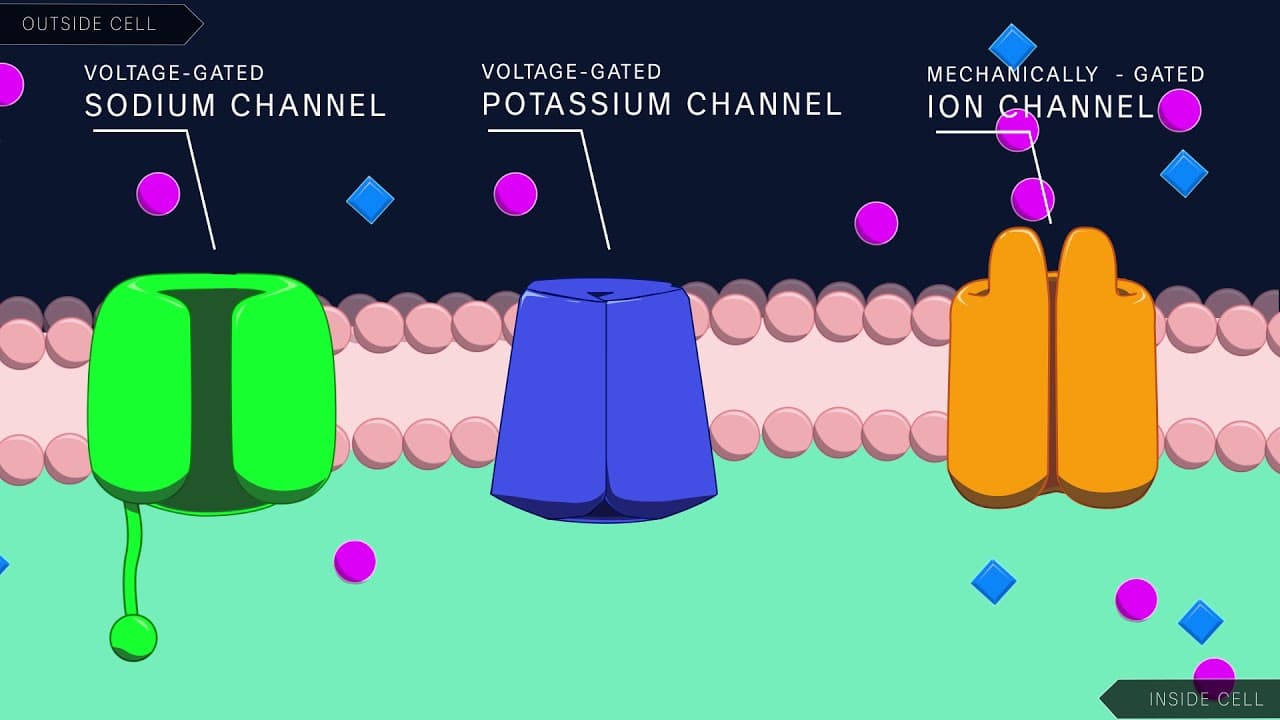
An action potential is triggered when the membrane potential reaches the threshold voltage, causing voltage-gated sodium channels to open and allowing sodium ions to enter the cell, leading to depolarization and signal transmission. Action potentials are essential for neuronal communication.
Q: What maintains the resting potential and ion distributions in a neuron?
The sodium-potassium pump actively transports ions against their concentration gradient, using ATP hydrolysis. This helps restore the chemical and electrical gradients, maintaining the resting potential.
Q: How does myelin affect conduction velocity?
Myelin sheaths, formed by Schwann cells in the peripheral nervous system and oligodendrocytes in the central nervous system, speed up conduction velocity by enabling saltatory conduction, where the action potential jumps from node to node along the myelinated axon.
Key Insights:
- Neurons have specialized structures that allow them to receive, process, and transmit information.
- The movement of ions across the cell membrane is crucial for neuronal signaling at rest and during action potentials.
- Resting potential, graded potentials, and action potentials are important concepts to understand neuronal communication.
- Myelin sheaths play a significant role in increasing conduction velocity in the nervous system.
- Neuronal communication is essential for various functions, including sensory perception, motor control, and cognitive processes.
Summary & Key Takeaways
-
Neurons have four main parts: dendrites, cell body, axon, and axon terminal, each playing a specific role in neuronal communication.
-
The transmission of neuronal signals relies on the movement of ions, such as sodium and potassium, across the cell membrane.
-
Resting potential, graded potentials, and action potentials are key concepts in understanding how neurons communicate.
Read in Other Languages (beta)
Share This Summary 📚
Summarize YouTube Videos and Get Video Transcripts with 1-Click
Try YouTube Summary with ChatGPT & Claude or YouTube Transcript Generator
Explore More Summaries from Harvard Extension School 📚

Summarize YouTube Videos and Get Video Transcripts with 1-Click
Try YouTube Summary with ChatGPT & Claude or YouTube Transcript Generator