How to Create a Custom Dataset Class in PyTorch
TL;DR
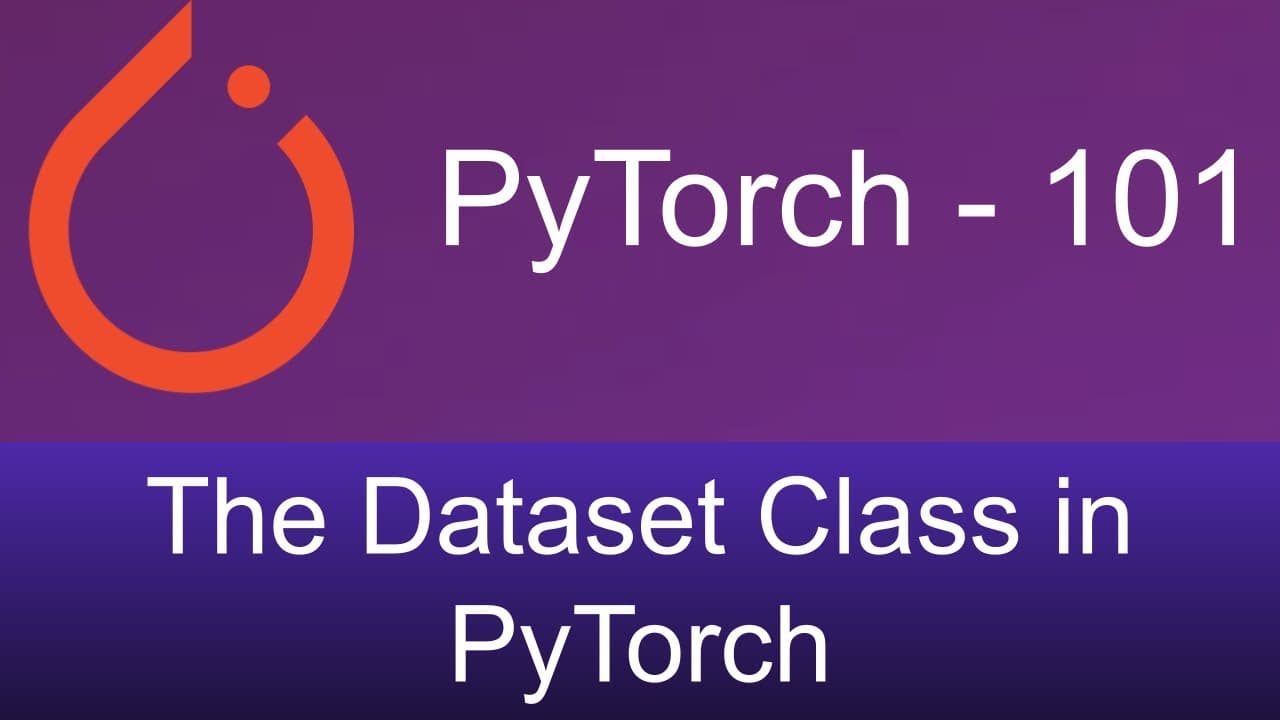
To create a custom dataset class in PyTorch, you need to implement the init, len, and getitem functions, which handle initialization, returning the dataset length, and retrieving specific items, respectively. You don't need to inherit from torch.data.dataset. Use this class to manage tabular data efficiently, as shown with scikit-learn's make_classification function.
Transcript
hello everyone and welcome to third video of the pytorch 101 series in today's video we are going to discuss the dataset class in bytorg so when you're building a pytorch model it's very important to have something that gives you the samples in your data set right you need samples from your data set to train something on and that's why you need the... Read More
Key Insights
- 🏛️ A custom dataset class is essential for providing data samples to train a PyTorch model.
- 🏛️ Inheriting from torch.data.dataset is not necessary to create a custom dataset class.
- 🏛️ The init function initializes the dataset class and its arguments.
- 🤫 The len function returns the length of the dataset.
- ❓ The getitem function retrieves a specific item from the dataset.
- 🍵 The custom dataset class can be used to handle tabular data, as demonstrated with scikit-learn's make_classification function.
- 👻 The dataset class allows for easy iteration and access to individual samples in the data.
Install to Summarize YouTube Videos and Get Transcripts
Explore YouTube Video Summarizer or Get YouTube Transcript Extractor
Questions & Answers
Q: Why is it important to have a dataset class when building a PyTorch model?
A dataset class provides the samples needed to train a model. It allows for easy iteration and handling of the data during the training process.
Q: What are the main components of a custom dataset class?
A custom dataset class consists of an init function, a len function that returns the length of the dataset, and a getitem function that retrieves a specific item from the dataset.
Q: Do we always need to inherit from torch.data.dataset when creating a custom dataset class?
No, it is not necessary to inherit from torch.data.dataset. The video demonstrates how to create a custom dataset class without inheriting from it.
Q: How can we create a custom dataset class for tabular data?
To create a custom dataset class for tabular data, define the init, len, and getitem functions. In the getitem function, return a dictionary of tensors representing the sample and target.
Summary & Key Takeaways
-
The video discusses the importance of having a dataset class when building a PyTorch model and introduces the concept of a custom dataset class.
-
It explains the structure of a custom dataset class, including the init, len, and getitem functions.
-
The video demonstrates the creation of a custom dataset class for tabular data, using scikit-learn's make_classification function.
Read in Other Languages (beta)
Share This Summary 📚
Summarize YouTube Videos and Get Video Transcripts with 1-Click
Try YouTube Summary with ChatGPT & Claude or YouTube Transcript Generator
Explore More Summaries from Abhishek Thakur 📚
Summarize YouTube Videos and Get Video Transcripts with 1-Click
Try YouTube Summary with ChatGPT & Claude or YouTube Transcript Generator