Are Market Patterns Real? A Simulation Study
TL;DR
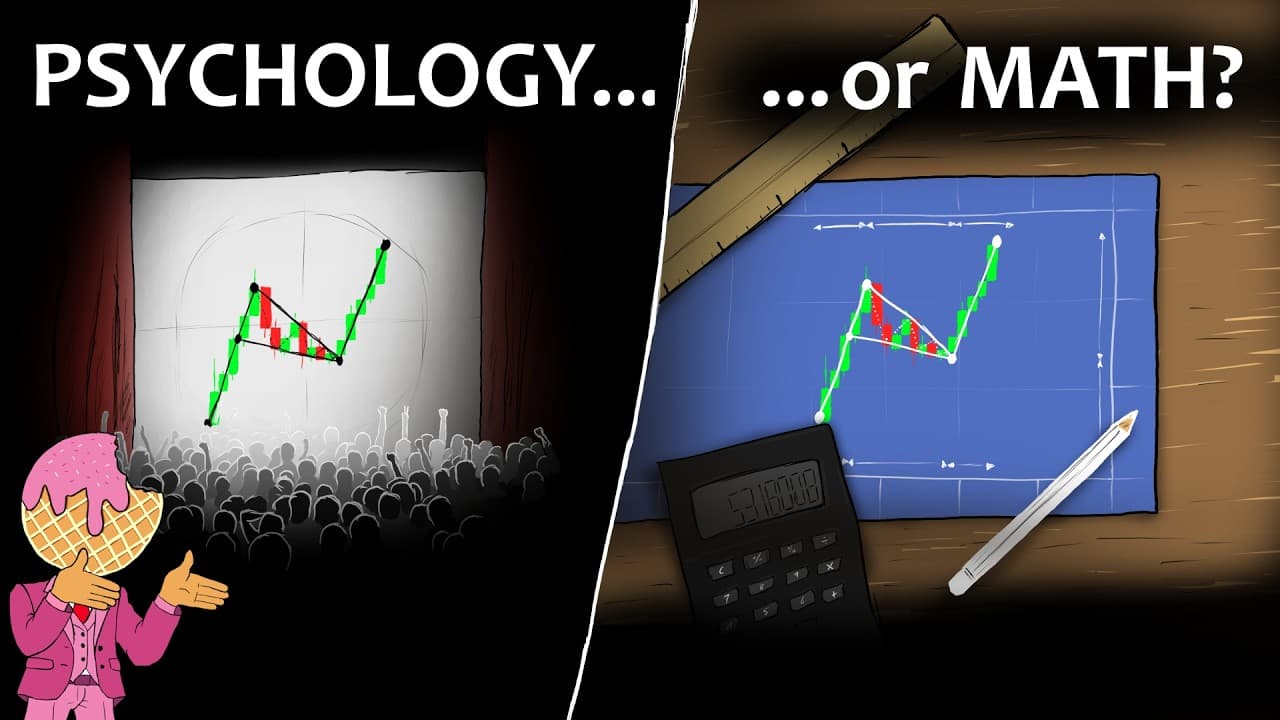
Market patterns are not merely psychological; they arise from mathematical principles, even in random trading scenarios. The simulation shows that concepts like support and resistance emerge naturally, suggesting that traders often behave unpredictably. The creator plans to develop an AI for trading based on these findings, challenging common trading strategies.
Transcript
have you ever wanted an answer to a problem but no one can agree on anything all right here's the problem there are fake gurus out there who will sell you on secrets to making money that don't actually work worse yet these gurus are proven liars who make their money from lying to beginner traders who don't know anything no on the other hand there a... Read More
Key Insights
- The video explores the authenticity of trading patterns, questioning if they are real or merely psychological illusions, and uses a market simulation to investigate.
- A market simulation was created to test the validity of trading patterns, focusing on mathematical rather than psychological factors.
- Different types of traders, including random and trend-followers, were simulated to observe their impact on market patterns.
- The simulation revealed that even random trading can produce recognizable market patterns, suggesting a mathematical basis for these patterns.
- Support and resistance lines emerged in the simulation, indicating that these patterns are inherent to the mathematical structure of markets.
- The video concludes that most traders act unpredictably, similar to random number generators, reinforcing the mathematical nature of market patterns.
- The creator plans to develop an AI to trade based on these patterns, highlighting the potential for further exploration in algorithmic trading.
- The project files and simulation are available on the creator's Patreon, inviting viewers to experiment and engage with the findings.
Install to Summarize YouTube Videos and Get Transcripts
Explore YouTube Video Summarizer or Get YouTube Transcript Extractor
Questions & Answers
Q: What was the main objective of the market simulation?
The main objective of the market simulation was to determine if trading patterns are real or merely psychological illusions. By creating a market environment with different types of traders, the simulation aimed to explore whether patterns like support and resistance lines could emerge from purely mathematical interactions, without any psychological influence.
Q: How did the simulation address the issue of price determination?
The simulation addressed the issue of price determination by incorporating human psychology to some extent, allowing traders to adjust prices up or down by 1% at random. This method ensured that prices remained within a reasonable range, preventing unrealistic price jumps and creating a more stable simulation environment to observe the formation of trading patterns.
Q: What role did different types of traders play in the simulation?
Different types of traders, such as random traders, trend followers, high-frequency traders, and whales, were incorporated into the simulation to observe their impact on market patterns. Each trader type followed specific strategies, such as buying when prices rose or placing large orders, to test whether these behaviors could influence the emergence of recognizable market patterns like support and resistance lines.
Q: What surprising result did the simulation reveal about market patterns?
The simulation revealed the surprising result that recognizable market patterns, such as support and resistance lines, could form even with random trading. This finding suggests that these patterns are not the result of psychological factors but are instead a mathematical phenomenon inherent to the structure of markets, challenging the common belief that patterns are driven by human behavior.
Q: How did the creator plan to further explore the findings from the simulation?
The creator planned to further explore the findings by developing an AI capable of trading based on the observed patterns. The goal is to see if an algorithmic approach can capitalize on these mathematically driven patterns, potentially providing insights into more effective trading strategies and further validating the mathematical nature of market patterns.
Q: What conclusion was drawn about the behavior of most traders?
The conclusion drawn about the behavior of most traders is that they act unpredictably, similar to random number generators. This unpredictability reinforces the notion that market patterns are mathematically driven rather than psychologically influenced, as even random trading can produce patterns that resemble those seen in real-world markets.
Q: How can viewers engage with the simulation and its findings?
Viewers can engage with the simulation and its findings by accessing the project files and simulation on the creator's Patreon page. This allows them to experiment with the simulation, test their own strategies, and potentially contribute to further understanding of market patterns. The creator also invites viewers to join their Discord for collaborative projects and discussions.
Q: What potential future developments were hinted at in the video?
Potential future developments hinted at in the video include the creation of an AI to trade using the patterns identified in the simulation, as well as the possibility of gamifying the simulation for broader engagement. The creator also mentioned plans to develop the fluid simulation game into an app, suggesting ongoing exploration and innovation in related projects.
Summary & Key Takeaways
-
The video investigates whether trading patterns are real or simply psychological phenomena. Through a market simulation, it finds that patterns can emerge even from random trading, suggesting a mathematical basis.
-
Different trader types, including random and trend-followers, were simulated to explore their impact on market patterns. The results indicate that patterns like support and resistance lines can form without psychological influence.
-
The creator plans to develop an AI to trade using these patterns, proposing that most traders act unpredictably, similar to random number generators. The simulation is available for viewers to experiment with on Patreon.
Read in Other Languages (beta)
Share This Summary 📚
Summarize YouTube Videos and Get Video Transcripts with 1-Click
Try YouTube Summary with ChatGPT & Claude or YouTube Transcript Generator