Reflex Klystron oscillator | Expression for output power | Microwave Engineering | Lec-92
TL;DR
The video discusses calculations of output power in a reflex oscillator using mathematical derivations and Bessel functions.
Transcript
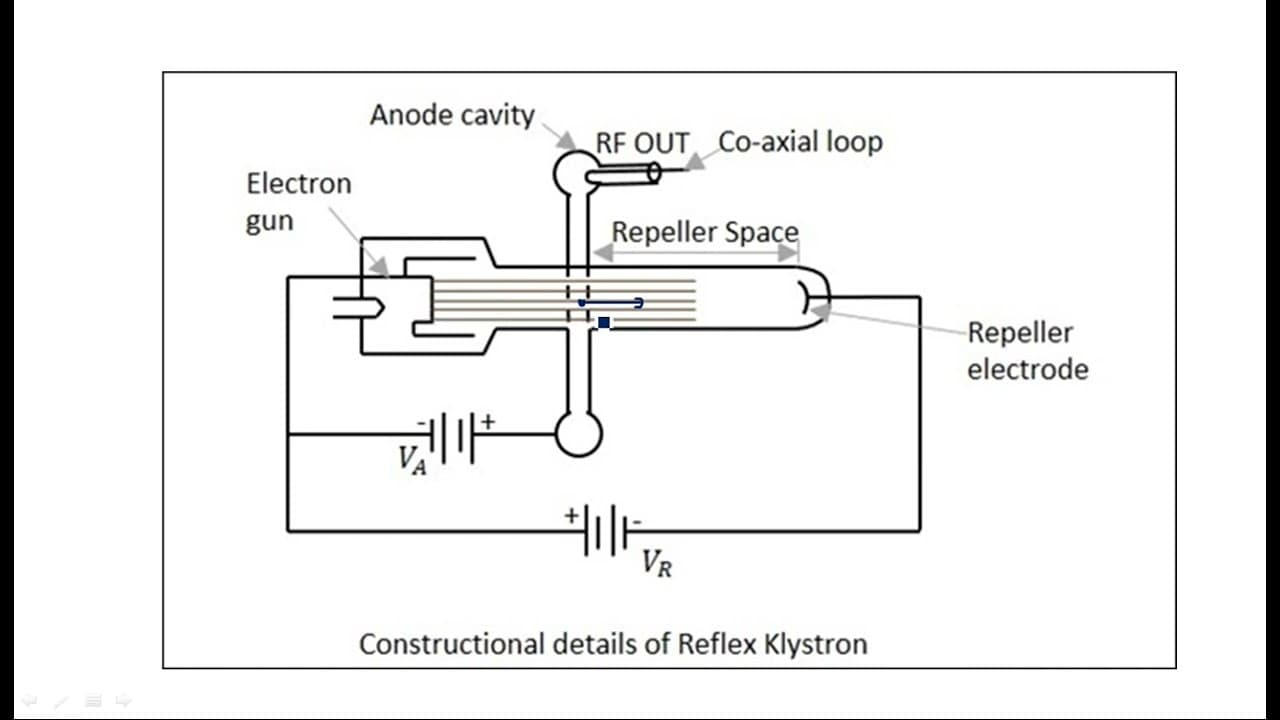
hi everyone in this video I am just continuing the mathematical uh derivation from the previous video in the previous video I have calculated what is the distance traveled by the electron in the replied space okay based on the application of this accelerating voltage VR the electron can travel from this Gap to this one okay so because of this elect... Read More
Key Insights
- 👾 The distance an electron travels in a reflex space is foundational to understanding its dynamics within the oscillator system.
- 🤢 Variations in electrode potentials affect how electrons oscillate, impacting the RF output generated by the system.
- ✊ Bessel functions are mathematically critical for accurately predicting power output in oscillation scenarios.
- 😑 The output power can be expressed in terms of measurable quantities like current and voltage, linking theoretical principles to practical outcomes.
- ✊ Conditions for achieving maximum power involve optimizing the phase angle and electron modulation effects.
- 🈸 The integration of mathematical concepts enhances the understanding of electron behavior in advanced physics applications.
- ⚡ The relationship between voltage and current directly affects the performance of electron-driven systems like the reflex oscillator.
Install to Summarize YouTube Videos and Get Transcripts
Explore YouTube Video Summarizer or Get YouTube Transcript Extractor
Questions & Answers
Q: What is the primary focus of this video regarding electrons?
The video focuses on the mathematical derivation of the distance traveled by electrons in a reflex oscillator, discussing their behavior under the influence of applied voltages and repulsion in a reflected space.
Q: How is output power related to electron behavior in this context?
Output power is determined by the behavior of electrons that are reflected back, creating oscillations that influence the RF output, showing the intricate link between electron motion and electrical power generation.
Q: What role do Bessel functions play in calculating output power?
Bessel functions are crucial for calculating output power in reflex oscillators, as they describe the relationship between voltage, current, and the phase variations that occur with electron modulation in the system.
Q: Can you explain the significance of the parameters V1 and V0 mentioned in the content?
V1 represents the generated RF output voltage amplitude while V0 stands for the accelerating anode voltage. Their relationship is essential for deriving formulas that predict output power, influenced by the modulation of electron velocities.
Q: What is mentioned about the maximum power calculations in the video?
The maximum power is calculated using specific known values for parameters like current and voltage, enabling the determination of optimal performance conditions for the coaxial cable of the reflex oscillator.
Q: What other aspects will be covered in future videos?
Future videos promise to explore the efficiency of the reflex oscillator, providing a deeper understanding of the performance characteristics and potential improvements in the system.
Summary & Key Takeaways
-
The video continues from a previous discussion on electron travel distance and reflects on how electrons behave in an accelerator and a reflex space.
-
It delves into the mathematical analysis required to calculate output power, emphasizing the role of Bessel functions and the relationships between voltage and current.
-
The final parts explain the conditions necessary for maximizing power output and provide formulas for obtaining maximum values from known parameters in a coaxial cable.
Read in Other Languages (beta)
Share This Summary 📚
Summarize YouTube Videos and Get Video Transcripts with 1-Click
Try YouTube Summary with ChatGPT & Claude or YouTube Transcript Generator