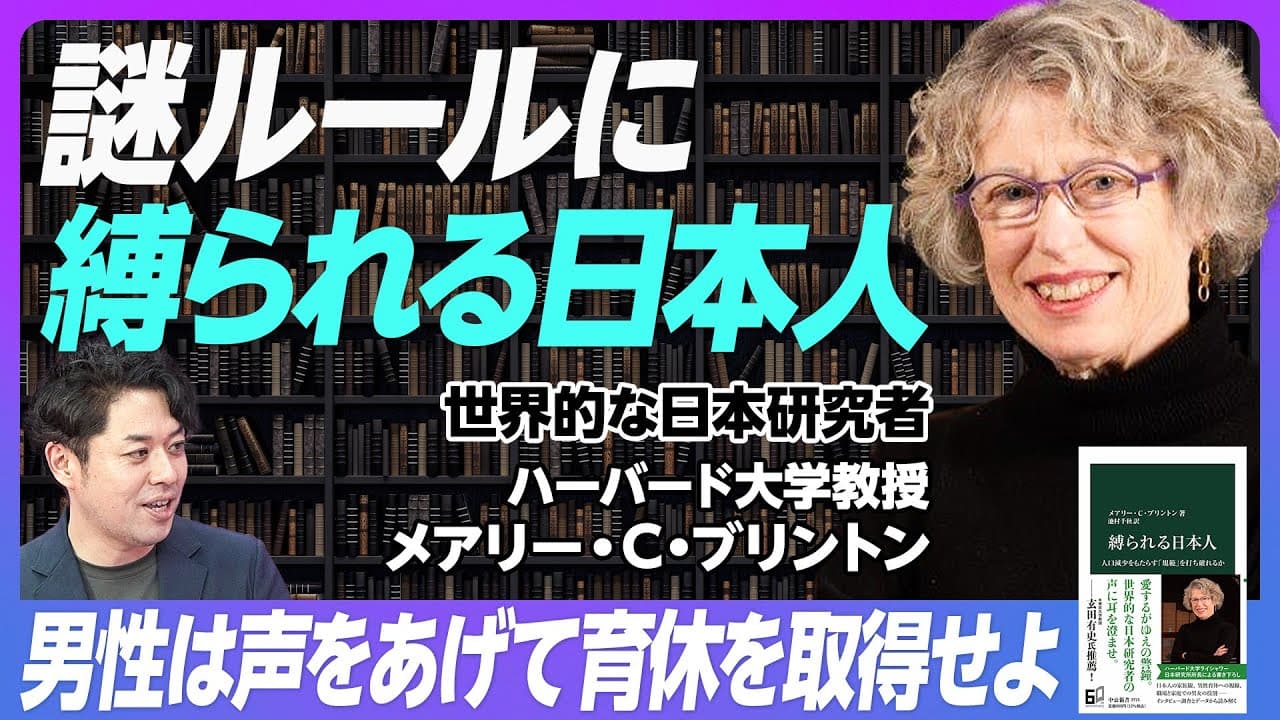
【日本は育休制度が恵まれている】ハーバード大教授が語る少子化日本/制度はあるが、男性育休は進まない/日本は古い制度の報いを受けている/「新しい挑戦を妨ぐ安心社会/企業には働き方を変える責任がある
TL;DR
Japan's social norms hinder effective use of parental leave policies.
Transcript
I've been going back and forth between Japan and the United States for many years now when I started studying Japan was on the top of the world Japan was number one as in the words of my late colleague Esther Vogel Japan was not through one Japan was on the top of the world and you know that changed right in the 1990s those people in the United Sta... Read More
Key Insights
- Japan's social norms create barriers to utilizing existing parental leave policies, contributing to a low birth rate despite supportive policies.
- The societal expectation in Japan is for men to be breadwinners and women to be caregivers, which limits the adoption of more equitable gender roles.
- American society tends to define family more broadly, including friends and neighbors, compared to Japan's narrower definition.
- Japanese companies are slowly diversifying and changing workplace policies, but more needs to be done to support work-life balance.
- The generational gap in Japan affects workplace dynamics, where older managers may not understand younger employees' desires for work-life balance.
- The U.S. lacks national policies for parental leave, but market forces and employee bargaining power drive companies to offer better benefits.
- In Japan, the stigma around job changing is decreasing, which may lead to more dynamic labor market conditions.
- Both Japan and the U.S. face challenges in supporting families, but the issues stem from different cultural and policy landscapes.
Install to Summarize YouTube Videos and Get Transcripts
Explore YouTube Video Summarizer or Get YouTube Transcript Extractor
Questions & Answers
Q: What are the main challenges Japan faces in increasing its birth rate?
Japan's primary challenge in increasing its birth rate lies in its rigid social norms. Despite having supportive parental leave policies, societal expectations around traditional gender roles and the narrow definition of family restrict their effective use. These norms prevent both men and women from fully utilizing parental leave, contributing to a low birth rate.
Q: How do Japanese and American societies differ in their definition of family?
Japanese society tends to define family in a narrow sense, typically as two adults with children, which can lead to feelings of isolation. In contrast, American society has a broader definition of family that includes friends and neighbors, creating a more inclusive social support network. This difference reflects cultural attitudes towards social connections and support.
Q: What role do companies play in changing gender roles in Japan?
Japanese companies play a crucial role in changing gender roles by adapting workplace policies to support work-life balance. However, progress is slow due to a generational gap where older managers may not understand younger employees' desires for more equitable gender roles. Companies need to recognize the benefits of such changes and actively support them to foster a more inclusive work environment.
Q: Why are American companies more responsive to employee needs despite lacking national policies?
In the U.S., the lack of national policies for parental leave is offset by market forces and employee bargaining power. Companies compete to retain talent by offering better benefits, including parental leave, which creates a dynamic environment where employee needs drive policy changes. This contrasts with Japan, where social norms and less labor market mobility hinder similar progress.
Q: How is the stigma around job changing in Japan evolving?
The stigma around job changing in Japan is gradually decreasing, which is a positive development for the labor market. As more people change jobs, the negative perception of job mobility is diminishing, allowing for a more dynamic and flexible workforce. This change is essential for adapting to new work-life balance expectations and diversifying career paths.
Q: What are the implications of Japan's narrow definition of family on social support?
Japan's narrow definition of family, typically limited to the nuclear unit, can lead to a sense of isolation and limited social support. This contrasts with more inclusive definitions in other societies, such as the U.S., where family can include friends and neighbors. The limited social support in Japan can affect individuals' willingness to take risks and seek help, impacting social cohesion and community dynamics.
Q: What changes are occurring in Japanese workplace policies?
Japanese workplace policies are slowly evolving, with companies beginning to diversify and modify their human resource policies to support work-life balance. However, these changes are not yet widespread, and more efforts are needed to align workplace practices with the desires of younger employees for more flexible work arrangements and equitable gender roles.
Q: How do social norms in Japan and the U.S. affect family support policies?
In Japan, supportive family policies exist, but rigid social norms hinder their utilization, particularly around gender roles and family definitions. In contrast, the U.S. has strong social norms supporting dual-income families and parental involvement, but lacks national policies to support these norms. Both countries face challenges, but the underlying issues differ, with Japan needing cultural shifts and the U.S. requiring policy development.
Summary & Key Takeaways
-
The interview explores Japan's low birth rate despite having supportive parental leave policies, attributing this to rigid social norms that restrict their effective use.
-
Japanese societal norms emphasize traditional gender roles, with men as breadwinners and women as caregivers, limiting changes in workplace dynamics.
-
In contrast to Japan, American society defines family more inclusively, encompassing friends and neighbors, which reflects broader social support networks.
Read in Other Languages (beta)
Share This Summary 📚
Summarize YouTube Videos and Get Video Transcripts with 1-Click
Try YouTube Summary with ChatGPT & Claude or YouTube Transcript Generator
Explore More Summaries from PIVOT 公式チャンネル 📚




Summarize YouTube Videos and Get Video Transcripts with 1-Click
Try YouTube Summary with ChatGPT & Claude or YouTube Transcript Generator