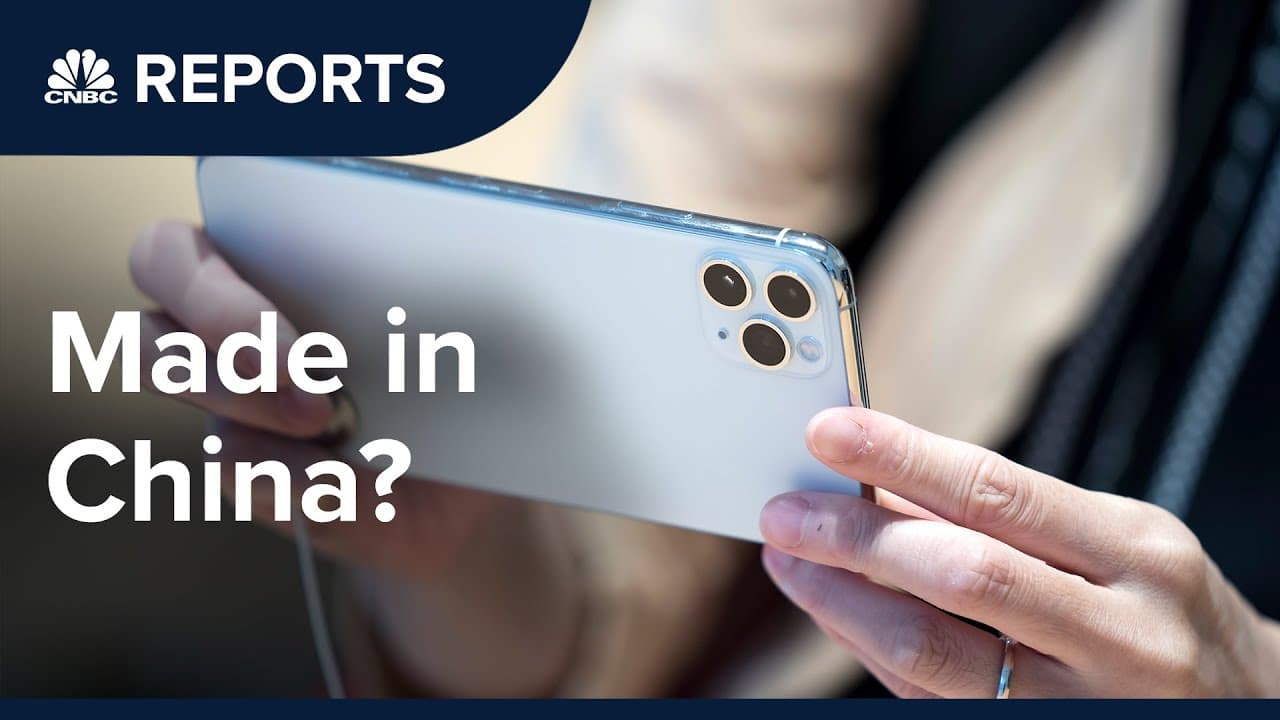
What it really means to be ‘Made in China’ | CNBC Reports
TL;DR
The 'Made in China' label involves complex global supply chains.
Transcript
Made in China. We’ve become accustomed to seeing the label on products manufactured in the world’s second biggest economy. But buying one of these products in China instead of say, the U.S., doesn’t guarantee you’re getting a better price. So why is that? And what does it truly mean to be Made in China? To start looking for some answers, I visited ... Read More
Key Insights
- The 'Made in China' label does not guarantee lower prices, as demonstrated by price comparisons between the U.S. and China for various products.
- Factors such as demand, tariffs, and tax refunds significantly influence product pricing across different countries, leading to price disparities.
- Apple's supply chain strategy involves contract manufacturing in China, which is crucial for maintaining profit margins despite political pressures to manufacture in the U.S.
- The concept of 'Made in' is oversimplified, as products often involve components sourced from multiple countries, making the label misleading.
- China's manufacturing prowess is attributed to its large pool of skilled engineers and advanced tooling capabilities, which are difficult to replicate elsewhere.
- The U.S.-China trade war and the COVID-19 pandemic have prompted companies to consider diversifying their supply chains beyond China.
- The 'Made in China 2025' initiative aims to transition China's economy from low-end manufacturing to high-tech, high-quality production.
- Despite China's reputation for cheap labor, it has evolved into a hub for skilled labor and advanced manufacturing, attracting global companies.
Install to Summarize YouTube Videos and Get Transcripts
Explore YouTube Video Summarizer or Get YouTube Transcript Extractor
Questions & Answers
Q: Why doesn't buying products in China guarantee lower prices?
Purchasing products in China does not guarantee lower prices due to various factors such as demand, tariffs, and tax refunds, which influence pricing across different countries. Price comparisons of products like Starbucks coffee and Adidas hats show that prices in China can be similar or even higher than in the U.S.
Q: How does Apple's supply chain strategy impact its product pricing?
Apple's supply chain strategy involves using contract manufacturers in China, which helps maintain profit margins. This strategy allows Apple to benefit from China's skilled labor and advanced tooling capabilities. However, political pressures to manufacture in the U.S. could increase production costs significantly, impacting product pricing.
Q: What does the 'Made in China' label truly signify?
The 'Made in China' label is often an oversimplification, as products typically involve components sourced from multiple countries. For instance, an iPhone may be assembled in China, but its parts come from various regions, making the label misleading. It reflects a global supply chain rather than a single country's manufacturing.
Q: Why is China a preferred manufacturing hub for global companies?
China is a preferred manufacturing hub due to its large pool of skilled engineers and advanced tooling capabilities, which are difficult to replicate elsewhere. The country's infrastructure and business-friendly environment also contribute to its attractiveness for global companies seeking efficient production capabilities.
Q: What impact did the U.S.-China trade war have on manufacturing?
The U.S.-China trade war led to increased tariffs on many products, raising costs for consumers. As a result, many companies began exploring options to diversify their supply chains beyond China to mitigate risks. This trend was further accelerated by the COVID-19 pandemic's impact on global manufacturing.
Q: What is the 'Made in China 2025' initiative?
The 'Made in China 2025' initiative aims to transition China's economy from low-end manufacturing to high-tech, high-quality production. This strategic plan seeks to enhance China's manufacturing capabilities and increase its competitiveness in advanced industries, shifting its focus from labor-intensive to technology-driven production.
Q: How has China's manufacturing sector evolved over the years?
China's manufacturing sector has evolved from being known for cheap labor to a hub for skilled labor and advanced manufacturing. While it initially attracted companies with low costs, it now offers expertise in engineering and tooling, making it a vital part of global supply chains for high-tech products.
Q: Why are companies considering moving production from China?
Companies are considering moving production from China due to increasing costs from tariffs and the desire to diversify supply chains to reduce reliance on a single country. The COVID-19 pandemic highlighted vulnerabilities in global manufacturing, prompting companies to explore alternatives in countries like Vietnam and Thailand.
Summary & Key Takeaways
-
The 'Made in China' label is complex, involving global supply chains. Price comparisons show that buying products in China doesn't always mean lower prices. Factors like tariffs and demand affect pricing. Apple's supply chain in China is crucial for profit margins, despite political pressures to manufacture in the U.S.
-
The concept of 'Made in' is misleading, as products involve components from multiple countries. China's manufacturing success is due to its skilled engineers and advanced tooling. The U.S.-China trade war and COVID-19 have prompted companies to diversify supply chains beyond China.
-
China's 'Made in China 2025' initiative aims to shift from low-end to high-tech manufacturing. Despite its reputation for cheap labor, China has evolved into a hub for skilled labor and advanced manufacturing, attracting global companies seeking efficient production capabilities.
Read in Other Languages (beta)
Share This Summary 📚
Summarize YouTube Videos and Get Video Transcripts with 1-Click
Try YouTube Summary with ChatGPT & Claude or YouTube Transcript Generator
Explore More Summaries from CNBC International 📚





Summarize YouTube Videos and Get Video Transcripts with 1-Click
Try YouTube Summary with ChatGPT & Claude or YouTube Transcript Generator